The post Bitcoin’s recent pricedecline fuels sleep nights among traders appeared on BitcoinEthereumNews.com. Bitcoin’s recent slide below $80,000 has triggered a wave of sleep disruption across the retail trading community, according to a new report from CEX.io. The flagship digital asset has since rebounded to about $88,000, but the roughly 31% drawdown from its recent peak left many investors monitoring prices through the night. This behavior has moved beyond simple anxiety, as nearly 70% of surveyed traders attribute execution errors and “bad trades” directly to sleep deprivation, creating a scenario where physical fatigue is compounding portfolio losses. Late-night monitoring CEX.io’s survey points to a striking shift in behavior: 68% of respondents say they check prices after going to bed almost every night or every night, while only 8% say they never do. This pattern highlights how market swings increasingly influence daily routines and nighttime habits. Moreover, the data suggests that sleep loss is becoming normalized in crypto trading. According to the report, more than half of the surveyed participants said they have stayed awake until at least 2 A.M. because of market moves, and another 33% said they remain awake until 4 A.M. or later. In total, 81% reported losing sleep while waiting for a favorable setup or a key event. How Late Crypto Traders Stay Awake (Source: CEX.io) Meanwhile, the psychological drivers of this behavior indicate a market increasingly driven by emotion rather than technical analysis. The primary culprit for sleeplessness is not fear of liquidation, but the Fear of Missing Out (FOMO), cited by 59% of respondents. Why Crypto Traders Stay Awake (SOurce: CEX.io) This aligns with findings that sleep quality is inextricably linked to market direction: 64% sleep better in bull markets, compared to just 10% in bear markets. BTC’s Nighttime volatility CEX.io argued that this insomnia is not merely a reaction to price, but to a shift in the… The post Bitcoin’s recent pricedecline fuels sleep nights among traders appeared on BitcoinEthereumNews.com. Bitcoin’s recent slide below $80,000 has triggered a wave of sleep disruption across the retail trading community, according to a new report from CEX.io. The flagship digital asset has since rebounded to about $88,000, but the roughly 31% drawdown from its recent peak left many investors monitoring prices through the night. This behavior has moved beyond simple anxiety, as nearly 70% of surveyed traders attribute execution errors and “bad trades” directly to sleep deprivation, creating a scenario where physical fatigue is compounding portfolio losses. Late-night monitoring CEX.io’s survey points to a striking shift in behavior: 68% of respondents say they check prices after going to bed almost every night or every night, while only 8% say they never do. This pattern highlights how market swings increasingly influence daily routines and nighttime habits. Moreover, the data suggests that sleep loss is becoming normalized in crypto trading. According to the report, more than half of the surveyed participants said they have stayed awake until at least 2 A.M. because of market moves, and another 33% said they remain awake until 4 A.M. or later. In total, 81% reported losing sleep while waiting for a favorable setup or a key event. How Late Crypto Traders Stay Awake (Source: CEX.io) Meanwhile, the psychological drivers of this behavior indicate a market increasingly driven by emotion rather than technical analysis. The primary culprit for sleeplessness is not fear of liquidation, but the Fear of Missing Out (FOMO), cited by 59% of respondents. Why Crypto Traders Stay Awake (SOurce: CEX.io) This aligns with findings that sleep quality is inextricably linked to market direction: 64% sleep better in bull markets, compared to just 10% in bear markets. BTC’s Nighttime volatility CEX.io argued that this insomnia is not merely a reaction to price, but to a shift in the…

Bitcoin’s recent pricedecline fuels sleep nights among traders

For feedback or concerns regarding this content, please contact us at crypto.news@mexc.com

Bitcoin’s recent slide below $80,000 has triggered a wave of sleep disruption across the retail trading community, according to a new report from CEX.io.

The flagship digital asset has since rebounded to about $88,000, but the roughly 31% drawdown from its recent peak left many investors monitoring prices through the night.

This behavior has moved beyond simple anxiety, as nearly 70% of surveyed traders attribute execution errors and “bad trades” directly to sleep deprivation, creating a scenario where physical fatigue is compounding portfolio losses.

Late-night monitoring

CEX.io’s survey points to a striking shift in behavior: 68% of respondents say they check prices after going to bed almost every night or every night, while only 8% say they never do.

This pattern highlights how market swings increasingly influence daily routines and nighttime habits.

Moreover, the data suggests that sleep loss is becoming normalized in crypto trading.

According to the report, more than half of the surveyed participants said they have stayed awake until at least 2 A.M. because of market moves, and another 33% said they remain awake until 4 A.M. or later. In total, 81% reported losing sleep while waiting for a favorable setup or a key event.

How Late Crypto Traders Stay Awake (Source: CEX.io)

Meanwhile, the psychological drivers of this behavior indicate a market increasingly driven by emotion rather than technical analysis.

The primary culprit for sleeplessness is not fear of liquidation, but the Fear of Missing Out (FOMO), cited by 59% of respondents.

Why Crypto Traders Stay Awake (SOurce: CEX.io)

This aligns with findings that sleep quality is inextricably linked to market direction: 64% sleep better in bull markets, compared to just 10% in bear markets.

BTC’s Nighttime volatility

CEX.io argued that this insomnia is not merely a reaction to price, but to a shift in the timing of volatility.

The firm, citing Blockworks Research data, noted that the most violent price swings have shifted to the overnight window.

The data shows the highest realized volatility clustering between 18:00 and 06:00 UTC. This timeline coincides with a thinning of institutional order books as US liquidity providers go offline.

So, with reduced market depth during the Asian-Pacific crossover, relatively smaller order flows are triggering outsized moves.

For retail traders in EMEA time zones, this volatility window overlaps directly with rest periods, forcing a binary choice between sleep and active risk management.

Source: https://cryptoslate.com/bitcoins-recent-decline-fuels-sleep-nights-among-traders/

Market Opportunity
IO Logo
IO Price(IO)
$0.1045
$0.1045$0.1045
-0.75%
USD
IO (IO) Live Price Chart
Disclaimer: The articles reposted on this site are sourced from public platforms and are provided for informational purposes only. They do not necessarily reflect the views of MEXC. All rights remain with the original authors. If you believe any content infringes on third-party rights, please contact crypto.news@mexc.com for removal. MEXC makes no guarantees regarding the accuracy, completeness, or timeliness of the content and is not responsible for any actions taken based on the information provided. The content does not constitute financial, legal, or other professional advice, nor should it be considered a recommendation or endorsement by MEXC.

You May Also Like

Shocking OpenVPP Partnership Claim Draws Urgent Scrutiny

Shocking OpenVPP Partnership Claim Draws Urgent Scrutiny

The post Shocking OpenVPP Partnership Claim Draws Urgent Scrutiny appeared on BitcoinEthereumNews.com. The cryptocurrency world is buzzing with a recent controversy surrounding a bold OpenVPP partnership claim. This week, OpenVPP (OVPP) announced what it presented as a significant collaboration with the U.S. government in the innovative field of energy tokenization. However, this claim quickly drew the sharp eye of on-chain analyst ZachXBT, who highlighted a swift and official rebuttal that has sent ripples through the digital asset community. What Sparked the OpenVPP Partnership Claim Controversy? The core of the issue revolves around OpenVPP’s assertion of a U.S. government partnership. This kind of collaboration would typically be a monumental endorsement for any private cryptocurrency project, especially given the current regulatory climate. Such a partnership could signify a new era of mainstream adoption and legitimacy for energy tokenization initiatives. OpenVPP initially claimed cooperation with the U.S. government. This alleged partnership was said to be in the domain of energy tokenization. The announcement generated considerable interest and discussion online. ZachXBT, known for his diligent on-chain investigations, was quick to flag the development. He brought attention to the fact that U.S. Securities and Exchange Commission (SEC) Commissioner Hester Peirce had directly addressed the OpenVPP partnership claim. Her response, delivered within hours, was unequivocal and starkly contradicted OpenVPP’s narrative. How Did Regulatory Authorities Respond to the OpenVPP Partnership Claim? Commissioner Hester Peirce’s statement was a crucial turning point in this unfolding story. She clearly stated that the SEC, as an agency, does not engage in partnerships with private cryptocurrency projects. This response effectively dismantled the credibility of OpenVPP’s initial announcement regarding their supposed government collaboration. Peirce’s swift clarification underscores a fundamental principle of regulatory bodies: maintaining impartiality and avoiding endorsements of private entities. Her statement serves as a vital reminder to the crypto community about the official stance of government agencies concerning private ventures. Moreover, ZachXBT’s analysis…
Share
BitcoinEthereumNews2025/09/18 02:13
A Netflix ‘KPop Demon Hunters’ Short Film Has Been Rated For Release

A Netflix ‘KPop Demon Hunters’ Short Film Has Been Rated For Release

The post A Netflix ‘KPop Demon Hunters’ Short Film Has Been Rated For Release appeared on BitcoinEthereumNews.com. KPop Demon Hunters Netflix Everyone has wondered what may be the next step for KPop Demon Hunters as an IP, given its record-breaking success on Netflix. Now, the answer may be something exactly no one predicted. According to a new filing with the MPA, something called Debut: A KPop Demon Hunters Story has been rated PG by the ratings body. It’s listed alongside some other films, and this is obviously something that has not been publicly announced. A short film could be well, very short, a few minutes, and likely no more than ten. Even that might be pushing it. Using say, Pixar shorts as a reference, most are between 4 and 8 minutes. The original movie is an hour and 36 minutes. The “Debut” in the title indicates some sort of flashback, perhaps to when HUNTR/X first arrived on the scene before they blew up. Previously, director Maggie Kang has commented about how there were more backstory components that were supposed to be in the film that were cut, but hinted those could be explored in a sequel. But perhaps some may be put into a short here. I very much doubt those scenes were fully produced and simply cut, but perhaps they were finished up for this short film here. When would Debut: KPop Demon Hunters theoretically arrive? I’m not sure the other films on the list are much help. Dead of Winter is out in less than two weeks. Mother Mary does not have a release date. Ne Zha 2 came out earlier this year. I’ve only seen news stories saying The Perfect Gamble was supposed to come out in Q1 2025, but I’ve seen no evidence that it actually has. KPop Demon Hunters Netflix It could be sooner rather than later as Netflix looks to capitalize…
Share
BitcoinEthereumNews2025/09/18 02:23
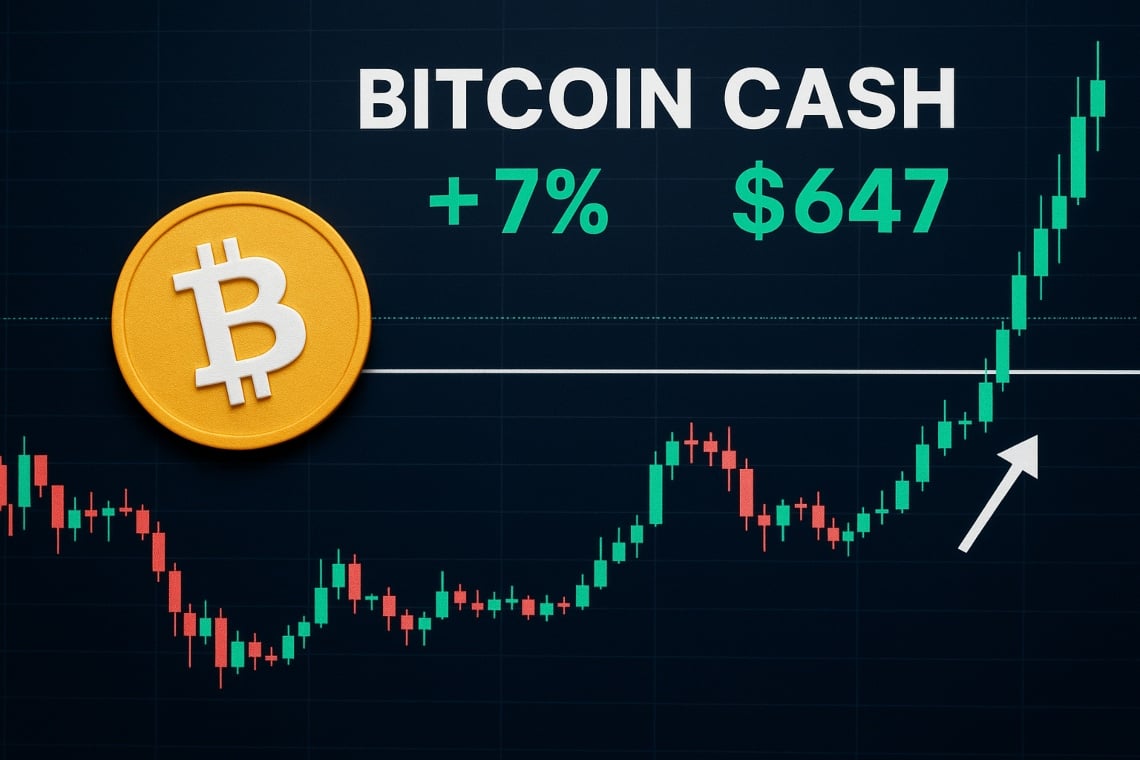
Bitcoin Cash: price +7% at $647, breakout and key levels (09/18/2025)

Bitcoin Cash: price +7% at $647, breakout and key levels (09/18/2025)

Bitcoin Cash gains 7% and reaches $647, hitting highs not seen since last April: the movement fits into a risk-on climate.
Share
The Cryptonomist2025/09/18 21:47