The dark tide under the "vintage" effect: Crypto funds usher in the silence before dawn

Author: Zen, PANews
Vintage originally refers to the "year" of wine. A good year is a gift from nature to mankind, while a bad year is subject to the constraints of weather and soil and cannot hide its defects. In funds, the "founding year" is usually also called Vintage. Just as the year of wine is a feedback of "terroir", the year of the fund is a snapshot of the economic cycle, which directly affects the return.
For crypto funds established during the period of massive money printing during the pandemic, they are currently experiencing the painful backlash from the "bad year."
Bubbles make you successful, bubbles break you down
Recently, crypto fund investors have been complaining to each other on social media. The reason is that Web3 Fund ABCDE announced that the $400 million fund will no longer invest in new projects and will not raise funds for the second phase. The founder of the fund, Du Jun, said that in the past three years, ABCDE has invested more than $40 million in more than 30 projects. Despite the current poor market environment, its internal rate of return (IRR) is still at the leading level in the world.
ABCDE has paused investment, reflecting the plight of crypto VCs today: institutional fundraising and project investment enthusiasm have both declined, the token launch lock-up model has been frequently questioned, and flexible investors have even used the secondary market and hedging operations to preserve the value of their portfolios. With high macro interest rates, unclear supervision, and internal industry problems, crypto VCs are experiencing the most severe adjustment period to date. Especially for crypto funds established around 2021, the current environment has exacerbated the difficulty of the funds' work during the exit period.
Bill Qian, co-founder of Cypher Capital, disclosed the performance of the funds they invested in. "We invested in 10+VC funds in this cycle. The GPs are very good and have captured top projects. But for our investment in the entire VC fund (we are LP), we have made 60% accounting reductions, which means we hope to get back 40% of the principal in the end. There is no way. We have to admit that we have caught up with the vintage of 2022/23 investment. Sometimes you are not wrong, but you are defeated by time and year." But he is optimistic about the next cycle of crypto VC, because things will turn around when they reach the extreme. Just like the web2 VC in 2000 was completely wiped out in Silicon Valley, but the years after that became good years for incubating and investing in innovation.
The "capital carnival" from 2021 to 2022, in addition to the continuous creativity within the industry, has boosted market sentiment with the prosperity of DeFi, NFT and blockchain games, but also has something to do with the special background of the times - affected by the COVID-19 epidemic, many central banks implemented large-scale quantitative easing and zero interest rates during this period, resulting in a flood of global liquidity, "hot money" looking for high-return assets, this environment is called "Everything Bubble" by academia and the industry. The cryptocurrency industry that emerged at that time became one of the important beneficiaries.

Faced with such a trend, crypto venture capital institutions that easily obtained funds have started to play the "sedan-style" investment, betting on the concept track with large bets, and less rational analysis of the intrinsic value of the project. Similar to the bubble in technology stocks, this crazy investment and short-term rally that is divorced from fundamentals is essentially "expected pricing" at ultra-low capital costs. Crypto VCs have invested a lot of money in projects with inflated valuations, which has laid hidden dangers.
Drawing on the traditional equity incentive mechanism, the token lock-up mechanism aims to release tokens in installments over a long period of time to prevent project parties and early investors from concentrated selling in the short term, thereby protecting the stability of the ecosystem and the interests of retail investors. Common design mechanisms include "1-year cliff period + 3-year linear release", and even longer 5-10-year lock-ups to ensure that the team and VC cannot cash out before the project matures. This design itself does not have too many problems, especially for the crypto industry that has grown wildly for many years. In order to dispel the outside world's concerns about the "evil" of project parties and VCs, locking up tokens to constrain them is an effective way to enhance investor confidence.
However, when the Fed began to shrink its balance sheet and raise interest rates in 2022, liquidity tightened rapidly, and the bubble in the crypto industry burst. When these inflated valuations fell rapidly, the market entered the painful stage of "value return". The crypto VCs who reaped the fruits of their own labor gradually fell into the "darkest moment" - many institutions not only lost a lot of money in early investments, but also were questioned by retail investors who mistakenly believed that they had made large profits.
According to data recently released by Taran Sabharwal, founder of STIX, almost all projects tracked by STIX have seen a sharp drop in valuation, with SCR and BLAST even seeing year-on-year declines of 85% and 88%, respectively. Multiple data show that many crypto VCs that promised to lock positions may have missed their better exit opportunities in the secondary market last year. This forced them to find another way to make a living - Bloomberg reported that several venture capital firms secretly worked with market makers to hedge the risk of lock-in through derivatives and short positions, and profit from market declines.
In a weak market, fundraising for new crypto funds is also challenging. The Galaxy Digital report shows that although the number of new funds increased throughout 2024, 2024 was the weakest year for crypto venture capital financing since 2020 on an annualized basis, with a total of 79 new funds raising $5.1 billion, far below the frenzy during the 2021-2022 bull market.
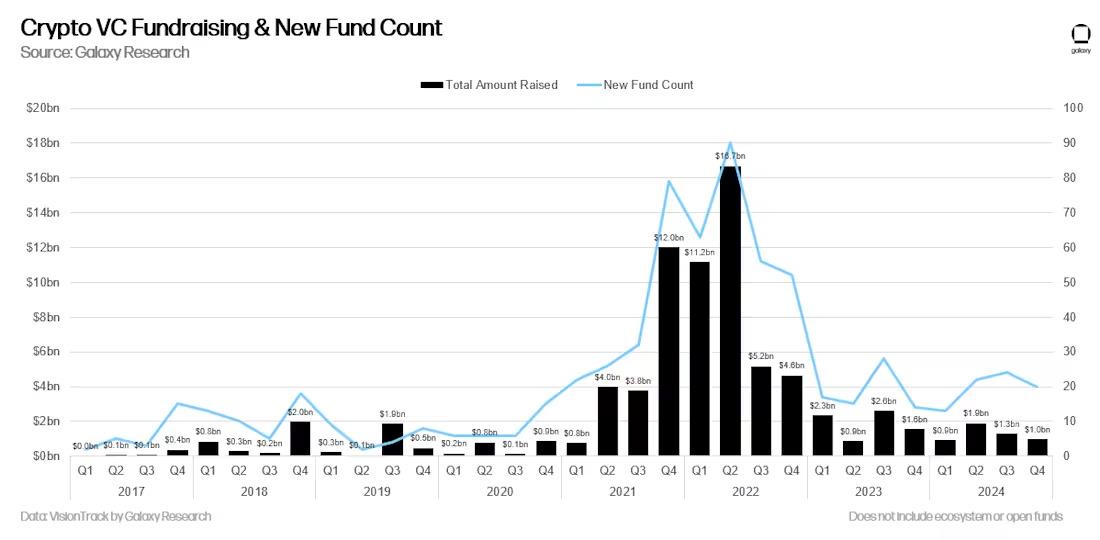
According to a research article previously released by PANews, according to incomplete statistics, there were 107 Web3-related investment funds launched in the first half of 2022, with a total amount of US$39.9 billion.
Meme and the Bitcoin ETF’s Funding Diversion
In the absence of clear product narratives and actual use cases in the industry, the community began to rely on Meme hot spots to create topics and traffic. Meme tokens, with the appeal of the "get rich quick myth", have repeatedly set off a trading frenzy and attracted a large amount of short-term speculative funds.
These meme projects are often hyped up quickly at one time, but lack sustainable support. As the narrative of "casinoization" on the chain continues to spread, meme tokens begin to dominate market liquidity, occupying the focus of user attention and capital allocation. This has led to some Web3 projects with real potential being squeezed and obscured, and their exposure and resource acquisition capabilities have been limited.
At the same time, some hedge funds have also begun to seek to enter the Memecoin market to capture the excess returns brought by high volatility. Among them is Stratos, a venture capital firm supported by a16z co-founder Marc Andreessen. The hedge fund launched a liquid fund holding Solana-based memecoin WIF, which brought it a considerable return of 137% in the first quarter of 2024.
In addition to the meme, another milestone event in the crypto industry - the launch of the Bitcoin spot ETF - may also be one of the potential reasons for the sluggish altcoin market and the difficulties faced by VCs.

Since the first batch of Bitcoin spot ETFs were approved in January 2024, institutions and retail investors have been able to invest directly in Bitcoin through regulated channels, and traditional Wall Street asset management giants have entered the market. The ETF attracted nearly $2 billion in capital inflows in the first three days of its launch, greatly improving Bitcoin's market position and liquidity. This also further strengthened Bitcoin's asset attributes as "digital gold" and attracted a wider range of traditional financial participants.
However, due to the emergence of Bitcoin ETFs, which provide a more convenient and lower-cost compliant investment path, the original capital flow logic of the industry has begun to change. A large amount of funds that might have flowed to early venture capital funds or altcoins have chosen to remain in ETF products and turned into passive holdings. This not only interrupted the previous capital rotation rhythm of altcoins following the rise of Bitcoin, but also made Bitcoin and other tokens increasingly decoupled in terms of price trends and market narratives.
Under the continued influence of the siphon effect, Bitcoin's dominance in the entire crypto market continues to rise. According to TradingView data, as of April 22, Bitcoin's market share (BTC.D) has risen to 64.61%, a new high since February 2021. This shows that Bitcoin's position as the "main entrance for institutions" is becoming increasingly consolidated.
The impact of this trend is multi-layered: traditional capital is increasingly concentrated in Bitcoin, making it difficult for startups in the Web3 field to obtain sufficient financing attention; and for early VCs, the exit channels for project tokens are limited and the liquidity of the secondary market is weak, resulting in longer collection cycles and difficulties in realizing profits, forcing them to slow down their investment pace or even suspend investment.
In addition, the external environment is equally grim: high interest rates and increasingly tight liquidity make LPs reluctant to make high-risk allocations, and although regulatory policies are constantly evolving, they still need to be improved.
As Rui from Hashkey Capital wrote on Twitter: Will there be a Jedi counterattack like in 20 years? Many friends are pessimistic, so they leave the market one after another. Their logic is simple and effective. On the one hand, all the users who should come in have come in. Everyone is used to the way of playing Casino and is used to defining the quality of projects by pulling up and smashing the market, just like being used to shorting ETH. The attributes of users have been finalized. On the other hand, it is difficult for us to see the outbreak of big applications at the chain level. Social, Gaming, ID, etc., etc. have been "tried to reconstruct" by Crypto, but in the end everyone found that it was a mess. It is difficult to find new Infra opportunities and new unlimited imagination.

Under multiple pressures, the "dark moment" of crypto VC will probably continue for quite some time.


You May Also Like

Why Is MemeCore Up 20% Today?

Telegram steps in as Toncoin validator – Can $191M staking drive TON’s rally?