

‘Bitcoin is the hurdle rate’: What does it mean in the age of crypto?

Phrases like “Bitcoin is the hurdle rate” and “Bitcoin is the new hurdle rate” frequently re-occur in the Bitcoin communities, often without a context. In short, this motto means that Bitcoin is the best benchmark for investment: avoid investing in anything that yields lower returns than Bitcoin. Let’s delve deeper into the meaning of this phrase and explore what this credo challenges and why some find it controversial.
What is the hurdle rate?
The hurdle rate indicates the minimum return that makes an investment or a project viable. The hurdle rate is used while deciding whether to start a business project or make an investment. If it is too high, the project or an investment may be rejected.
To determine a hurdle rate, one considers costs, inflation, interest rates, and potential risks. Some companies use their weighted average cost of capital (WACC) as a reference for the hurdle rate. However, some add the risk premium to WACC to get a safer hurdle rate. It’s understood that the return on investment rate should be above the hurdle rate so that the investment would be viable.
The current yield on 10-year U.S. Treasury bills is often used as a benchmark when calculating the hurdle rate, as it serves as the risk-free rate, since other investments are typically riskier. Some models use 3-month treasury bills instead. And that’s what Bitcoin maxis are challenging when they say Bitcoin is the hurdle rate.
How is Bitcoin the hurdle rate?
There are at least two messages attached to the “Bitcoin is the hurdle rate” motto. First off, bitcoiners point out the poor performance of the U.S. Treasury bills if compared to Bitcoin’s performance.
The second meaning of Bitcoin as the hurdle rate is that sometimes you should just buy Bitcoin instead of trying to find a better-performing investment.
Explaining how Bitcoin is better than t-bills, Bitcoin enthusiasts usually emphasize Bitcoin’s predictability, citing the hard supply cap of nearly 21 million units, the pre-programmed issuance of new bitcoins, predetermined dates of halvings, etceters. Additionally, Bitcoin exhibits strong long-term price appreciation. In the past, there were no negative returns in any 5-year period. The constant long-term value accumulation is cited as one of the main reasons for the inclusion of Bitcoin in various state or corporate reserves.
None of these is the case for the U.S. Treasury bills, nor for gold, which is an asset most frequently compared with Bitcoin. While U.S. Treasury bills are usually chosen as the benchmark for the hurdle rate because they are considered a risk-free asset, many admit that risks are there.
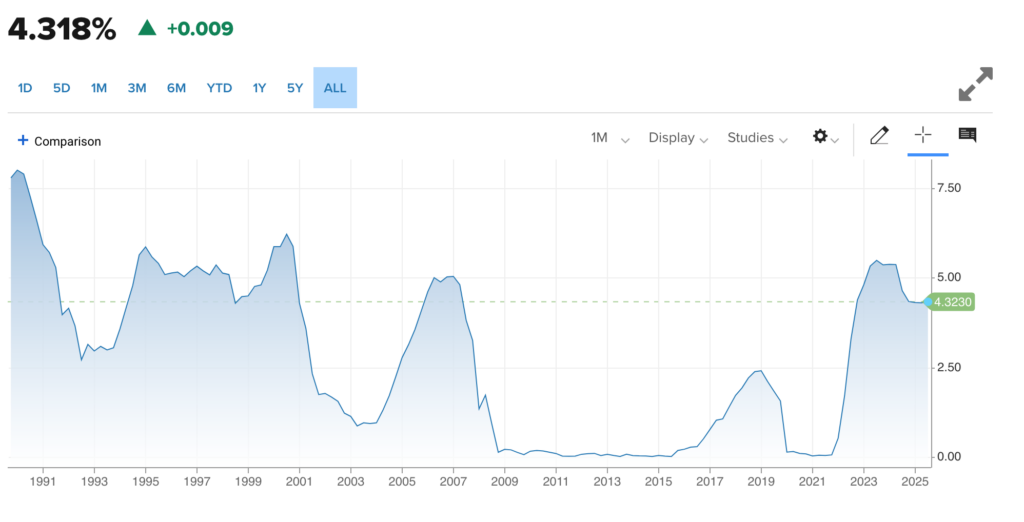
If you look at the chart, you may notice that the yield is subjected to serious volatility. In 2008, the yield rate fell below 1% and was this low until 2015. The COVID-19 pandemic managed to crash the yield rate again in 2020. At the same time, cryptocurrencies began to grow following the March 2020 market crash. In those days, many observers admitted that Bitcoin proved itself as a safe haven asset.
The latest drop in the T-bill yield occurred in 2024. U.S. Treasury bill yield rates depend on various factors, including the actions of the Federal Reserve, in a centralized manner, not thinkable for Bitcoin. The incumbent POTUS, Donald Trump, is calling on the Fed to cut the rates, which it, as an independent agency, refuses to do, citing the inflation threat as the reason. Once the Fed complies and cuts the rates, the yield on Treasury bills will go down. Some expect that the increased inflation will propel Bitcoin’s price up.
Despite the fact that other traditional assets are considered even riskier, bitcoiners argue that the U.S. Treasury bills are not a suitable risk-free benchmark asset, and Bitcoin is a better fit. Bitcoin’s recognition by governments, financial institutions, corporations, and high-profile financial experts (including former Bitcoin skeptics) may solidify Bitcoin’s reputation as the benchmark.
Bitcoin treasury companies, like Strategy, Metaplanet, or Nakamoto, emphasize that Bitcoin yield outperforms yield from other assets, so the accumulation of Bitcoin and releasing stocks that expose buyers to indirect “ownership” of Bitcoin is presented as a viable strategy. So far, MSTR (Strategy’s stock) has seen higher returns than the returns from Bitcoin itself. Until the Bitcoin treasuries bubble burst, Bitcoin may have been seen as the hurdle rate for treasury companies: if you can’t outperform Bitcoin, then you should own it.
However, hard-core Bitcoin enthusiasts warn that holding Bitcoin self-custody is safer than outsourcing BTC ownership to a centralized third party, whether it is a crypto exchange, treasury company, or anything else.
Why do some dispute this claim?
Some of the Bitcoin purists ridicule the idea that Bitcoin is the new hurdle rate—notably those critical towards Bitcoin treasury companies per se.
The logic is clear: as the Bitcoin treasury companies’ frontmen weaponized the hurdle rate concept, it may be seen as a gimmick to promote these companies’ stocks as performing as well or even better than Bitcoin. They often discuss Bitcoin while selling traditional stocks to their clients.
So, generally, “Bitcoin is the hurdle rate” can serve as an economic observation, a slogan for treasury companies, or at least a Crypto Twitter meme.


You May Also Like

Rumors fly as JD Vance abruptly cancels Colorado event: 'Perhaps he’s worried'

Ethereum Price Today: Standard Chartered Forecasts ETH to Hit $4,000

Exclusive interview with Smokey The Bera, co-founder of Berachain: How the innovative PoL public chain solves the liquidity problem and may be launched in a few months



