Cardano founder Charles Hoskinson wants crypto to stop acting like it’s permanently stuck in 2021 brain. In a Dec. 15 livestream titled “Some End of Year ThoughtsCardano founder Charles Hoskinson wants crypto to stop acting like it’s permanently stuck in 2021 brain. In a Dec. 15 livestream titled “Some End of Year Thoughts

Cardano Founder Calls For Crypto ‘Reset’ Heading Into 2026

Cardano founder Charles Hoskinson wants crypto to stop acting like it’s permanently stuck in 2021 brain.

In a Dec. 15 livestream titled “Some End of Year Thoughts,” the IOG CEO delivered a blunt year-end diagnosis of a market that, in his telling, lost its retail engine, let politics turn into a sideshow, and drifted back into the easiest (and laziest) narrative in the business: find the next 10x, then dump it on someone else.

“This has been a really [expletive] up year for our industry as a whole,” Hoskinson said from Colorado, describing 2025 as “a donkey of a year” — “an old donkey with a gas problem.”

Cardano’s Hoskinson Warns Of Retail Exodus

His first big complaint was structural, not emotional. The Cardano founder argued that institutional capital did arrive, but much of it got “locked into the Bitcoin layer,” and didn’t rotate into altcoins the way prior cycles did. “So we lost our trickle down effect that we enjoyed in 2021 and in 2017,” he said, framing it as a market-mechanics issue as much as a sentiment one.

Then he pivoted to politics. Hoskinson described a messy set of expectations heading into 2025 — hopes of a more constructive US regulatory posture, then disappointment as crypto became entangled in headline-grabbing memes and what he characterized as erratic signaling. He pointed to the launch of TRUMP coin at the inauguration (as he recounted it), followed by MELANIA, calling them “cash grab situations” that left the broader industry wearing the reputational fallout while still chasing regulatory relief.

The deeper problem, though, was retail. The Cardano founder argued the industry never rebuilt trust after the 2022 wipeout, and that 2025 didn’t offer a compelling reason for everyday participants to come back beyond speculative churn. “Retail showed up in 2021… and then they got screwed again and again and again,” he said. “And now you want them to come back so you can do it again. Will they? No.”

That sets up his core pitch for 2026: a reset framed as a return to “first principles,” with less reliance on governments, celebrity catalysts, or “the cavalry.” His language wasn’t subtle. “No government is coming to save us. No large company is coming to save us. No large investor is coming to save us,” he said. “We are on the island.”

He also tied that reset to a broader, darker worldview — AI, robotics, and a society he worries will drift into a “dystopian hellscape” without credible systems for agency, ownership, and verification. Whether you buy that framing or not, it’s clearly the rhetorical engine he wants crypto to run on: less number-go-up, more “what are we actually building, and who does it help?”

Hoskinson didn’t completely let his own camp off the hook, either. He acknowledged missed predictions — including his past expectation that bitcoin would reach $250,000 in 2025 — and the ongoing criticism he gets for timelines.

“I honestly believed [Bitcoin] would be back in December of 2024. Because I believed that Trump would be good for crypto. I was wrong. I believed it and I was wrong. I’ll admit that. But I do believe in 2026 there’s a path for it to get there. And I do believe we as an industry will pivot and return to retail and rebuild those relationships and get it done. It’ll be a difficult road, but I see a path to make that happen. Leios will ship. We know how to do it. We wrote all the code down. We got it done,” Hoskinson said.

Towards the end, he tried to anchor the “reset” in concrete ecosystem moments, pointing to Midnight’s launch mechanics as an example of retail-first distribution and highlighting heavy trading activity around the token. “The bullshit’s over,” he said. “We’re back to work… in 2026 it’s a return to first principles.”

At press time, Cardano traded at $0.3843.
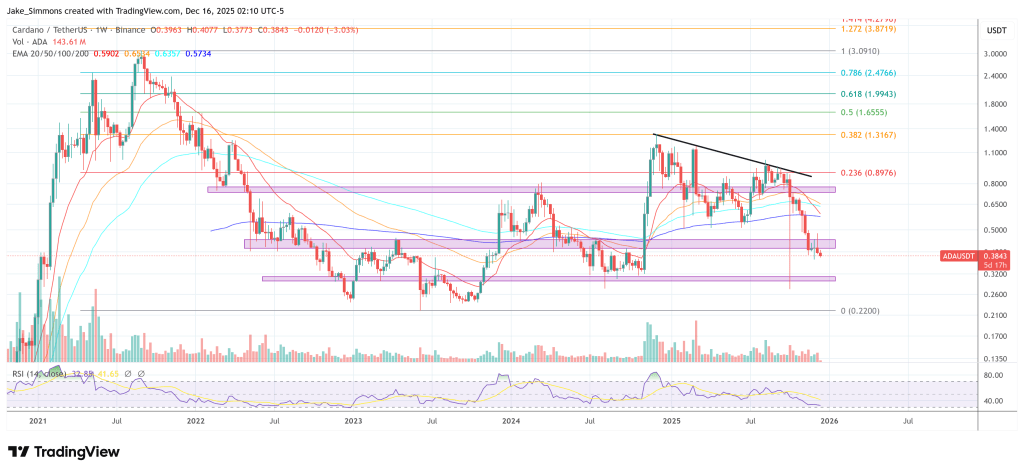
Cardano price
Market Opportunity
LETSTOP Logo
LETSTOP Price(STOP)
$0.01635
$0.01635$0.01635
+0.06%
USD
LETSTOP (STOP) Live Price Chart
Disclaimer: The articles reposted on this site are sourced from public platforms and are provided for informational purposes only. They do not necessarily reflect the views of MEXC. All rights remain with the original authors. If you believe any content infringes on third-party rights, please contact service@support.mexc.com for removal. MEXC makes no guarantees regarding the accuracy, completeness, or timeliness of the content and is not responsible for any actions taken based on the information provided. The content does not constitute financial, legal, or other professional advice, nor should it be considered a recommendation or endorsement by MEXC.

You May Also Like

Solana Treasury Stocks: Why Are These Companies Buying Up SOL?

Solana Treasury Stocks: Why Are These Companies Buying Up SOL?

The post Solana Treasury Stocks: Why Are These Companies Buying Up SOL? appeared on BitcoinEthereumNews.com. In 2020, everyone watched Strategy (called Microstrategy back then) scoop up Bitcoin and turn corporate crypto treasuries into a mainstream story. Now, a new wave is forming. And it’s centered on Solana. Dozens of companies are holding SOL as a bet on price. Except they’re not just holding. They’re building what’s being called Solana treasuries or Digital Asset Treasuries (DATs). These aren’t passive vaults. They’re active strategies that stake, earn yield, and tie into the fast-growing Solana ecosystem. Forward Industries, a Nasdaq-listed firm, recently bought more than 6.8 million SOL, making it the world’s largest Solana treasury company. Others like Helius Medical, Upexi, and DeFi Development are following a similar playbook, turning SOL into a centerpiece of their balance sheets. The trend is clear: Solana treasury stocks are emerging as a new class of crypto-exposed equities. And for investors, the question isn’t just who’s buying but why this strategy is spreading so fast. Key highlights: Solana treasuries (DATs) are corporate reserves of SOL designed to earn yield through staking and DeFi. Companies like Forward Industries, Helius Medical, Upexi, and DeFi Development Corp now hold millions of SOL. Public firms collectively own 17.1M SOL (≈$4B), which makes Solana one of the most adopted treasuries. Unlike Bitcoin treasuries, Solana holdings generate 6–8% annual rewards. It makes reserves into productive assets Solana treasury stocks are emerging as a new way for investors to gain indirect exposure to SOL. Risks remain: volatility, regulation, and concentrated holdings. But corporate adoption is growing fast. What is a Solana treasury (DAT)? A Solana treasury, sometimes called a Digital Asset Treasury (DAT), is when a company holds SOL as part of its balance sheet. But unlike Bitcoin treasuries, these usually aren’t just static reserves sitting in cold storage.  The key difference is productivity. SOL can be staked directly…
Share
BitcoinEthereumNews2025/09/21 06:09
Unstoppable: Why No Public Company Can Ever Catch MicroStrategy’s Massive Bitcoin Holdings

Unstoppable: Why No Public Company Can Ever Catch MicroStrategy’s Massive Bitcoin Holdings

BitcoinWorld Unstoppable: Why No Public Company Can Ever Catch MicroStrategy’s Massive Bitcoin Holdings Imagine trying to build a mountain of gold, only to discover
Share
bitcoinworld2025/12/17 14:30
Little Pepe soars from presale to market spotlight

Little Pepe soars from presale to market spotlight

The post Little Pepe soars from presale to market spotlight appeared on BitcoinEthereumNews.com. Disclosure: This article does not represent investment advice. The content and materials featured on this page are for educational purposes only. Early investors often capture the biggest rewards in crypto, and Little Pepe, priced under $0.005, is emerging as a memecoin that could rival big players. Summary LILPEPE has sold over 15 billion tokens in its presale, raising $25.4 million. The project’s community has grown to more than 41,000 holders and 30,000 Telegram members. Analysts suggest the token could see gains of up to 55x in two years and 100x by 2030. Crypto enthusiasts are aware that early investors tend to benefit the most from the market. Ripple (XRP) and Solana (SOL) are popular tokens that have profited traders. Little Pepe (LILPEPE), valued at less than $0.005, might produce more profit. LILPEPE is swiftly gaining popularity despite its recent introduction. Little Pepe: The market-changing memecoin Little Pepe has surprised everyone with its quick surge in cryptocurrencies. LILPEPE is becoming a popular meme currency. Its presale price is below $0.003. Strong foundations, a distinct market presence, and a developing and enthusiastic community distinguish it from other meme tokens. Many meme currencies use hype to attract investors, but LILPEPE’s rarity, community support, and distinctive roadmap have effectively drawn them in. Currently in its 13th presale stage, more than 15 billion tokens have been sold, generating over $25.4 million and sparking considerable interest. As the token approaches official listing, enthusiasm is growing, and many people believe it could be one of the following major memecoin success stories. LILPEPE’s growing community drives growth The strong community surrounding LILPEPE is a primary reason for its success. LILPEPE has built a loyal following of over 41,000 holders and about 30,000 active members on Telegram. Its rise is being fueled by this. The support of its community…
Share
BitcoinEthereumNews2025/09/19 15:12