Ethereum Coinbase Premium Drops To 2022 Bear-Market Levels: Capitulation Or Further Downside?
Ethereum has faced intense selling pressure in recent sessions, with price action struggling to stabilize as broader market weakness persists. The asset has revisited the $2,100 zone, a level now being closely monitored by traders attempting to identify potential demand. Despite occasional relief bounces, momentum remains fragile, reflecting ongoing uncertainty across both derivatives and spot markets.
A recent CryptoQuant report highlights a notable shift in investor behavior, particularly among US-based participants. The Ethereum Coinbase Premium Index, measured on a 30-day moving average, has dropped to its lowest level since July 2022. This metric compares ETH pricing on Coinbase—often considered a proxy for U.S. institutional flows—against global exchange benchmarks such as Binance. Sustained negative readings typically indicate stronger selling pressure from US entities relative to the broader market.
This development suggests that institutional demand may currently be subdued, with some investors reducing exposure amid volatile macro conditions and declining crypto risk appetite. Historically, such deep negative premiums have appeared during periods of market stress, sometimes preceding stabilization phases, though not consistently signaling immediate bottoms.
Coinbase Premium Signals Weak Institutional Demand
The report notes that the last time the Ethereum Coinbase Premium 30-day moving average reached similarly negative territory was during the deepest phase of the 2022 bear market. Such readings historically reflect a material imbalance between US and global demand, with American investors either actively reducing exposure or remaining on the sidelines. Given the importance of US institutional flows in past crypto rallies, this absence of demand could limit the probability of a sustained near-term recovery.

At the same time, the signal is not purely bearish. Extreme negative premiums have often appeared during capitulation phases, when aggressive sellers exhaust available supply. Under those conditions, the market can stabilize as selling pressure fades, even before new inflows fully materialize. This dynamic makes the indicator context-dependent rather than a standalone directional signal.
From a technical standpoint, the $2,100 level now carries clear psychological and structural significance. Holding this zone would suggest that demand is beginning to absorb supply despite negative sentiment. However, a durable trend reversal typically requires confirmation from spot demand metrics. A normalization—or eventual return to positive territory—in the Coinbase Premium would indicate renewed institutional participation.
Ethereum Tests Critical Support As Downtrend Intensifies
Ethereum price action on this daily chart reflects a clear deterioration in market structure following the rejection from the $4,000–$4,800 distribution zone seen in late 2025. Since then, ETH has transitioned into a sustained downtrend characterized by lower highs, persistent selling pressure, and repeated failures to reclaim key moving averages.
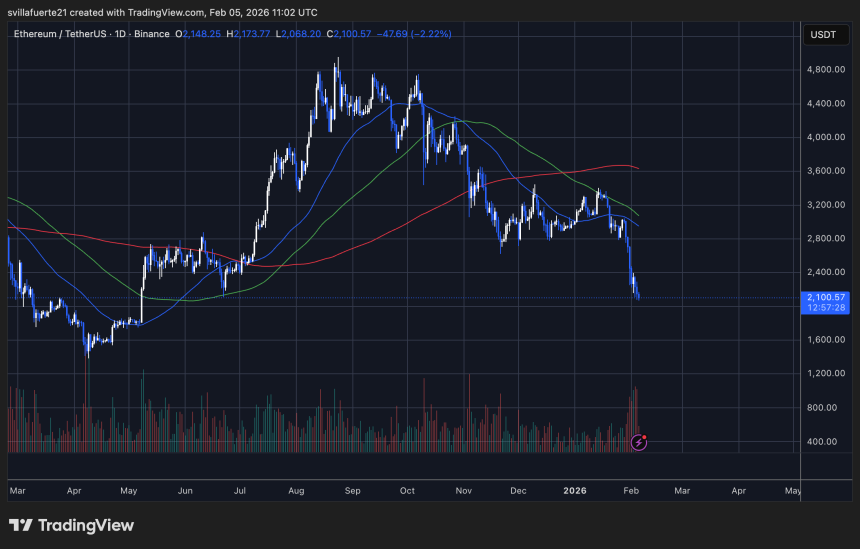
The most recent breakdown below the $2,300 region accelerated bearish momentum, with price now testing the psychological $2,100 support area. This level carries technical relevance because it previously acted as a consolidation zone during earlier phases of the cycle. However, the sharp decline toward it, combined with rising sell-side volume, suggests that market participants are still in risk-reduction mode rather than accumulation.
Moving averages reinforce the bearish bias. The short-term average has crossed below the medium-term line, while the price remains well under the long-term trend indicator. This confirms structural weakness. Unless ETH can quickly reclaim the $2,400–$2,600 range, rallies are likely to be viewed as relief bounces rather than trend reversals.
If $2,100 fails decisively, the next meaningful support could emerge closer to the $1,800–$1,900 zone, where historical demand previously stabilized price action.
Featured image from ChatGPT, chart from TradingView.com


You May Also Like

Sterling Weakens As Dollar Soars On Geopolitical Escalation And Bailey’s Cautious Stance

Crypto mining stocks suffer brutal quarterly slump