

“Staking, ETF, and Treasury” launch three arrows at the same time: Is the value logic of Ethereum being rewritten?
Ethereum is standing at an unprecedented "multi-narrative resonance" node.
At the on-chain level, the scale of ETH staking continues to rise, gradually establishing a "risk-free interest rate anchor"; at the traditional financial level, spot ETFs have been operating for more than a year, and trading volume and net inflows are rapidly increasing, indicating a continued increase in compliant funds; at the corporate level, more and more US-listed companies are choosing to strategically include ETH in their treasury reserves.
Staking, ETFs, and corporate treasuries, these three seemingly independent threads are echoing each other, jointly pushing ETH from a single crypto token to a comprehensive financial asset with income attributes, compliance channels, and corporate reserve value.
If the story of Bitcoin is "digital gold", then the narrative of Ethereum is quietly shifting to "global ledger" and will usher in a critical "resonance moment" in 2025.
01. Staking steadily climbs, and ETH "base rate" emerges
Since Shanghai upgraded and opened the staking withdrawal function in April 2023, Ethereum has completely solved the hidden dangers of a dammed lake-like exit and released the growth potential of the staking ecosystem. Since then, the LSD-based derivatives market has expanded rapidly, driving the ETH staking rate to continue to rise.
As of the time of writing, the amount of ETH staked has exceeded 33.8 million, which is approximately US$140 billion at current prices and accounts for more than 25% of the total supply. This is a significant increase compared to the staking rate of approximately 10% a few years ago. This not only strengthens network security, but also increases the scarcity of ETH from the supply and demand perspective.
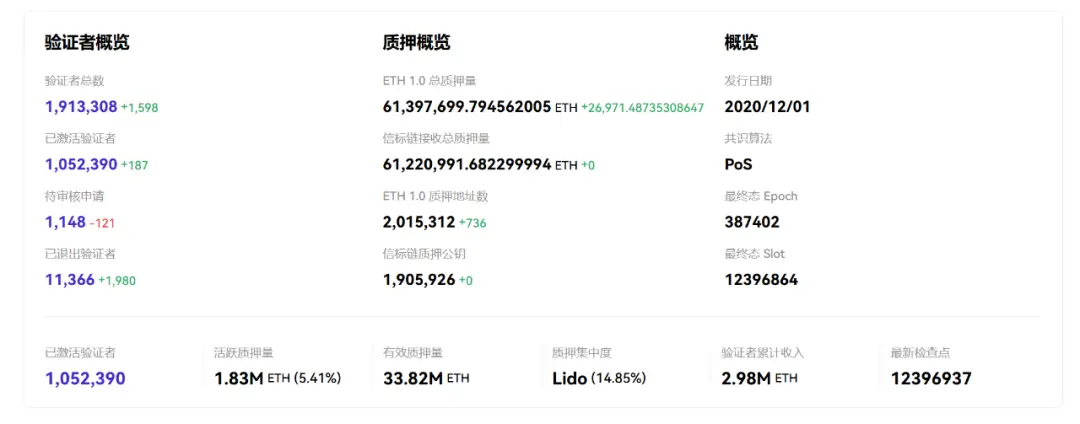
More importantly, ETH staking is gradually becoming the "interest rate anchor" for on-chain finance.
Over the past year, the annualized staking return rate of 3%-5% has been widely accepted by the market, and has even been regarded by some institutional research reports as an "on-chain version of Treasury bond yields," forming an implicit contrast with the U.S. Treasury yield curve. This attribute makes ETH no longer just a trading asset, but rather possesses the underlying logic of a fixed-income product.
Of course, there has also been a noteworthy reverse trend recently – since July 16, ETH unstacking requests have surged, with validator exit requests soaring from less than 2,000 to 475,000 on July 22, and waiting time lengthened from less than an hour to more than eight days.
According to data from The Block, there are currently about 670,000 ETH (about 3.1 billion US dollars) in the exit queue, far exceeding the demand for new staking. The processing time is expected to be close to 12 days. Among them, the unwinding of the leveraged staking cycle under the background of rising prices, the risk of LST decoupling and arbitrage opportunities are the main reasons for the large-scale unstaking of ETH. Therefore, Lido, EthFi and Coinbase are the main sources of exits.
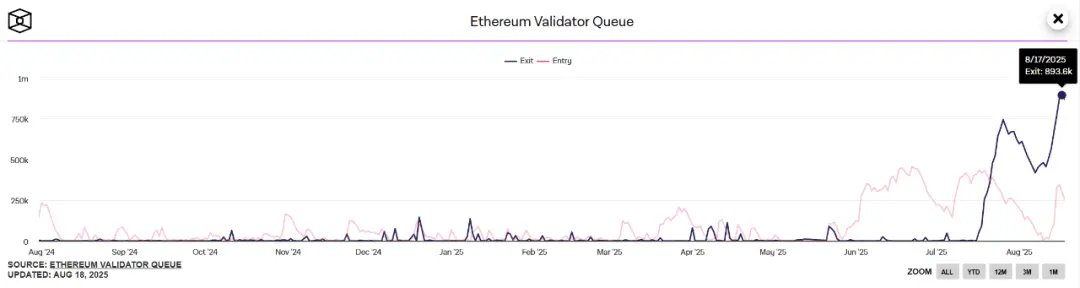
Source: The Block
However, although the unstaking trend has brought fluctuations in the short term, from a long-term perspective, ETH staking has gradually become the "risk-free interest rate anchor" on the chain and has become one of the underlying financial logics of ETH.
It is worth noting that in 2024, the U.S. Treasury yield remained in the 4%-5% range for a long time, which made the ETH staking rate seem unattractive for a time. However, as the Federal Reserve started to cut interest rates in 2025, ETH's 3%-5% staking income became competitive again, and was even regarded as "excess return" in some risk models.
This means that a deeper implicit connection is being established between ETH's on-chain interest rate and the global liquidity environment. In particular, re-staking protocols such as EigenLayer have attracted over tens of billions of US dollars in ETH participation, giving rise to the chain logic of "staking rate → re-staking premium → protocol security".
In other words, ETH is not only an asset itself, but is also gradually becoming the underlying collateral of the Web3 financial system.
02. ETFs become the main channel for traditional funds
In May 2024, the U.S. SEC approved the 19b-4 applications for eight Ethereum spot ETFs, which were officially listed and traded on July 23, marking the official opening of the compliance channel between ETH and Wall Street. To date, the Ethereum spot ETF has been operating for more than a year.
Objectively speaking, ETFs, as a "compliance entry point", provide traditional institutions with a channel to directly configure ETH, and also reduce compliance friction at the financial and audit levels. According to SoSoValue data, as of now, the total net asset value of US Ethereum spot ETFs has exceeded US$27 billion, accounting for approximately 5.34% of Ethereum's market value. Since its listing, the cumulative net inflow has reached US$12.4 billion.
It’s just that the market tends to overestimate the short-term effects of new things in the early stages and underestimate their long-term influence. The development of ETH spot ETF is a microcosm of this rule, because the real outbreak of ETF did not appear at the beginning - before May this year, the average daily trading volume of ETH ETF was still low and market interest was limited.
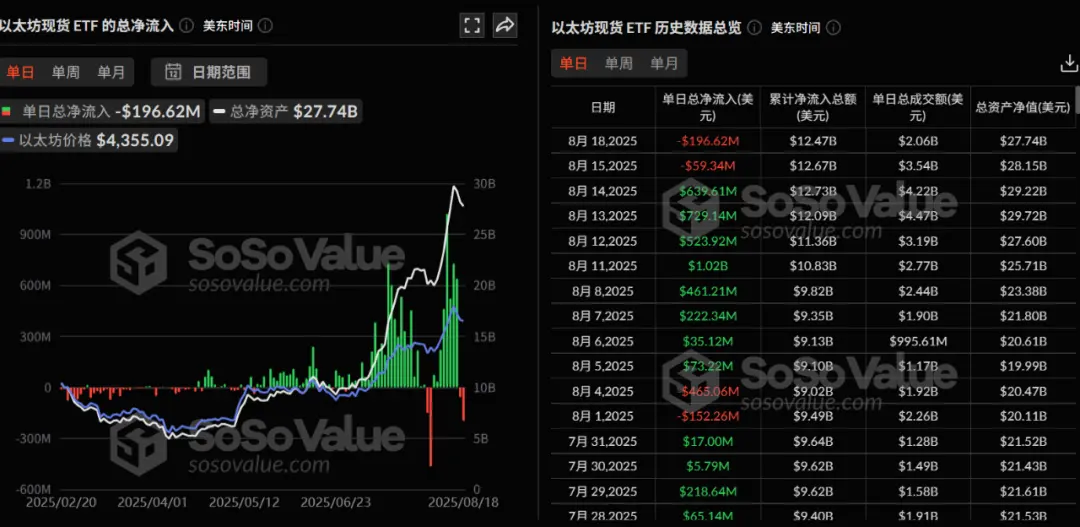
Source: SoSoValue
The turning point occurred on August 11, 2025, when the single-day net inflow of Ethereum ETF exceeded US$1 billion for the first time. Among them, BlackRock's ETHA attracted US$640 million and Fidelity's FETH attracted US$277 million. The capital siphoning effect of the two giants was highlighted, and the institutional shift of Ethereum ETF has become apparent.
The significance of ETF lies in that it is not only a "channel" for funds, but also a "legal status" in compliance audits and financial statements, which greatly reduces the resistance for institutions to hold ETH. Another far-reaching significance is that it opens up arbitrage and allocation paths for cross-border financial institutions.
More importantly, the concentration of ETF holdings has begun to emerge. The two major ETFs, BlackRock and Fidelity, account for 2/3 of the US ETH ETF market. This head-to-head trend not only brings about a capital siphoning effect, but may also mean that the "institutional pricing" characteristics of ETH will become more and more obvious in the future.
03. ETH is rapidly flowing into US stock balance sheets
If MicroStrategy is a milestone case for listed companies to include crypto assets in their balance sheets for BTC, then starting in 2025, ETH is also ushering in a similar turning point.
Recently, more and more US-listed companies have chosen to include ETH in their treasury, and not just symbolically holding it, but making large-scale, strategic allocations.
Take BitMine as an example. According to official disclosures, its cryptocurrency holdings have exceeded US$6.612 billion, an increase of approximately US$1.7 billion compared to US$4.9 billion the previous week. BitMine holds 1.523 million ETH (calculated at the current price of US$4,326 per ETH) and 192 BTC.
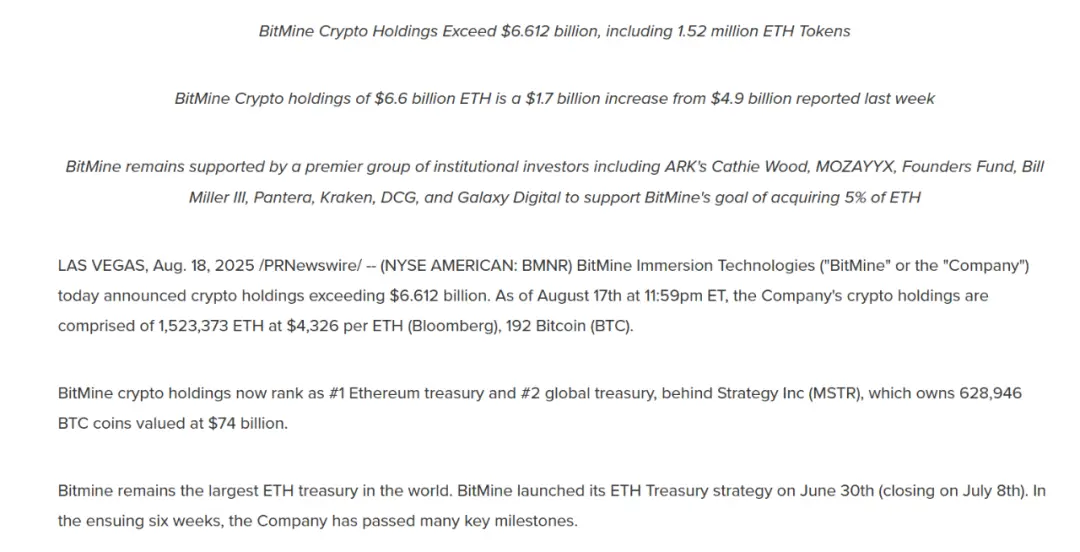
Source: BitMine
At the same time, Nasdaq-listed Cosmos Health also announced that it had reached a securities purchase agreement of up to US$300 million with a US institutional investor to launch an ETH treasury strategy and provide custody and staking infrastructure through BitGo Trust.
This trend of active inclusion in the treasury is different from the passive allocation of ETFs: ETFs are more about carrying the exposure needs of financial products, while companies directly purchase ETH and include it in the treasury, which means that ETH is becoming an actual settlement medium and reserve asset. Whether it is financial diversification, cross-border payments, or employee incentives and R&D incentives, ETH is beginning to show its application potential as a "liquid asset."
Overall, after the previous wave of widespread bearishness, Ethereum’s multiple narratives are now forming a synergy:
- Staking income brings a “government bond”-like interest rate anchor to ETH;
- ETFs open up a channel for allocating compliant funds;
- The corporate treasury further gives ETH real value for reserves and payments;
The three are intertwined, jointly pushing ETH from a "crypto token" to a "financial infrastructure asset."
If Bitcoin represents "digital gold" in corporate treasuries, then Ethereum's value narrative is gradually pointing to "the liquidity core of the global ledger."


You May Also Like

Rights group demands end to ‘culture of impunity’ over Bicol rapes

Retired general suggests Trump go to Walter Reed National Military Medical Center




