The Pi Network price has crashed for three consecutive days and is hovering near its all-time low as token unlocks continue and demand wanes.The Pi Network price has crashed for three consecutive days and is hovering near its all-time low as token unlocks continue and demand wanes.

Pi Network price prediction: 205 million tokens unlock, but demand is low

2026/02/12 01:50
3 min read

The Pi Network price has crashed for three consecutive days and is hovering near its all-time low as token unlocks continue and demand wanes.

Summary
  • Pi Network price continued its strong downward trend this week.
  • The network will unlock over 200 million tokens later this month.
  • Technical analysis suggests that the token will likely continue falling to $0.100.

Pi Coin (PI) token dropped to $0.1330 on Wednesday, down by 96% from its all-time high. In other words, the token has erased billions of dollars in value.

The ongoing crash coincided with the broader crypto market crash, which has affected Bitcoin and other altcoins. Data shows that the market capitalization of all tokens dropped by over 2.30% in the last 24 hours to $2.2 trillion.

The decline continued after the United States published strong jobs numbers. Data by the Bureau of Labor Statistics showed that the economy added 130k jobs in January, much higher than the expected 70k. The strong jobs report means that the Federal Reserve may not cut interest rates soon.

Pi Network price has also crashed amid the ongoing token unlocks. Data compiled by PiScan shows that the network will unlock 205 million tokens worth over $27 million in the remainder of the month. Most of these tokens will happen in the next two days, when the network will release over 37 million tokens.

Pi Network will unlock an additional 1.3 billion tokens over the next 12 months, substantially increasing the circulating supply. In most cases, token unlocks lead to lower prices, especially when the demand is weak.

The supply will increase in March when the developers launch the KYC validator rewards distribution. Most of the validators will likely dump their rewards into the market.

Meanwhile, more data show that Pi Network’s demand continued to fall. Data compiled by CoinMarketCap shows that the volume dropped to over $11 million in the last 24 hours.

A potential catalyst for higher prices is Kraken’s listing. The company has listed it in the chain category of its listing roadmap.

Pi Network price prediction: Technical analysis 
pi network price

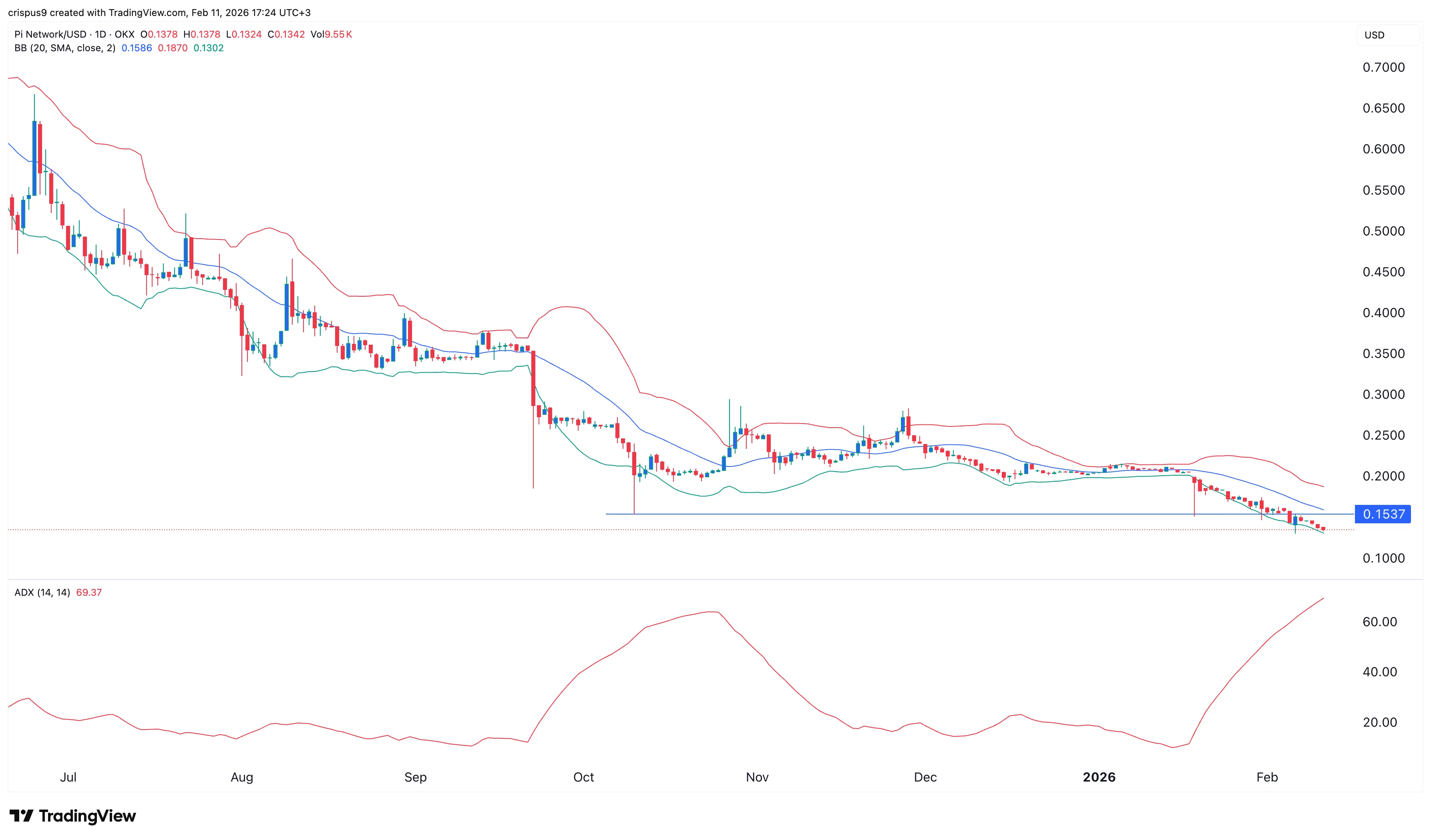
The daily timeframe chart shows that the Pi Coin price has plunged since its mainnet launch in February. It has crashed below the important support level at $0.1537, where it formed a double-bottom pattern. A double bottom is one of the most common bullish reversal patterns in technical analysis.

The coin has moved to the lower side of the Bollinger Bands tool, a sign that bears are in control. Also, the Average Directional Index has jumped to 70, a sign that the downtrend is gaining momentum.

Therefore, the coin will likely continue falling as bears target the next key support level at $0.100. This view will be invalidated if it moves above the key resistance level at $0.1537.


Market Opportunity
Pi Network Logo
Pi Network Price(PI)
$0.13323
$0.13323$0.13323
+0.84%
USD
Pi Network (PI) Live Price Chart
Disclaimer: The articles reposted on this site are sourced from public platforms and are provided for informational purposes only. They do not necessarily reflect the views of MEXC. All rights remain with the original authors. If you believe any content infringes on third-party rights, please contact service@support.mexc.com for removal. MEXC makes no guarantees regarding the accuracy, completeness, or timeliness of the content and is not responsible for any actions taken based on the information provided. The content does not constitute financial, legal, or other professional advice, nor should it be considered a recommendation or endorsement by MEXC.

You May Also Like

White House adviser: Cryptocurrency bill is "very close" to passage

White House adviser: Cryptocurrency bill is "very close" to passage

PANews reported on June 18 that according to Jinshi, a US White House adviser said that the cryptocurrency bill is "very close" to passage, which will create demand for the
Share
PANews2025/06/18 23:52
Trump caves on his own snubs as retaliation ploy against Dem governors backfires

Trump caves on his own snubs as retaliation ploy against Dem governors backfires

President Donald Trump on Wednesday walked back a snub he gave to two Democratic Governors. Last week, Trump notably did not invite Democratic governors Wes Moore
Share
Rawstory2026/02/12 10:29
Bitcoin devs cheer block reconstruction stats, ignore security budget concerns

Bitcoin devs cheer block reconstruction stats, ignore security budget concerns

The post Bitcoin devs cheer block reconstruction stats, ignore security budget concerns appeared on BitcoinEthereumNews.com. This morning, Bitcoin Core developers celebrated improved block reconstruction statistics for node operators while conveniently ignoring the reason for these statistics — the downward trend in fees for Bitcoin’s security budget. Reacting with heart emojis and thumbs up to a green chart showing over 80% “successful compact block reconstructions without any requested transactions,” they conveniently omitted red trend lines of the fees that Bitcoin users pay for mining security which powered those green statistics. Block reconstructions occur when a node requests additional information about transactions within a compact block. Although compact blocks allow nodes to quickly relay valid bundles of transactions across the internet, the more frequently that nodes can reconstruct without extra, cumbersome transaction requests from their peers is a positive trend. Because so many nodes switched over in August to relay transactions bidding 0.1 sat/vB across their mempools, nodes now have to request less transaction data to reconstruct blocks containing sub-1 sat/vB transactions. After nodes switched over in August to accept and relay pending transactions bidding less than 1 sat/vB, disparate mempools became harmonized as most nodes had a better view of which transactions would likely join upcoming blocks. As a result, block reconstruction times improved, as nodes needed less information about these sub-1 sat/vB transactions. In July, several miners admitted that user demand for Bitcoin blockspace had persisted at such a low that they were willing to accept transaction fees of just 0.1 satoshi per virtual byte — 90% lower than their prior 1 sat/vB minimum. With so many blocks partially empty, they succumbed to the temptation to accept at least something — even 1 billionth of one bitcoin (BTC) — rather than $0 to fill up some of the excess blockspace. Read more: Bitcoin’s transaction fees have fallen to a multi-year low Green stats for block reconstruction after transaction fees crash After…
Share
BitcoinEthereumNews2025/09/18 04:07