

Must Read
COLLISION. Video from the PCG shows a Chinese navy vessel (left, light gray) and a China Coast Guard ship (center, with blue and red stripes) colliding close toCOLLISION. Video from the PCG shows a Chinese navy vessel (left, light gray) and a China Coast Guard ship (center, with blue and red stripes) colliding close to
View from Manila: Mr. President, put order in your West Philippine Sea house
For feedback or concerns regarding this content, please contact us at crypto.news@mexc.com
MANILA, Philippines — After over six weeks of statements, responses, and retorts exchanged between the Chinese embassy in the Philippines and various officials and agencies in the country, the Department of Foreign Affairs (DFA) issued what it probably hoped would signal the end of a war of words that has taken on a life of its own.
“[The] DFA urges that such responses be made in a calm and professional manner, conscious of the mutual respect that must prevail in all diplomatic interactions,” the DFA’s new spokesperson for maritime affairs, Deputy Assistant Secretary Rogelio Villanueva Jr., said in a February 11 statement.
In response, the Chinese embassy in Manila told its host country to “speak with a unified and constructive voice” and said the DFA should “[lead] efforts to manage differences and advance the overall bilateral relationship.”
So as it lectures, provokes, and agitates everyone — from Philippine Coast Guard (PCG) spokesperson for the West Philippine Sea Commodore Jay Tarriela to Senate President Tito Sotto — the embassy is also singling out who it prefers to engage with and who it wants to silence.
It’s about time for President Ferdinand Marcos Jr. to convene the National Maritime Council, through Executive Secretary Ralph Recto. After all, when it was established in 2024, it was envisioned to be the “central body-in-charge of formulating policies and strategies to ensure a unified, coordinated and effective governance framework for the country’s maritime security and domain awareness.”
A council meeting would at least send the strong message that this administration and government is more than able to cut above the noise and close ranks when external forces are trying — and succeeding — in sowing chaos within.
The disarray has been aplenty.
On February 13, the DFA through Villanueva issued another, longer statement — the spiciest lines reserved not for an embassy that’s been waging a disinformation and influence campaign through public statements but to “casual commentators, non-practitioners, and self-styled experts” whose jeers, it said, would not “sidetrack” its “firm and professional” engagement with counterparts.
“While performative rhetoric is a reality in modern public discourse, the DFA has long ago resolved to conduct our work with the national interest as the sole consideration not for fanfare, not for followers, and certainly not for likes, but solely for the national interest and welfare of the Filipino people,” said Villanueva, in what was only his third statement in the new role.
Play Video 
It was a quip directed at nobody in particular and at everyone it could possibly apply to.
It’s also been met with strong responses — both explicit and cryptic — from the Philippines’ lively community of analysts, academics, commentators and observers, both casual and, well, formal. After all, it’s language you seldom hear or expect from the DFA, an agency whose default is diplomacy.
It was certainly not what many, “casual commentators” included, expected and wanted to hear as the Chinese embassy continues to push forward its narrative on the West Philippine Sea while picking fights with Philippine spokespersons, government agencies, and elected legislators.
And it’s not what the Philippines needs at a time when China’s envoys are exploiting differences — both personal and political — within the executive and legislative branches. It’s not what the country needs when the Chinese embassy, its proxies, and its apparent army of online supporters (whether real or manufactured) are flooding an already toxic information space with China’s position — which undermines Manila’s, including the 2016 Arbitral Award.
The escalation of tensions within — long existing, but almost always sorted out or suppressed in the name of national interest — can only stand to benefit Beijing.
China’s “theory of victory,” retired Rear Admiral Rommel Ong pointed out most recently in an Op-Ed for PhilStar, is “sow discord among fellow Filipinos within its society” and “create division within our government and its political leaders.”
Disrupting ties between the Philippines and the United States, as well as with other like-minded partners, is also a key indicator of success — a scenario bureaucrats in the defense, security, and diplomatic spaces prevented despite the best efforts of former president Rodrigo Duterte and his China pivot dreams.
Debates on, about, and tangential to the West Philippine Sea have taken lives of their own, and many of them have proven to be less than fruitful.
One offshoot has been the oversimplification of Philippine strategy as a choice between transparency and opacity — as if transparency does not exist as a graduation of tools that diplomats, soldiers, civilian personnel, and politicians can choose from, depending on the situation.
The “transparency initiative” — the name-and-shame effort that’s long been derided by China (and even, at times, some sectors of Philippine government) — should be understood as part of a greater maritime strategy, if it does exist, that also involves diplomacy, the modernization of the military, and external defense relationships.
Did Commodore Tarriela overstep in using satirical images of Chinese President Xi Jinping in a lecture? Perhaps. But a course of action in its aftermath should be navigated by Philippines officials and agencies together — unified, as the Chinese embassy in Manila has so kindly suggested.
Has Beijing, time and time again, overstepped in its “defense” of its South China Sea claims? Certainly. But they speak in unity — as they always do — in defending their position, even if it sometimes defies most logic.
It is, admittedly, a difficult position to be in for the Philippines. As chair of the Association of Southeast Asian Nations (ASEAN), it must act as a unifier of a region united by geography and history and divided by varying interests. As chair in the same year ASEAN wants a Code of Conduct, the stakes are even higher — what could it do to end a decades-old negotiation between the bloc and its superpower neighbors that’s been harassing it in its own backyard?
This means that in 2026, Manila is expected to think beyond itself and consider ASEAN more than ever.
“Dapat pag-aralan mabuti at pag-ingatan din [na] hindi yan maging resulta ng pagkatalo naman natin… Kahit magkaroon ng compromise, dapat meron pa rin tayong minimum na dapat i-ensure na hindi natin ma-compromise rin,” said Jay Batongbacal, a maritime law expert who heads the the UP Law Institute for Maritime Affairs and Law of the Sea (IMLOS), in an interview with Rappler.
(The Philippines must study this thoroughly and exercise caution so this [ASEAN chairmanship and the COC] does not result in us losing. Even if the Philippines makes compromises, there should be minimums that we should not compromise.)
Play Video 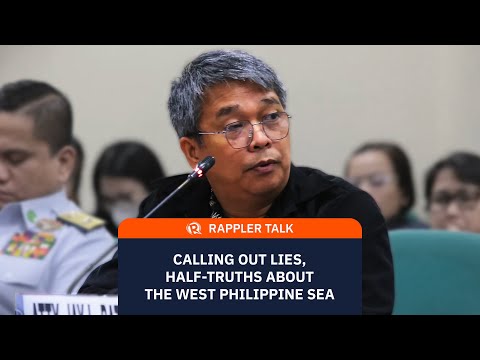
And then, of course, there are the things happening outside the Philippines and ASEAN — disarray in the long-upheld rules-based order both hastened by the superpower that set it up and by another superpower that has long wanted those norms changed.
The noise can be overwhelming.
To this, Batongbacal said: “Keep your eye on the ball regardless of what’s happening. Keep your core steady regardless of all these influences. Ang Pilipinas para sa Pilipino. Siguro, yun yung pinaka-gist nito (The Philippines is for the Filipino. That’s the gist of it).”
“Dapat pagdating sa mga issue katulad ng West Philippine Sea, ng ating maritime space, yung ating mga territories, pare-pareho tayo dapat ng posisyon, pare-pareho tayong tumitingin sa isang interest ng sambayan ng Pilipino – hindi yung mga individual interest ng mga ‘to. Mga iba dyan na nagka-grandstand, o kaya nagpapakitang gilas lamang, o kaya mismong kumakampi sa kabila, dapat [‘di] nila tanggapin yan. Dapat lagi, isaalang-alang kung ano ang para sa Pilipinas. ‘Yun dapat ang ating laging tinitingnan,” he added.
(When it comes to issues like the West Philippine Sea, our maritime space, our territories — we must have the same position, we must all look at the interest of the Filipino nation and not the interest of individuals. Some will grandstand and seek the spotlight, or will argue for the other side. Don’t just accept that. What you should always consider is what is for the Philippines. That’s what you should focus on.)
There can be virtue in staying in one’s lane — the ones on which commentators and analysts, whether casual, formal, or professional, have spent years developing knowledge and expertise through both study and field experience.
But one would think knowing what’s right or what’s wrong in defending the country’s sovereignty or sovereign rights is everyone’s business, especially in the face of a threat as large and resourced as China. – Rappler.com
Market Opportunity
Orderly Network Price(ORDER)
$0.055
$0.055$0.055
USD
Orderly Network (ORDER) Live Price Chart


Disclaimer: The articles reposted on this site are sourced from public platforms and are provided for informational purposes only. They do not necessarily reflect the views of MEXC. All rights remain with the original authors. If you believe any content infringes on third-party rights, please contact crypto.news@mexc.com for removal. MEXC makes no guarantees regarding the accuracy, completeness, or timeliness of the content and is not responsible for any actions taken based on the information provided. The content does not constitute financial, legal, or other professional advice, nor should it be considered a recommendation or endorsement by MEXC.
You May Also Like

X-Energy (XE) Stock Jumps 27% in Nasdaq Debut Fueled by Amazon Partnership
X-Energy (XE) stock jumped 27% on its Nasdaq debut after a $1B IPO backed by Amazon and Citadel's Ken Griffin, with shares rising further on Monday. The post X-
Share
Blockonomi2026/04/27 19:44

Polymarket: Only 3.5% Of Traders Profit While Others Pay The Price
The post Polymarket: Only 3.5% Of Traders Profit While Others Pay The Price appeared on BitcoinEthereumNews.com. The accuracy of prediction markets is driven by
Share
BitcoinEthereumNews2026/04/27 18:48

XR news gets a new rival: BlockchainFX named leading crypto to invest this week by presale watchers
XRP price outlook stays in focus as BlockchainFX gains attention in the multi-asset crypto investment market. Can XRP (XRP) price prediction news still matter when
Share
Crypto.news2026/04/27 18:54



