The long, messy saga of FTX’s bankruptcy is inching forward again. The FTX Recovery Trust, tasked with untangling Sam Bankman-Fried’s collapsed empire, has announced its third distribution: roughly $1.6 billion will be released to creditors on September 30, with funds expected to hit accounts within three business days.The long, messy saga of FTX’s bankruptcy is inching forward again. The FTX Recovery Trust, tasked with untangling Sam Bankman-Fried’s collapsed empire, has announced its third distribution: roughly $1.6 billion will be released to creditors on September 30, with funds expected to hit accounts within three business days.

FTX Recovery Trust to Release $1.6B in September Payout — Creditors Edge Closer to $16.5B Total

The long, messy saga of FTX’s bankruptcy is inching forward again. The FTX Recovery Trust, tasked with untangling Sam Bankman-Fried’s collapsed empire, has announced its third distribution: roughly $1.6 billion will be released to creditors on September 30, with funds expected to hit accounts within three business days.

This marks the third round of repayments since the trust started cutting checks earlier this year, bringing some measure of relief to those who lost funds in one of crypto’s most infamous implosions.
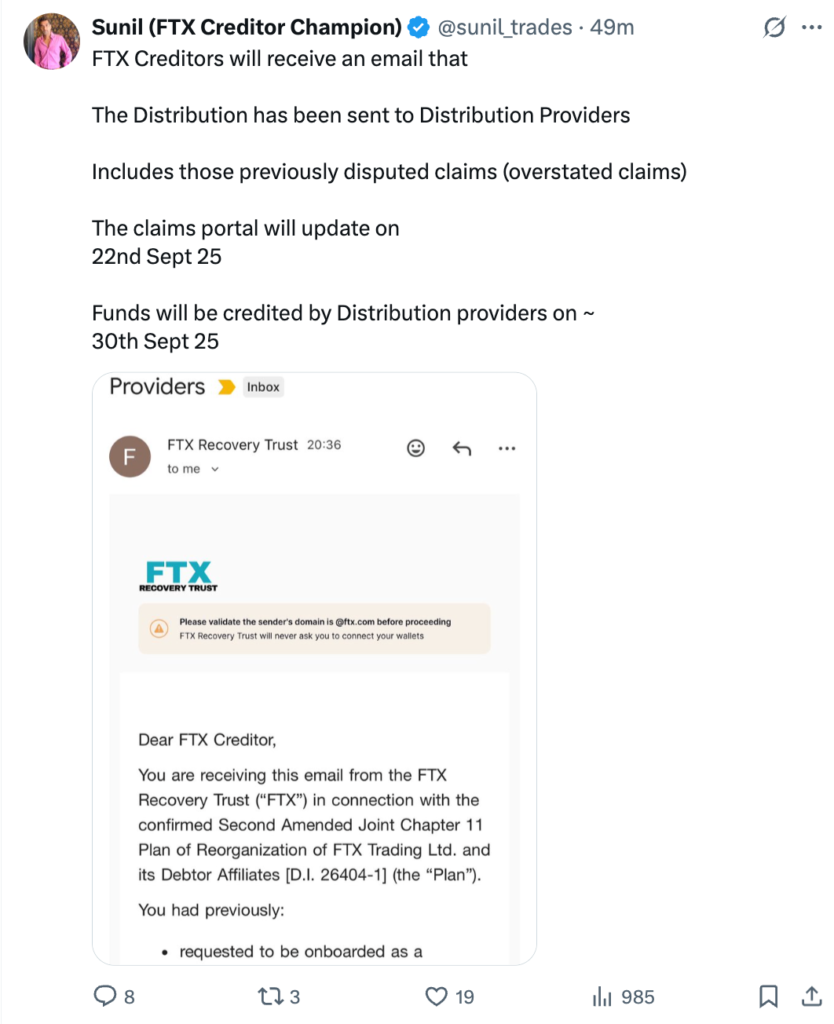
The long, messy saga of FTX’s bankruptcy is inching forward again. The FTX Recovery Trust, tasked with untangling Sam Bankman-Fried’s collapsed empire, has announced its third distribution: roughly $1.6 billion will be released to creditors on September 30, with funds expected to hit accounts within three business days.

The claims portal will open tomorrow, source: X

Who Gets What This Time

September’s payout isn’t uniform—it’s a carefully sliced pie:

  • Dotcom Customer Claims: 6% distribution

  • US Customer Entitlement Claims: 40% distribution

  • General Unsecured Claims & Digital Asset Loan Claims: 24% distribution

  • Convenience Claims: a whopping 120% reimbursement

That last one—“convenience claims”—is essentially the bankruptcy court’s way of settling smaller claims quickly and cleanly. Creditors in that category are actually walking away whole, plus a little extra, which is unusual in bankruptcy cases.

The Bigger Picture

This latest tranche follows a $1.2 billion disbursement in February and a $5 billion payout in May, with up to $16.5 billion ultimately earmarked for creditors. Given how chaotic the collapse was in 2022, when FTX’s implosion dragged the entire crypto market deeper into winter, the fact that creditors are seeing money back at all—and at this scale—is remarkable.

But make no mistake: these repayments are not a victory lap. They are the unwinding of one of the most spectacular failures in financial history. Traders still watch each new distribution nervously, wondering whether sudden liquidity for former customers might slosh back into crypto markets in unpredictable ways.

The Shadow of SBF

All of this, of course, is happening under the long shadow of Sam Bankman-Fried. Convicted in late 2023 on seven counts ranging from wire fraud to money laundering conspiracy, SBF was sentenced in March 2024 to 25 years in prison. Judge Lewis Kaplan called his crimes “serious” enough to warrant decades behind bars.

Naturally, SBF isn’t done yet. His lawyers are appealing the conviction this November, arguing that the trial was unfair and—almost laughably—that FTX was never actually insolvent and always had the funds to pay customers. Tell that to the creditors waiting nearly two years for partial repayments.

Why It Matters

For many, these repayments are less about the money and more about closure. The FTX collapse wasn’t just another exchange failure; it was a confidence nuke that reshaped how regulators, investors, and even normies view crypto.

Now, as the Recovery Trust continues to unwind what’s left of the empire, the question isn’t just how much creditors will get back—but whether the industry can rebuild the trust that Sam Bankman-Fried so thoroughly torched.


Market Opportunity
Edge Logo
Edge Price(EDGE)
$0.12738
$0.12738$0.12738
+0.54%
USD
Edge (EDGE) Live Price Chart
Disclaimer: The articles reposted on this site are sourced from public platforms and are provided for informational purposes only. They do not necessarily reflect the views of MEXC. All rights remain with the original authors. If you believe any content infringes on third-party rights, please contact service@support.mexc.com for removal. MEXC makes no guarantees regarding the accuracy, completeness, or timeliness of the content and is not responsible for any actions taken based on the information provided. The content does not constitute financial, legal, or other professional advice, nor should it be considered a recommendation or endorsement by MEXC.

You May Also Like

The Channel Factories We’ve Been Waiting For

The Channel Factories We’ve Been Waiting For

The post The Channel Factories We’ve Been Waiting For appeared on BitcoinEthereumNews.com. Visions of future technology are often prescient about the broad strokes while flubbing the details. The tablets in “2001: A Space Odyssey” do indeed look like iPads, but you never see the astronauts paying for subscriptions or wasting hours on Candy Crush.  Channel factories are one vision that arose early in the history of the Lightning Network to address some challenges that Lightning has faced from the beginning. Despite having grown to become Bitcoin’s most successful layer-2 scaling solution, with instant and low-fee payments, Lightning’s scale is limited by its reliance on payment channels. Although Lightning shifts most transactions off-chain, each payment channel still requires an on-chain transaction to open and (usually) another to close. As adoption grows, pressure on the blockchain grows with it. The need for a more scalable approach to managing channels is clear. Channel factories were supposed to meet this need, but where are they? In 2025, subnetworks are emerging that revive the impetus of channel factories with some new details that vastly increase their potential. They are natively interoperable with Lightning and achieve greater scale by allowing a group of participants to open a shared multisig UTXO and create multiple bilateral channels, which reduces the number of on-chain transactions and improves capital efficiency. Achieving greater scale by reducing complexity, Ark and Spark perform the same function as traditional channel factories with new designs and additional capabilities based on shared UTXOs.  Channel Factories 101 Channel factories have been around since the inception of Lightning. A factory is a multiparty contract where multiple users (not just two, as in a Dryja-Poon channel) cooperatively lock funds in a single multisig UTXO. They can open, close and update channels off-chain without updating the blockchain for each operation. Only when participants leave or the factory dissolves is an on-chain transaction…
Share
BitcoinEthereumNews2025/09/18 00:09
Onyxcoin Price Breakout Coming — Is a 38% Move Next?

Onyxcoin Price Breakout Coming — Is a 38% Move Next?

The post Onyxcoin Price Breakout Coming — Is a 38% Move Next? appeared on BitcoinEthereumNews.com. Onyxcoin price action has entered a tense standoff between bulls
Share
BitcoinEthereumNews2026/01/14 00:33
CEO Sandeep Nailwal Shared Highlights About RWA on Polygon

CEO Sandeep Nailwal Shared Highlights About RWA on Polygon

The post CEO Sandeep Nailwal Shared Highlights About RWA on Polygon appeared on BitcoinEthereumNews.com. Polygon CEO Sandeep Nailwal highlighted Polygon’s lead in global bonds, Spiko US T-Bill, and Spiko Euro T-Bill. Polygon published an X post to share that its roadmap to GigaGas was still scaling. Sentiments around POL price were last seen to be bearish. Polygon CEO Sandeep Nailwal shared key pointers from the Dune and RWA.xyz report. These pertain to highlights about RWA on Polygon. Simultaneously, Polygon underlined its roadmap towards GigaGas. Sentiments around POL price were last seen fumbling under bearish emotions. Polygon CEO Sandeep Nailwal on Polygon RWA CEO Sandeep Nailwal highlighted three key points from the Dune and RWA.xyz report. The Chief Executive of Polygon maintained that Polygon PoS was hosting RWA TVL worth $1.13 billion across 269 assets plus 2,900 holders. Nailwal confirmed from the report that RWA was happening on Polygon. The Dune and https://t.co/W6WSFlHoQF report on RWA is out and it shows that RWA is happening on Polygon. Here are a few highlights: – Leading in Global Bonds: Polygon holds 62% share of tokenized global bonds (driven by Spiko’s euro MMF and Cashlink euro issues) – Spiko U.S.… — Sandeep | CEO, Polygon Foundation (※,※) (@sandeepnailwal) September 17, 2025 The X post published by Polygon CEO Sandeep Nailwal underlined that the ecosystem was leading in global bonds by holding a 62% share of tokenized global bonds. He further highlighted that Polygon was leading with Spiko US T-Bill at approximately 29% share of TVL along with Ethereum, adding that the ecosystem had more than 50% share in the number of holders. Finally, Sandeep highlighted from the report that there was a strong adoption for Spiko Euro T-Bill with 38% share of TVL. He added that 68% of returns were on Polygon across all the chains. Polygon Roadmap to GigaGas In a different update from Polygon, the community…
Share
BitcoinEthereumNews2025/09/18 01:10