Two MIT-educated brothers accused of orchestrating the largest MEV bot exploitation in cryptocurrency history will face trial after a federal judge rejected their attempts to dismiss fraud and money laundering charges. Anton Peraire-Bueno, 24, and James Peraire-Bueno, 28, allegedly stole $25 million in cryptocurrency within 12 seconds by manipulating Ethereum’s MEV-Boost protocol in April 2023. Technical Error or Deliberate Exploit? The brothers meticulously planned their operation over several months, studying trading patterns of Ethereum bots and establishing shell companies. They created 16 Ethereum validators using approximately $880,000 in cryptocurrency, then executed what prosecutors called a “bait, block, search, and propagation” scheme targeting three victim traders operating MEV bots. Their exploit involved proposing “lure transactions” to induce victim traders’ bots to purchase illiquid cryptocurrencies worth $25 million. The brothers then sent a false signature to the relay system, gaining premature access to private transaction data. They replaced the lure transactions with their own trades, selling the illiquid tokens and rendering the victims’ holdings worthless. Following the theft, the brothers laundered the stolen funds through complex transactions across multiple addresses and foreign exchanges with limited KYC requirements. They converted the cryptocurrency to DAI stablecoin, then to USDC , before transferring $20 million to U.S. dollar accounts. Foreign law enforcement froze $3 million of the stolen funds. The case comes amid rising concerns about MEV exploitation across blockchain networks. Recent incidents include a $2 million insider attack on Bedrock’s UniBTC protocol by a former Fuzzland employee and a notorious Solana MEV bot named “arsc” that accumulated $30 million in two months through sandwich attacks. Brothers’ Legal Battle Reaches Critical Juncture Federal prosecutors arrested the Peraire-Bueno brothers on May 15, 2024, with Anton taken into custody in Boston and James in New York. U.S. Attorney Damian Williams described the scheme as meticulously planned, noting how the brothers “ used their specialized skills and education to tamper with and manipulate the protocols relied upon by millions of Ethereum users. “ Two Brothers Arrested for Attacking Ethereum Blockchain and Stealing $25M in Cryptocurrency 🔗: https://t.co/rY4No6YUrm pic.twitter.com/2Mlb3zIdpo — U.S. Department of Justice (@TheJusticeDept) May 15, 2024 The brothers face charges of conspiracy to commit wire fraud, wire fraud, and conspiracy to commit money laundering. Each charge carries a potential 20-year prison sentence. A federal judge scheduled their trial for October 14, 2025 , after denying their motions to dismiss the indictment. The court found the wire fraud charges legally sufficient, determining that the brothers’ lure transactions and false signatures constituted material misrepresentations. The judge ruled that the $25 million in stolen cryptocurrency represented a traditionally recognized property interest, not merely contingent profits. IRS Criminal Investigation’s New York Cyber Unit traced the stolen funds back to the brothers despite their sophisticated laundering efforts. Special Agent Thomas Fattorusso noted that investigators “simply followed the money” using cutting-edge technology and traditional investigative methods. Growing MEV Threat Challenges Blockchain Scalability MEV exploitation has emerged as a dominant threat to blockchain scalability, according to recent research from Flashbots. According to a report covered by Cryptonews in June, MEV bots now consume 40% of all blockspace on Solana and over half of the gas usage on Ethereum rollups, such as Base and OP Mainnet. 🔍 MEV bot spam is now the main barrier to blockchain scalability, consuming most new throughput on Ethereum rollups and Solana. #MEV #BlockchainScalability https://t.co/kNRiwwORsU — Cryptonews.com (@cryptonews) June 17, 2025 The Peraire-Bueno case represents the first criminal prosecution of MEV manipulation; however, similar exploits continue to occur across various networks. A Ronin Network breach in August 2024 initially appeared malicious but was later revealed to be a white-hat operation, with the hacker returning $9.8 million after discovering a vulnerability in the bridge. Recent data from EigenPhi shows more than 81,000 users fell victim to sandwich attacks in the last 30 days alone. Source: EigenPhi These attacks now account for nearly $1 billion in weekly trading volume on Ethereum-based decentralized exchanges. Flashbots has proposed new frameworks to address MEV abuse, including explicit MEV auctions and programmable privacy using Trusted Execution Environments. The organization argues that current spam from MEV bots creates artificial fee floors, undermining the promise of near-zero transaction costs on scaled networks. The brothers’ trial, scheduled for October, is likely to set precedents for future MEV-related prosecutions, as it isn’t technically precise whether it can be attributed to an exploit of a technical oversight.Two MIT-educated brothers accused of orchestrating the largest MEV bot exploitation in cryptocurrency history will face trial after a federal judge rejected their attempts to dismiss fraud and money laundering charges. Anton Peraire-Bueno, 24, and James Peraire-Bueno, 28, allegedly stole $25 million in cryptocurrency within 12 seconds by manipulating Ethereum’s MEV-Boost protocol in April 2023. Technical Error or Deliberate Exploit? The brothers meticulously planned their operation over several months, studying trading patterns of Ethereum bots and establishing shell companies. They created 16 Ethereum validators using approximately $880,000 in cryptocurrency, then executed what prosecutors called a “bait, block, search, and propagation” scheme targeting three victim traders operating MEV bots. Their exploit involved proposing “lure transactions” to induce victim traders’ bots to purchase illiquid cryptocurrencies worth $25 million. The brothers then sent a false signature to the relay system, gaining premature access to private transaction data. They replaced the lure transactions with their own trades, selling the illiquid tokens and rendering the victims’ holdings worthless. Following the theft, the brothers laundered the stolen funds through complex transactions across multiple addresses and foreign exchanges with limited KYC requirements. They converted the cryptocurrency to DAI stablecoin, then to USDC , before transferring $20 million to U.S. dollar accounts. Foreign law enforcement froze $3 million of the stolen funds. The case comes amid rising concerns about MEV exploitation across blockchain networks. Recent incidents include a $2 million insider attack on Bedrock’s UniBTC protocol by a former Fuzzland employee and a notorious Solana MEV bot named “arsc” that accumulated $30 million in two months through sandwich attacks. Brothers’ Legal Battle Reaches Critical Juncture Federal prosecutors arrested the Peraire-Bueno brothers on May 15, 2024, with Anton taken into custody in Boston and James in New York. U.S. Attorney Damian Williams described the scheme as meticulously planned, noting how the brothers “ used their specialized skills and education to tamper with and manipulate the protocols relied upon by millions of Ethereum users. “ Two Brothers Arrested for Attacking Ethereum Blockchain and Stealing $25M in Cryptocurrency 🔗: https://t.co/rY4No6YUrm pic.twitter.com/2Mlb3zIdpo — U.S. Department of Justice (@TheJusticeDept) May 15, 2024 The brothers face charges of conspiracy to commit wire fraud, wire fraud, and conspiracy to commit money laundering. Each charge carries a potential 20-year prison sentence. A federal judge scheduled their trial for October 14, 2025 , after denying their motions to dismiss the indictment. The court found the wire fraud charges legally sufficient, determining that the brothers’ lure transactions and false signatures constituted material misrepresentations. The judge ruled that the $25 million in stolen cryptocurrency represented a traditionally recognized property interest, not merely contingent profits. IRS Criminal Investigation’s New York Cyber Unit traced the stolen funds back to the brothers despite their sophisticated laundering efforts. Special Agent Thomas Fattorusso noted that investigators “simply followed the money” using cutting-edge technology and traditional investigative methods. Growing MEV Threat Challenges Blockchain Scalability MEV exploitation has emerged as a dominant threat to blockchain scalability, according to recent research from Flashbots. According to a report covered by Cryptonews in June, MEV bots now consume 40% of all blockspace on Solana and over half of the gas usage on Ethereum rollups, such as Base and OP Mainnet. 🔍 MEV bot spam is now the main barrier to blockchain scalability, consuming most new throughput on Ethereum rollups and Solana. #MEV #BlockchainScalability https://t.co/kNRiwwORsU — Cryptonews.com (@cryptonews) June 17, 2025 The Peraire-Bueno case represents the first criminal prosecution of MEV manipulation; however, similar exploits continue to occur across various networks. A Ronin Network breach in August 2024 initially appeared malicious but was later revealed to be a white-hat operation, with the hacker returning $9.8 million after discovering a vulnerability in the bridge. Recent data from EigenPhi shows more than 81,000 users fell victim to sandwich attacks in the last 30 days alone. Source: EigenPhi These attacks now account for nearly $1 billion in weekly trading volume on Ethereum-based decentralized exchanges. Flashbots has proposed new frameworks to address MEV abuse, including explicit MEV auctions and programmable privacy using Trusted Execution Environments. The organization argues that current spam from MEV bots creates artificial fee floors, undermining the promise of near-zero transaction costs on scaled networks. The brothers’ trial, scheduled for October, is likely to set precedents for future MEV-related prosecutions, as it isn’t technically precise whether it can be attributed to an exploit of a technical oversight.

MIT Brothers Who Exploited MEV Bots for $25M Must Face Trial, Judge Rules

Two MIT-educated brothers accused of orchestrating the largest MEV bot exploitation in cryptocurrency history will face trial after a federal judge rejected their attempts to dismiss fraud and money laundering charges.

Anton Peraire-Bueno, 24, and James Peraire-Bueno, 28, allegedly stole $25 million in cryptocurrency within 12 seconds by manipulating Ethereum’s MEV-Boost protocol in April 2023.

Technical Error or Deliberate Exploit?

The brothers meticulously planned their operation over several months, studying trading patterns of Ethereum bots and establishing shell companies.

They created 16 Ethereum validators using approximately $880,000 in cryptocurrency, then executed what prosecutors called a “bait, block, search, and propagation” scheme targeting three victim traders operating MEV bots.

Their exploit involved proposing “lure transactions” to induce victim traders’ bots to purchase illiquid cryptocurrencies worth $25 million.

The brothers then sent a false signature to the relay system, gaining premature access to private transaction data.

They replaced the lure transactions with their own trades, selling the illiquid tokens and rendering the victims’ holdings worthless.

Following the theft, the brothers laundered the stolen funds through complex transactions across multiple addresses and foreign exchanges with limited KYC requirements.

They converted the cryptocurrency to DAI stablecoin, then to USDC, before transferring $20 million to U.S. dollar accounts. Foreign law enforcement froze $3 million of the stolen funds.

The case comes amid rising concerns about MEV exploitation across blockchain networks.

Recent incidents include a $2 million insider attack on Bedrock’s UniBTC protocol by a former Fuzzland employee and a notorious Solana MEV bot named “arsc” that accumulated $30 million in two months through sandwich attacks.

Federal prosecutors arrested the Peraire-Bueno brothers on May 15, 2024, with Anton taken into custody in Boston and James in New York.

U.S. Attorney Damian Williams described the scheme as meticulously planned, noting how the brothers “used their specialized skills and education to tamper with and manipulate the protocols relied upon by millions of Ethereum users.

The brothers face charges of conspiracy to commit wire fraud, wire fraud, and conspiracy to commit money laundering.

Each charge carries a potential 20-year prison sentence. A federal judge scheduled their trial for October 14, 2025, after denying their motions to dismiss the indictment.

The court found the wire fraud charges legally sufficient, determining that the brothers’ lure transactions and false signatures constituted material misrepresentations.

The judge ruled that the $25 million in stolen cryptocurrency represented a traditionally recognized property interest, not merely contingent profits.

IRS Criminal Investigation’s New York Cyber Unit traced the stolen funds back to the brothers despite their sophisticated laundering efforts.

Special Agent Thomas Fattorusso noted that investigators “simply followed the money” using cutting-edge technology and traditional investigative methods.

Growing MEV Threat Challenges Blockchain Scalability

MEV exploitation has emerged as a dominant threat to blockchain scalability, according to recent research from Flashbots.

According to a report covered by Cryptonews in June, MEV bots now consume 40% of all blockspace on Solana and over half of the gas usage on Ethereum rollups, such as Base and OP Mainnet.

The Peraire-Bueno case represents the first criminal prosecution of MEV manipulation; however, similar exploits continue to occur across various networks.

A Ronin Network breach in August 2024 initially appeared malicious but was later revealed to be a white-hat operation, with the hacker returning $9.8 million after discovering a vulnerability in the bridge.

Recent data from EigenPhi shows more than 81,000 users fell victim to sandwich attacks in the last 30 days alone.
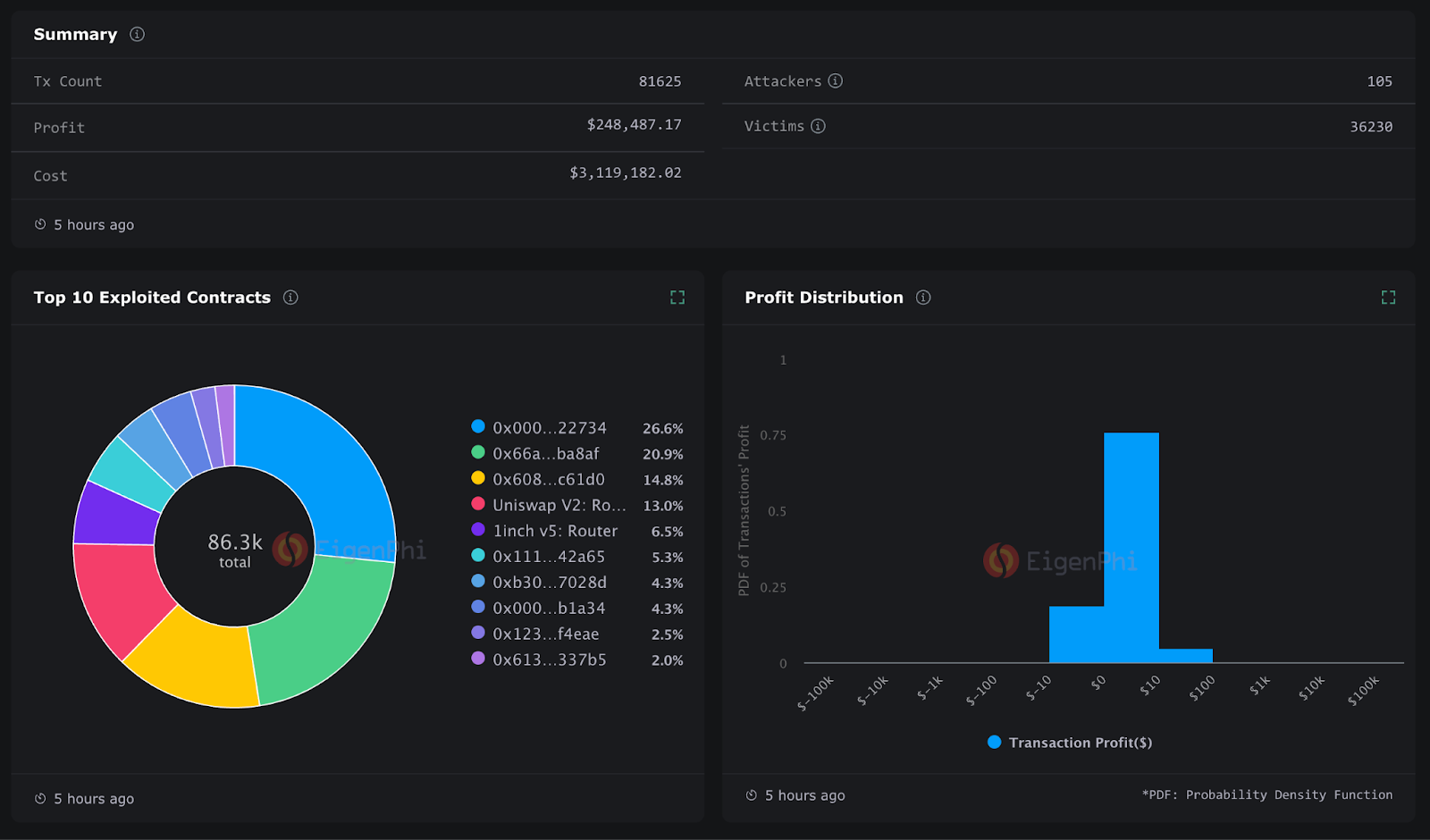
MIT Brothers Who Exploited MEV Bots for $25M Must Face Trial, Judge RulesSource: EigenPhi

These attacks now account for nearly $1 billion in weekly trading volume on Ethereum-based decentralized exchanges.

Flashbots has proposed new frameworks to address MEV abuse, including explicit MEV auctions and programmable privacy using Trusted Execution Environments.

The organization argues that current spam from MEV bots creates artificial fee floors, undermining the promise of near-zero transaction costs on scaled networks.

The brothers’ trial, scheduled for October, is likely to set precedents for future MEV-related prosecutions, as it isn’t technically precise whether it can be attributed to an exploit of a technical oversight.

Market Opportunity
NEAR Logo
NEAR Price(NEAR)
$1.551
$1.551$1.551
-0.51%
USD
NEAR (NEAR) Live Price Chart
Disclaimer: The articles reposted on this site are sourced from public platforms and are provided for informational purposes only. They do not necessarily reflect the views of MEXC. All rights remain with the original authors. If you believe any content infringes on third-party rights, please contact service@support.mexc.com for removal. MEXC makes no guarantees regarding the accuracy, completeness, or timeliness of the content and is not responsible for any actions taken based on the information provided. The content does not constitute financial, legal, or other professional advice, nor should it be considered a recommendation or endorsement by MEXC.

You May Also Like

How to earn from cloud mining: IeByte’s upgraded auto-cloud mining platform unlocks genuine passive earnings

How to earn from cloud mining: IeByte’s upgraded auto-cloud mining platform unlocks genuine passive earnings

The post How to earn from cloud mining: IeByte’s upgraded auto-cloud mining platform unlocks genuine passive earnings appeared on BitcoinEthereumNews.com. contributor Posted: September 17, 2025 As digital assets continue to reshape global finance, cloud mining has become one of the most effective ways for investors to generate stable passive income. Addressing the growing demand for simplicity, security, and profitability, IeByte has officially upgraded its fully automated cloud mining platform, empowering both beginners and experienced investors to earn Bitcoin, Dogecoin, and other mainstream cryptocurrencies without the need for hardware or technical expertise. Why cloud mining in 2025? Traditional crypto mining requires expensive hardware, high electricity costs, and constant maintenance. In 2025, with blockchain networks becoming more competitive, these barriers have grown even higher. Cloud mining solves this by allowing users to lease professional mining power remotely, eliminating the upfront costs and complexity. IeByte stands at the forefront of this transformation, offering investors a transparent and seamless path to daily earnings. IeByte’s upgraded auto-cloud mining platform With its latest upgrade, IeByte introduces: Full Automation: Mining contracts can be activated in just one click, with all processes handled by IeByte’s servers. Enhanced Security: Bank-grade encryption, cold wallets, and real-time monitoring protect every transaction. Scalable Options: From starter packages to high-level investment contracts, investors can choose the plan that matches their goals. Global Reach: Already trusted by users in over 100 countries. Mining contracts for 2025 IeByte offers a wide range of contracts tailored for every investor level. From entry-level plans with daily returns to premium high-yield packages, the platform ensures maximum accessibility. Contract Type Duration Price Daily Reward Total Earnings (Principal + Profit) Starter Contract 1 Day $200 $6 $200 + $6 + $10 bonus Bronze Basic Contract 2 Days $500 $13.5 $500 + $27 Bronze Basic Contract 3 Days $1,200 $36 $1,200 + $108 Silver Advanced Contract 1 Day $5,000 $175 $5,000 + $175 Silver Advanced Contract 2 Days $8,000 $320 $8,000 + $640 Silver…
Share
BitcoinEthereumNews2025/09/17 23:48
The aftermath of the energy war: As Microsoft, BlackRock monopolize infrastructure, Eden Miner becomes retail’s last backdoor to the “hashrate yield network”

The aftermath of the energy war: As Microsoft, BlackRock monopolize infrastructure, Eden Miner becomes retail’s last backdoor to the “hashrate yield network”

As mining goes institutional in 2025, Eden Miner opens retail access to hashrate investing through a new model. The year 2025 marks a watershed moment for global
Share
Crypto.news2025/12/17 00:08
Why The Green Bay Packers Must Take The Cleveland Browns Seriously — As Hard As That Might Be

Why The Green Bay Packers Must Take The Cleveland Browns Seriously — As Hard As That Might Be

The post Why The Green Bay Packers Must Take The Cleveland Browns Seriously — As Hard As That Might Be appeared on BitcoinEthereumNews.com. Jordan Love and the Green Bay Packers are off to a 2-0 start. Getty Images The Green Bay Packers are, once again, one of the NFL’s better teams. The Cleveland Browns are, once again, one of the league’s doormats. It’s why unbeaten Green Bay (2-0) is a 8-point favorite at winless Cleveland (0-2) Sunday according to betmgm.com. The money line is also Green Bay -500. Most expect this to be a Packers’ rout, and it very well could be. But Green Bay knows taking anyone in this league for granted can prove costly. “I think if you look at their roster, the paper, who they have on that team, what they can do, they got a lot of talent and things can turn around quickly for them,” Packers safety Xavier McKinney said. “We just got to kind of keep that in mind and know we not just walking into something and they just going to lay down. That’s not what they going to do.” The Browns certainly haven’t laid down on defense. Far from. Cleveland is allowing an NFL-best 191.5 yards per game. The Browns gave up 141 yards to Cincinnati in Week 1, including just seven in the second half, but still lost, 17-16. Cleveland has given up an NFL-best 45.5 rushing yards per game and just 2.1 rushing yards per attempt. “The biggest thing is our defensive line is much, much improved over last year and I think we’ve got back to our personality,” defensive coordinator Jim Schwartz said recently. “When we play our best, our D-line leads us there as our engine.” The Browns rank third in the league in passing defense, allowing just 146.0 yards per game. Cleveland has also gone 30 straight games without allowing a 300-yard passer, the longest active streak in the NFL.…
Share
BitcoinEthereumNews2025/09/18 00:41