Nemo Protocol, a decentralized finance (DeFi) yield platform operating on the Sui blockchain, fell victim to a cyberattack that resulted in $2.4 million in losses just ahead of its scheduled maintenance window on Monday and Tuesday. The security breach was initially detected by PeckShieldAlert on September 8, which reported via X that approximately $2.4 million in USDC had been drained from Nemo’s systems. According to the blockchain security firm’s investigation, the hacker swiftly moved the stolen assets via Circle by bridging USDC on Arbitrum to Ethereum. $6.3M TVL Crashes 75% as Users Flee Nemo Protocol Nemo acknowledged the incident in a subsequent tweet, stating that the protocol had experienced a security breach the previous evening that affected its Market pool. The development team confirmed that an investigation was in progress to identify the root cause of the vulnerability. As a precautionary measure, all smart contract operations were temporarily halted. The attack’s impact was immediately felt. According to DeFiLlama data, Nemo’s total value locked (TVL) collapsed to approximately $1.57 million from over $6.3 million before the breach.Source: DefilLama User withdrawals exceeded $3.8 million worth of USDC and SUI tokens as investors rushed to exit, fearing the exploit’s scope might be more extensive than initially disclosed.Source: DefilLama The breach specifically targeted Nemo’s yield-trading mechanism, which enables users to divide staked assets into Principal Tokens (PTs) and Yield Tokens (YTs) for yield speculation purposes. According to blockchain security auditor CertiK, security risks may arise from multiple sources, including coding errors, blockchain network vulnerabilities, and programming language limitations. Sui Blockchain Security Crisis Contributed to $2.37 Billion DeFi Losses in 2025 Notably, the Nemo security breach marks the third major hack targeting DeFi protocols this month. Earlier in September, Venus protocol lost $13.5 million to attackers, followed by an $8.4 million theft from the Bunni protocol. Similarly, in the Sui ecosystem, the Nemo incident follows another significant breach on the Layer-1 network from earlier this year. On May 22, Cetus Protocol, a prominent decentralized exchange and liquidity provider, suffered a $223 million exploit. The attacker leveraged an arithmetic overflow flaw in a third-party code library to complete the drain within 15 minutes. Moreover, these DeFi-focused attacks are on the rise in 2025. SlowMist’s mid-year analysis revealed that the blockchain sector experienced over $2.37 billion in losses across 121 security incidents during the first half of the year.Source: SlowMist DeFi protocols alone accounted for 76% of these cases, although centralized exchanges recorded higher individual losses. A complementary report from Hacken’s 2025 mid-year security assessment estimated total crypto industry losses at over $3.1 billion within the first six months.Source: Hacken Access control vulnerabilities, including misconfigured wallets and compromised legacy keys, represented 59% of these losses, while DeFi-specific smart contract exploits accounted for $263 million, or roughly 8%. A recent interview between Cryptonews and Mitchell Amador, founder and CEO of Immunefi, highlighted why conventional security methodologies prove inadequate in Web3’s open-source ecosystem. Amador explained that “Traditional audits, being static and pre-launch focused, fail to identify post-deployment vulnerabilities present in dynamic DeFi environments.” He advocated for bug bounty programs as a solution to incentivize ethical hackers, fundamentally restructuring cybersecurity economics to make defensive measures more lucrative than offensive onesNemo Protocol, a decentralized finance (DeFi) yield platform operating on the Sui blockchain, fell victim to a cyberattack that resulted in $2.4 million in losses just ahead of its scheduled maintenance window on Monday and Tuesday. The security breach was initially detected by PeckShieldAlert on September 8, which reported via X that approximately $2.4 million in USDC had been drained from Nemo’s systems. According to the blockchain security firm’s investigation, the hacker swiftly moved the stolen assets via Circle by bridging USDC on Arbitrum to Ethereum. $6.3M TVL Crashes 75% as Users Flee Nemo Protocol Nemo acknowledged the incident in a subsequent tweet, stating that the protocol had experienced a security breach the previous evening that affected its Market pool. The development team confirmed that an investigation was in progress to identify the root cause of the vulnerability. As a precautionary measure, all smart contract operations were temporarily halted. The attack’s impact was immediately felt. According to DeFiLlama data, Nemo’s total value locked (TVL) collapsed to approximately $1.57 million from over $6.3 million before the breach.Source: DefilLama User withdrawals exceeded $3.8 million worth of USDC and SUI tokens as investors rushed to exit, fearing the exploit’s scope might be more extensive than initially disclosed.Source: DefilLama The breach specifically targeted Nemo’s yield-trading mechanism, which enables users to divide staked assets into Principal Tokens (PTs) and Yield Tokens (YTs) for yield speculation purposes. According to blockchain security auditor CertiK, security risks may arise from multiple sources, including coding errors, blockchain network vulnerabilities, and programming language limitations. Sui Blockchain Security Crisis Contributed to $2.37 Billion DeFi Losses in 2025 Notably, the Nemo security breach marks the third major hack targeting DeFi protocols this month. Earlier in September, Venus protocol lost $13.5 million to attackers, followed by an $8.4 million theft from the Bunni protocol. Similarly, in the Sui ecosystem, the Nemo incident follows another significant breach on the Layer-1 network from earlier this year. On May 22, Cetus Protocol, a prominent decentralized exchange and liquidity provider, suffered a $223 million exploit. The attacker leveraged an arithmetic overflow flaw in a third-party code library to complete the drain within 15 minutes. Moreover, these DeFi-focused attacks are on the rise in 2025. SlowMist’s mid-year analysis revealed that the blockchain sector experienced over $2.37 billion in losses across 121 security incidents during the first half of the year.Source: SlowMist DeFi protocols alone accounted for 76% of these cases, although centralized exchanges recorded higher individual losses. A complementary report from Hacken’s 2025 mid-year security assessment estimated total crypto industry losses at over $3.1 billion within the first six months.Source: Hacken Access control vulnerabilities, including misconfigured wallets and compromised legacy keys, represented 59% of these losses, while DeFi-specific smart contract exploits accounted for $263 million, or roughly 8%. A recent interview between Cryptonews and Mitchell Amador, founder and CEO of Immunefi, highlighted why conventional security methodologies prove inadequate in Web3’s open-source ecosystem. Amador explained that “Traditional audits, being static and pre-launch focused, fail to identify post-deployment vulnerabilities present in dynamic DeFi environments.” He advocated for bug bounty programs as a solution to incentivize ethical hackers, fundamentally restructuring cybersecurity economics to make defensive measures more lucrative than offensive ones

Nemo Protocol Loses $2.4M to Hackers on Sui Blockchain Before Planned Maintenance

2025/09/09 00:36

Nemo Protocol, a decentralized finance (DeFi) yield platform operating on the Sui blockchain, fell victim to a cyberattack that resulted in $2.4 million in losses just ahead of its scheduled maintenance window on Monday and Tuesday.

The security breach was initially detected by PeckShieldAlert on September 8, which reported via X that approximately $2.4 million in USDC had been drained from Nemo’s systems.

According to the blockchain security firm’s investigation, the hacker swiftly moved the stolen assets via Circle by bridging USDC on Arbitrum to Ethereum.

$6.3M TVL Crashes 75% as Users Flee Nemo Protocol

Nemo acknowledged the incident in a subsequent tweet, stating that the protocol had experienced a security breach the previous evening that affected its Market pool.

The development team confirmed that an investigation was in progress to identify the root cause of the vulnerability.

As a precautionary measure, all smart contract operations were temporarily halted.

The attack’s impact was immediately felt. According to DeFiLlama data, Nemo’s total value locked (TVL) collapsed to approximately $1.57 million from over $6.3 million before the breach.
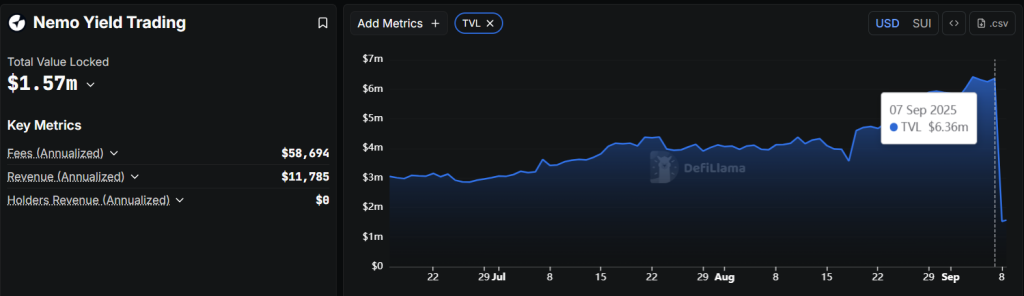
Nemo Protocol Loses $2.4M to Hackers on Sui Blockchain Before Planned MaintenanceSource: DefilLama

User withdrawals exceeded $3.8 million worth of USDC and SUI tokens as investors rushed to exit, fearing the exploit’s scope might be more extensive than initially disclosed.

Nemo Protocol Loses $2.4M to Hackers on Sui Blockchain Before Planned MaintenanceSource: DefilLama

The breach specifically targeted Nemo’s yield-trading mechanism, which enables users to divide staked assets into Principal Tokens (PTs) and Yield Tokens (YTs) for yield speculation purposes.

According to blockchain security auditor CertiK, security risks may arise from multiple sources, including coding errors, blockchain network vulnerabilities, and programming language limitations.

Sui Blockchain Security Crisis Contributed to $2.37 Billion DeFi Losses in 2025

Notably, the Nemo security breach marks the third major hack targeting DeFi protocols this month.

Earlier in September, Venus protocol lost $13.5 million to attackers, followed by an $8.4 million theft from the Bunni protocol.

Similarly, in the Sui ecosystem, the Nemo incident follows another significant breach on the Layer-1 network from earlier this year.

On May 22, Cetus Protocol, a prominent decentralized exchange and liquidity provider, suffered a $223 million exploit.

The attacker leveraged an arithmetic overflow flaw in a third-party code library to complete the drain within 15 minutes.

Moreover, these DeFi-focused attacks are on the rise in 2025.

SlowMist’s mid-year analysis revealed that the blockchain sector experienced over $2.37 billion in losses across 121 security incidents during the first half of the year.

Nemo Protocol Loses $2.4M to Hackers on Sui Blockchain Before Planned MaintenanceSource: SlowMist

DeFi protocols alone accounted for 76% of these cases, although centralized exchanges recorded higher individual losses.

A complementary report from Hacken’s 2025 mid-year security assessment estimated total crypto industry losses at over $3.1 billion within the first six months.

Nemo Protocol Loses $2.4M to Hackers on Sui Blockchain Before Planned MaintenanceSource: Hacken

Access control vulnerabilities, including misconfigured wallets and compromised legacy keys, represented 59% of these losses, while DeFi-specific smart contract exploits accounted for $263 million, or roughly 8%.

A recent interview between Cryptonews and Mitchell Amador, founder and CEO of Immunefi, highlighted why conventional security methodologies prove inadequate in Web3’s open-source ecosystem.

Amador explained that “Traditional audits, being static and pre-launch focused, fail to identify post-deployment vulnerabilities present in dynamic DeFi environments.”

He advocated for bug bounty programs as a solution to incentivize ethical hackers, fundamentally restructuring cybersecurity economics to make defensive measures more lucrative than offensive ones.

Disclaimer: The articles reposted on this site are sourced from public platforms and are provided for informational purposes only. They do not necessarily reflect the views of MEXC. All rights remain with the original authors. If you believe any content infringes on third-party rights, please contact service@support.mexc.com for removal. MEXC makes no guarantees regarding the accuracy, completeness, or timeliness of the content and is not responsible for any actions taken based on the information provided. The content does not constitute financial, legal, or other professional advice, nor should it be considered a recommendation or endorsement by MEXC.

You May Also Like

Aave DAO to Shut Down 50% of L2s While Doubling Down on GHO

Aave DAO to Shut Down 50% of L2s While Doubling Down on GHO

The post Aave DAO to Shut Down 50% of L2s While Doubling Down on GHO appeared on BitcoinEthereumNews.com. Aave DAO is gearing up for a significant overhaul by shutting down over 50% of underperforming L2 instances. It is also restructuring its governance framework and deploying over $100 million to boost GHO. This could be a pivotal moment that propels Aave back to the forefront of on-chain lending or sparks unprecedented controversy within the DeFi community. Sponsored Sponsored ACI Proposes Shutting Down 50% of L2s The “State of the Union” report by the Aave Chan Initiative (ACI) paints a candid picture. After a turbulent period in the DeFi market and internal challenges, Aave (AAVE) now leads in key metrics: TVL, revenue, market share, and borrowing volume. Aave’s annual revenue of $130 million surpasses the combined cash reserves of its competitors. Tokenomics improvements and the AAVE token buyback program have also contributed to the ecosystem’s growth. Aave global metrics. Source: Aave However, the ACI’s report also highlights several pain points. First, regarding the Layer-2 (L2) strategy. While Aave’s L2 strategy was once a key driver of success, it is no longer fit for purpose. Over half of Aave’s instances on L2s and alt-L1s are not economically viable. Based on year-to-date data, over 86.6% of Aave’s revenue comes from the mainnet, indicating that everything else is a side quest. On this basis, ACI proposes closing underperforming networks. The DAO should invest in key networks with significant differentiators. Second, ACI is pushing for a complete overhaul of the “friendly fork” framework, as most have been unimpressive regarding TVL and revenue. In some cases, attackers have exploited them to Aave’s detriment, as seen with Spark. Sponsored Sponsored “The friendly fork model had a good intention but bad execution where the DAO was too friendly towards these forks, allowing the DAO only little upside,” the report states. Third, the instance model, once a smart…
Share
BitcoinEthereumNews2025/09/18 02:28
Shytoshi Kusama Addresses $2.4 Million Shibarium Bridge Exploit

Shytoshi Kusama Addresses $2.4 Million Shibarium Bridge Exploit

The post Shytoshi Kusama Addresses $2.4 Million Shibarium Bridge Exploit appeared on BitcoinEthereumNews.com. The lead developer of Shiba Inu, Shytoshi Kusama, has publicly addressed the Shibarium bridge exploit that occurred recently, draining $2.4 million from the network. After days of speculation about his involvement in managing the crisis, the project leader broke his silence. Kusama emphasized that a special “war room” has been set up to restore stolen finances and enhance network security. The statement is his first official words since the bridge compromise occurred. “Although I am focusing on AI initiatives to benefit all our tokens, I remain with the developers and leadership in the war room,” Kusama posted on social media platform X. He dismissed claims that he had distanced himself from the project as “utterly preposterous.” The developer said that the reason behind his silence at first was strategic. Before he could make any statements publicly, he must have taken time to evaluate what he termed a complex and deep situation properly. Kusama also vowed to provide further updates in the official Shiba Inu channels as the team comes up with long-term solutions. As highlighted in our previous article, targeted Shibarium’s bridge infrastructure through a sophisticated attack vector. Hackers gained unauthorized access to validator signing keys, compromising the network’s security framework. The hackers executed a flash loan to acquire 4.6 million BONE ShibaSwap tokens. The validator power on the network was majority held by them after this purchase. They were able to transfer assets out of Shibarium with this control. The response of Shibarium developers was timely to limit the breach. They instantly halted all validator functions in order to avoid additional exploitation. The team proceeded to deposit the assets under staking in a multisig hardware wallet that is secure. External security companies were involved in the investigation effort. Hexens, Seal 911, and PeckShield are collaborating with internal developers to…
Share
BitcoinEthereumNews2025/09/18 03:46
