This article explores how physics-informed neural networks (PINNs) can simulate shock wave generation, interactions, and entropy solutions. Using Burgers’ equation as a test case, the models accurately handle wave formation, collisions, and rarefaction without prior knowledge of origin points. The results highlight how deep learning can advance computational fluid dynamics by tackling problems once limited to traditional numerical methods.This article explores how physics-informed neural networks (PINNs) can simulate shock wave generation, interactions, and entropy solutions. Using Burgers’ equation as a test case, the models accurately handle wave formation, collisions, and rarefaction without prior knowledge of origin points. The results highlight how deep learning can advance computational fluid dynamics by tackling problems once limited to traditional numerical methods.

Shocks, Collisions, and Entropy—Neural Networks Handle It All

2025/09/20 19:00

Abstract and 1. Introduction

1.1. Introductory remarks

1.2. Basics of neural networks

1.3. About the entropy of direct PINN methods

1.4. Organization of the paper

  1. Non-diffusive neural network solver for one dimensional scalar HCLs

    2.1. One shock wave

    2.2. Arbitrary number of shock waves

    2.3. Shock wave generation

    2.4. Shock wave interaction

    2.5. Non-diffusive neural network solver for one dimensional systems of CLs

    2.6. Efficient initial wave decomposition

  2. Gradient descent algorithm and efficient implementation

    3.1. Classical gradient descent algorithm for HCLs

    3.2. Gradient descent and domain decomposition methods

  3. Numerics

    4.1. Practical implementations

    4.2. Basic tests and convergence for 1 and 2 shock wave problems

    4.3. Shock wave generation

    4.4. Shock-Shock interaction

    4.5. Entropy solution

    4.6. Domain decomposition

    4.7. Nonlinear systems

  4. Conclusion and References

4.3. Shock wave generation

In this section, we demonstrate the potential of our algorithms to handle shock wave generation, as described in Subsection 2.3. One of the strengths of the proposed algorithm

\
\ is that it does not require to know the initial position&time of birth, in order to accurately track the DLs. Recall that the principle is to assume that in a given (sub)domain and from a smooth function a shock wave will eventually be generated. Hence we decompose the corresponding (sub)domain in two subdomains and consider three neural networks: two neural networks will approximate the solution in each subdomain, and one neural network will approximate the DL. As long as the shock wave is not generated (say for t < t∗ ), the global solution remains smooth and the Rankine-Hugoniot condition is trivially satisfied (null jump); hence the DL for t < t∗ does not have any meaning.

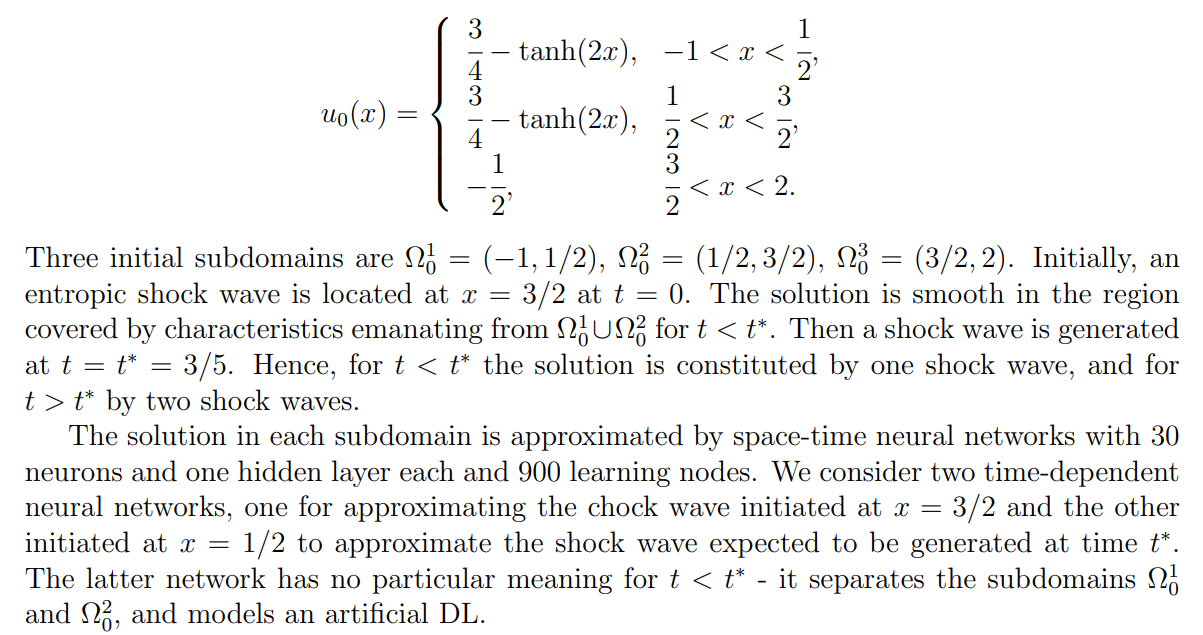
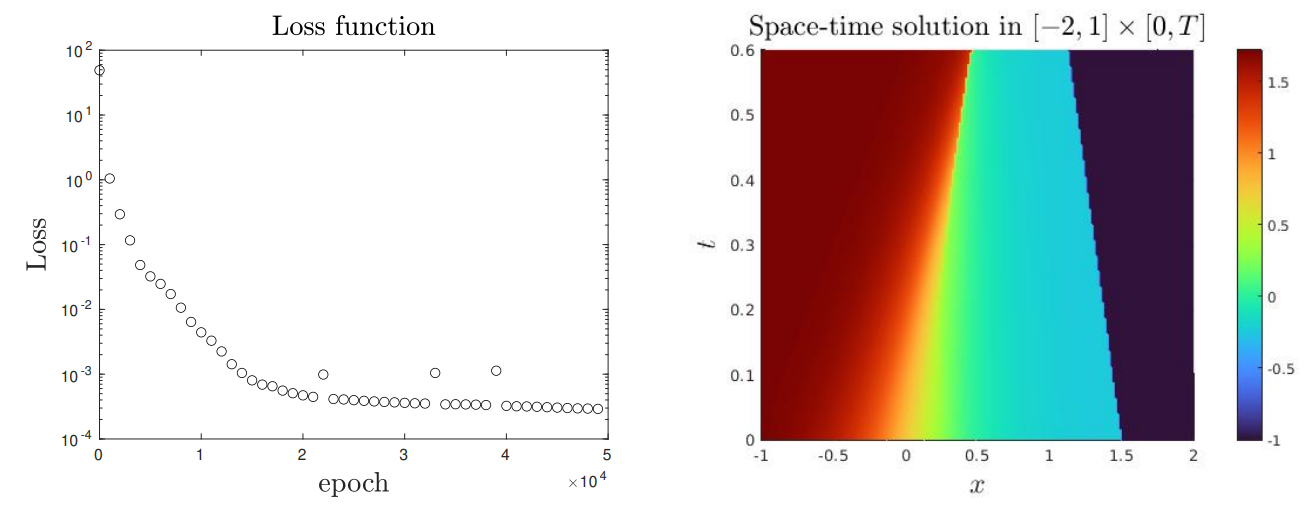
\ Experiment 4. We again consider the inviscid Burgers’ equation, Ω × [0, T] = (−1, 2) × [0, 0.5] and the initial condition

\
\
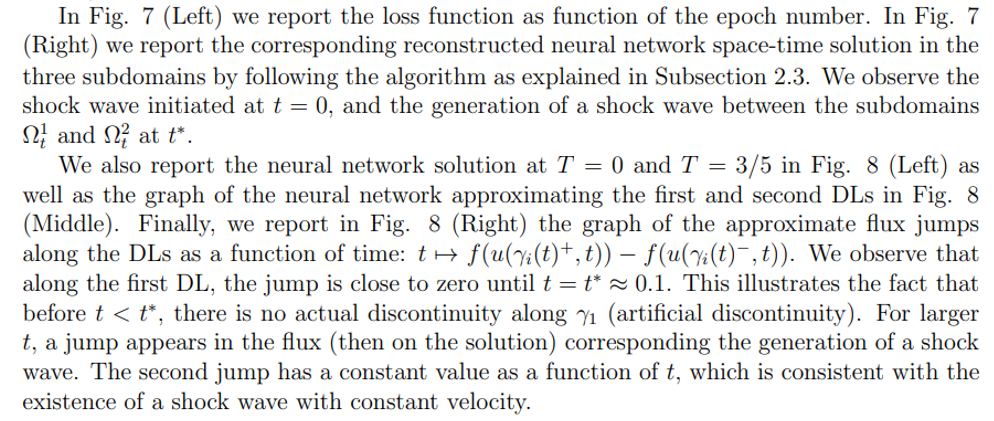
\ Figure 7: Experiment 4. (Left) Loss function. (Right) Space-time solution
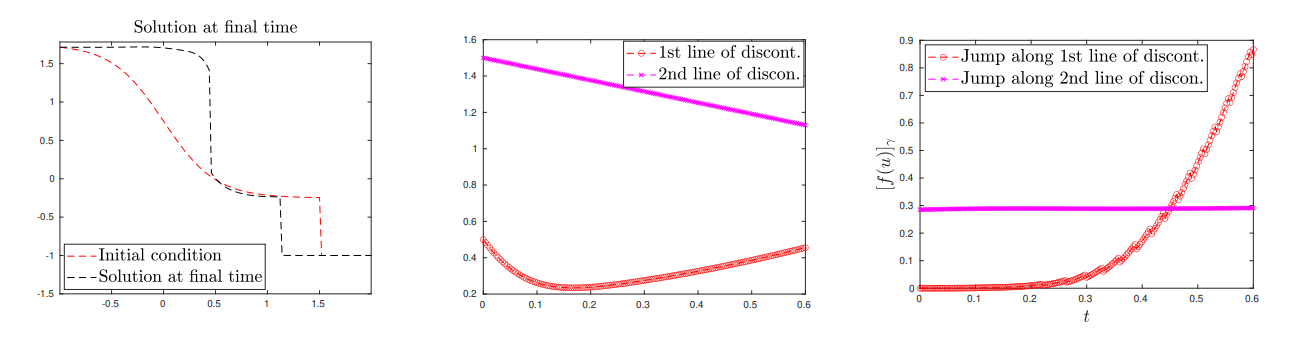
\ Figure 8: Experiment 4. (Left) Graph of the solution at T = 3/5. (Middle) Discontinuity lines. (Right) Flux jump along the DLs.

\

4.4. Shock-Shock interaction

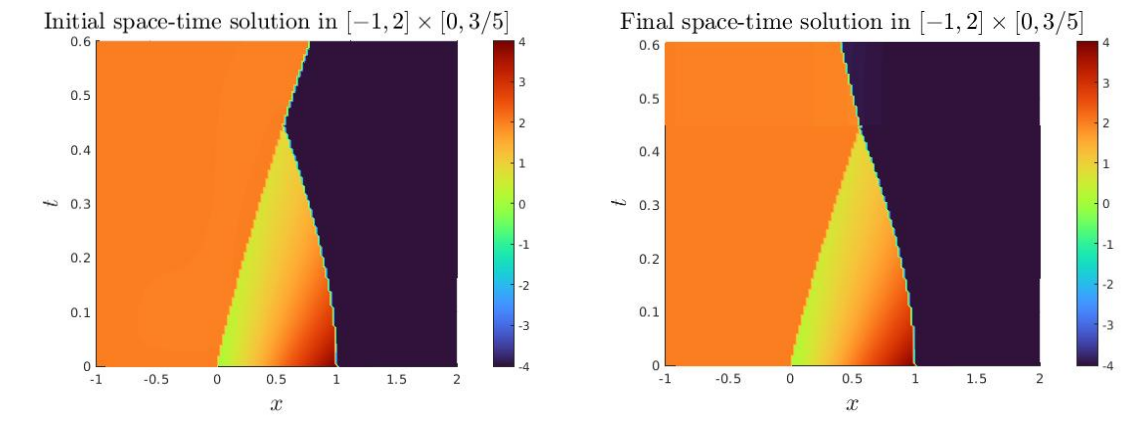
In this subsection, we are proposing a test involving the interaction of two shock waves merging to generate a third shock wave. As explained in Subsection 2.4, in this case it is necessary re-decompose the full domain once the two shock waves have interacted.

\ \
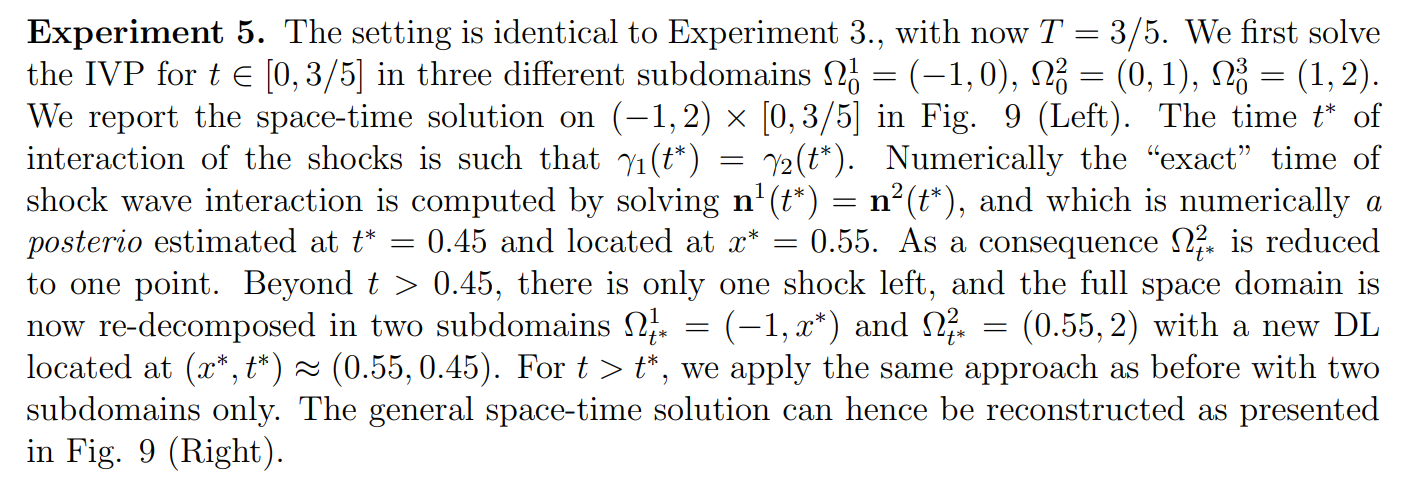
\ \ \ Figure 9: Experiment 5. (Left) Space-time solution without shock interaction (artificial for t > t∗ = 0.45. (Right) Space-time solution with shock interaction.
\

4.5. Entropy solution

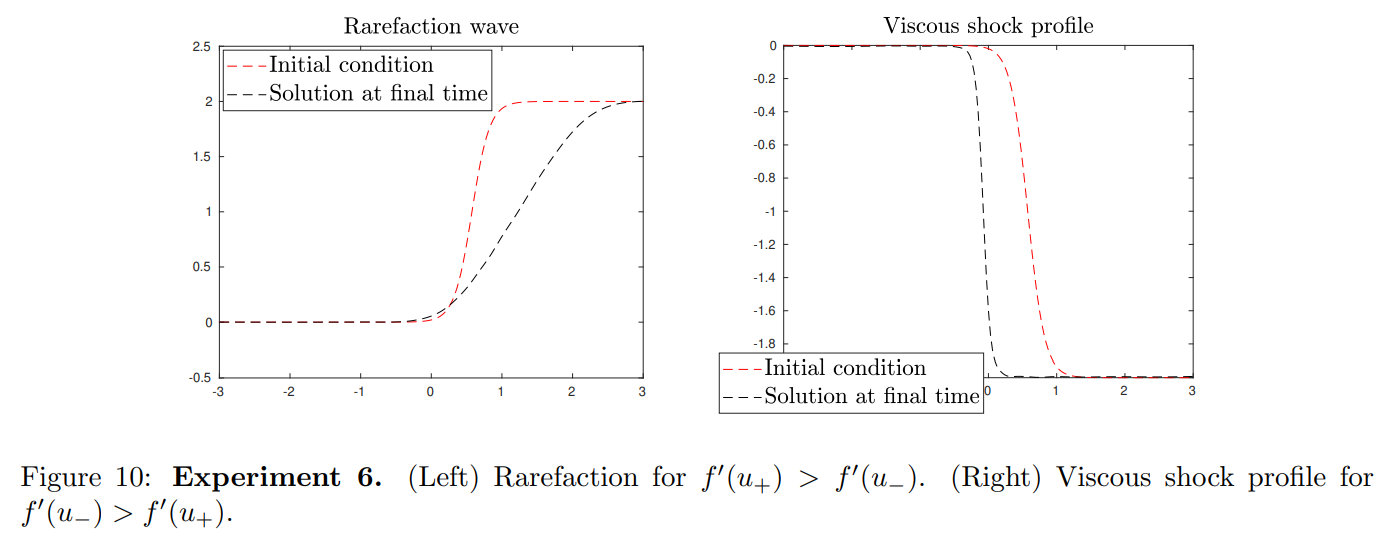
We propose here an experiment dedicated to the computation of the viscous shock profiles and rarefaction waves and illustrating the discussion from Subsection 1.3. In this example, a regularized non-entropic shock is shown to be “destabilized” into rarefaction wave by the direct PINN method.

\ \

\ \ \ \

\ \ \
\ \

:::info Authors:

(1) Emmanuel LORIN, School of Mathematics and Statistics, Carleton University, Ottawa, Canada, K1S 5B6 and Centre de Recherches Mathematiques, Universit´e de Montr´eal, Montreal, Canada, H3T 1J4 (elorin@math.carleton.ca);

(2) Arian NOVRUZI, a Corresponding Author from Department of Mathematics and Statistics, University of Ottawa, Ottawa, ON K1N 6N5, Canada (novruzi@uottawa.ca).

:::


:::info This paper is available on arxiv under CC by 4.0 Deed (Attribution 4.0 International) license.

:::

\

Disclaimer: The articles reposted on this site are sourced from public platforms and are provided for informational purposes only. They do not necessarily reflect the views of MEXC. All rights remain with the original authors. If you believe any content infringes on third-party rights, please contact service@support.mexc.com for removal. MEXC makes no guarantees regarding the accuracy, completeness, or timeliness of the content and is not responsible for any actions taken based on the information provided. The content does not constitute financial, legal, or other professional advice, nor should it be considered a recommendation or endorsement by MEXC.

You May Also Like

Little Pepe soars from presale to market spotlight

Little Pepe soars from presale to market spotlight

The post Little Pepe soars from presale to market spotlight appeared on BitcoinEthereumNews.com. Disclosure: This article does not represent investment advice. The content and materials featured on this page are for educational purposes only. Early investors often capture the biggest rewards in crypto, and Little Pepe, priced under $0.005, is emerging as a memecoin that could rival big players. Summary LILPEPE has sold over 15 billion tokens in its presale, raising $25.4 million. The project’s community has grown to more than 41,000 holders and 30,000 Telegram members. Analysts suggest the token could see gains of up to 55x in two years and 100x by 2030. Crypto enthusiasts are aware that early investors tend to benefit the most from the market. Ripple (XRP) and Solana (SOL) are popular tokens that have profited traders. Little Pepe (LILPEPE), valued at less than $0.005, might produce more profit. LILPEPE is swiftly gaining popularity despite its recent introduction. Little Pepe: The market-changing memecoin Little Pepe has surprised everyone with its quick surge in cryptocurrencies. LILPEPE is becoming a popular meme currency. Its presale price is below $0.003. Strong foundations, a distinct market presence, and a developing and enthusiastic community distinguish it from other meme tokens. Many meme currencies use hype to attract investors, but LILPEPE’s rarity, community support, and distinctive roadmap have effectively drawn them in. Currently in its 13th presale stage, more than 15 billion tokens have been sold, generating over $25.4 million and sparking considerable interest. As the token approaches official listing, enthusiasm is growing, and many people believe it could be one of the following major memecoin success stories. LILPEPE’s growing community drives growth The strong community surrounding LILPEPE is a primary reason for its success. LILPEPE has built a loyal following of over 41,000 holders and about 30,000 active members on Telegram. Its rise is being fueled by this. The support of its community…
Share
BitcoinEthereumNews2025/09/19 15:12