šŸ“Œ Table of Contents What is Sui? The Silicon Valley Blockchain Revolution From Facebook’s Crypto Ruins: The Birth of Sui Move Language & Performance: Why Sui is Different Ecosystem & Partnerships: Where Sui Stands Today Real-World Applications: DeFi, NFTs & Gaming SUI Tokenomics Explained Sui in 2025: Growth, Challenges & Milestones FAQ: 10 Unanswered Questions [...]]]>šŸ“Œ Table of Contents What is Sui? The Silicon Valley Blockchain Revolution From Facebook’s Crypto Ruins: The Birth of Sui Move Language & Performance: Why Sui is Different Ecosystem & Partnerships: Where Sui Stands Today Real-World Applications: DeFi, NFTs & Gaming SUI Tokenomics Explained Sui in 2025: Growth, Challenges & Milestones FAQ: 10 Unanswered Questions [...]]]>

Sui Blockchain Explained (2025): Move Language, High-Speed Layer-1 & The Future of Web3

2025/10/02 21:16

šŸ“Œ Table of Contents

  • What is Sui? The Silicon Valley Blockchain Revolution
  • From Facebook’s Crypto Ruins: The Birth of Sui
  • Move Language & Performance: Why Sui is Different
  • Ecosystem & Partnerships: Where Sui Stands Today
  • Real-World Applications: DeFi, NFTs & Gaming
  • SUI Tokenomics Explained
  • Sui in 2025: Growth, Challenges & Milestones
  • FAQ: 10 Unanswered Questions About Sui

šŸš€ What is Sui? The Silicon Valley Blockchain Revolution

While Ethereum struggles with scalability, a new blockchain from Silicon Valley promises a revolution: Can Sui deliver what others only claim?

šŸŒ From Facebook’s Crypto Ruins: The Birth of Sui

Sui was born in 2022 when former engineers from Meta’s failed Diem project founded Mysten Labs. Drawing on years of experience in high-performance systems, they launched Sui’s mainnet in May 2023 with backing from a16z and Coinbase Ventures. The vision: a blockchain for mass adoption, especially in gaming, NFTs, and DeFi, but without the regulatory baggage that doomed Facebook’s Libra.
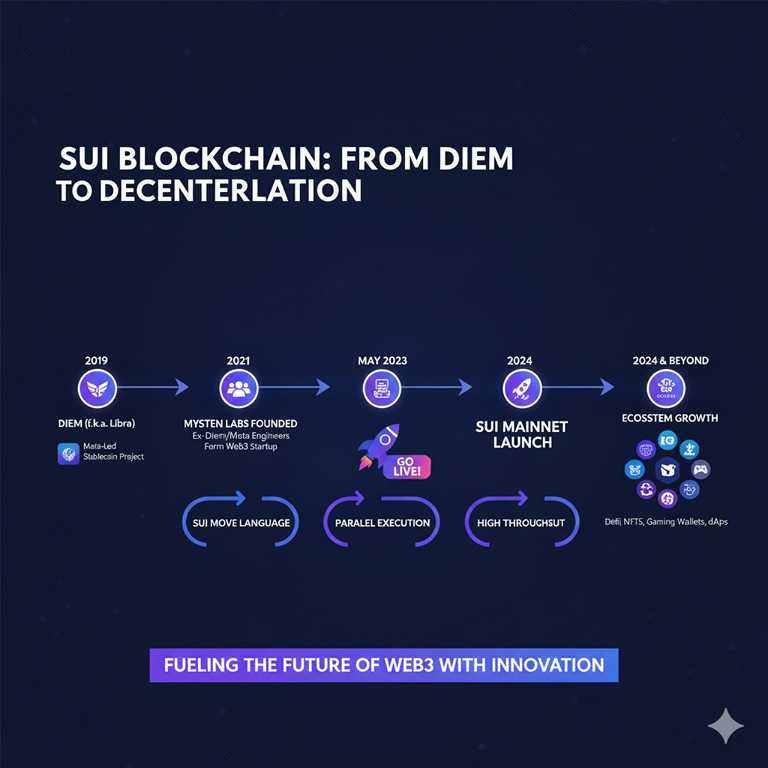
graphic illustrating the progression from Diem to Mysten Labs, the Sui Mainnet Launch in 2023, and subsequent Ecosystem Growth

āš™ Move Language & Performance: Why Sui is Different

At the heart of Sui lies the Move programming language, developed for Diem but now fully unleashed. Unlike Ethereum’s Solidity, Move treats digital assets as independent objects with their own properties. This architecture allows Sui to theoretically handle 100,000+ TPS with <400ms latency, dwarfing Ethereum’s 15 TPS.

BlockchainTransactions per Second (TPS)Latency
Ethereum (Mainnet)~15>10 seconds
Solana~65,000 (theoretical)400–600ms
Sui100,000+<400ms

🌐 Ecosystem & Partnerships: Where Sui Stands Today

The strength of a blockchain lies in its ecosystem. In DeFi, Cetus Protocol has emerged as Sui’s leading DEX, while Scallop provides lending and borrowing infrastructure. In NFTs and gaming, BlueMove and OriginX show promise, though liquidity still trails Solana and Avalanche.
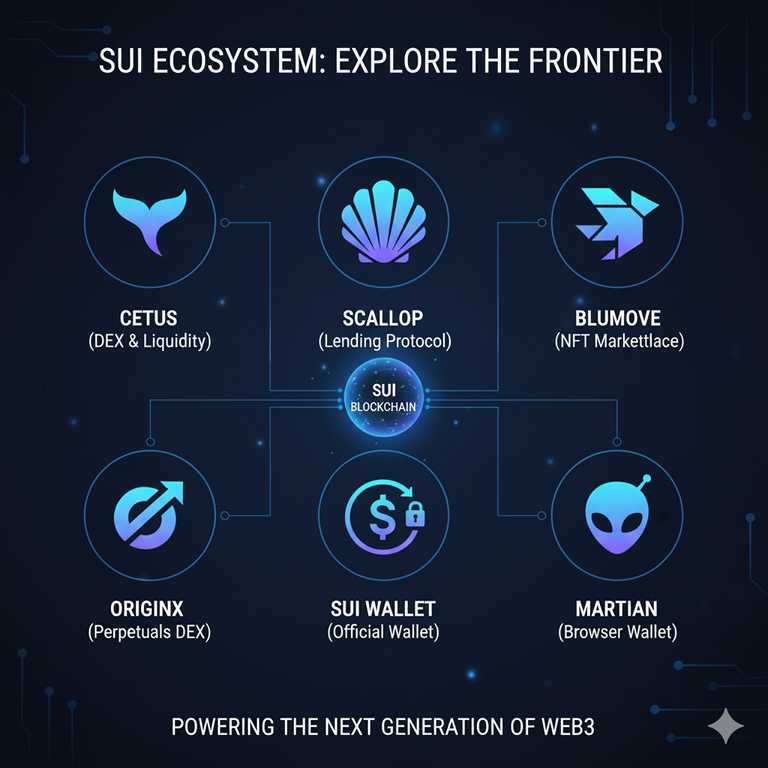
ogos of Cetus, Scallop, BlueMove, OriginX, Sui Wallet, and Martian

šŸŽ® Real-World Applications: DeFi, NFTs & Gaming

Sui demonstrates strengths beyond theory:

  • DeFi: Near-instant token swaps, low slippage, minimal fees.
  • NFTs: Affordable minting for small creators, unlike Ethereum’s gas-heavy model.
  • Gaming: Cost-effective, high-frequency asset transactions for in-game economies.
  • Micropayments: Content creators can sell digital goods for cents—unviable on Ethereum.

šŸ’° SUI Tokenomics Explained

Sui has a fixed max supply of 10 billion SUI, unlike Ethereum’s theoretically unlimited supply. Token utilities include:

  1. Transaction fees
  2. Staking for validator security
  3. Governance rights

UtilityFunctionCurrent Impact
FeesKeep the network runningUltra-low compared to Ethereum
StakingValidators secure the networkRewards ~3–5% annually
GovernanceProtocol upgrade votingGrowing role in decision-making

šŸ“° Sui in 2025: Growth, Challenges & Milestones

2025 brought new gaming partnerships (often under NDA), steady DeFi growth, and improved NFT marketplace activity. Network upgrades further reduced latency, underscoring Sui’s tech advantage. Yet, mass adoption remains elusive, with active wallets and daily transactions still below major competitors.

ā“ FAQ: 10 Unanswered Questions About Sui

1. Can Sui maintain its performance under massive real-world usage?
Current stress tests demonstrate impressive throughput and low latency, but true scalability will only be proven once millions of users and complex dApps interact on-chain simultaneously. Network upgrades planned for 2025–2026 aim to address this.
2. How does Sui handle regulatory compliance compared to Ethereum or Solana?
Unlike Facebook’s Libra, Sui does not face direct political scrutiny. Mysten Labs structures partnerships with regional incubators and ensures projects follow local KYC/AML requirements. However, global regulatory harmonization remains a challenge.
3. Will Sui become the go-to blockchain for gaming?
Sui’s architecture is ideal for gaming—low fees and fast transactions fit in-game economies. Several studios are already testing pilots, but it must still compete with Solana, ImmutableX, and Polygon, which have established ecosystems.
4. How sustainable are Sui’s staking rewards long term?
Initial staking rewards range from 3–5% annually. As circulating supply grows via token unlocks, yields will likely decrease. Long-term sustainability depends on balancing validator incentives with token scarcity.
5. What risks exist for early investors and token unlocks?
Vesting schedules gradually release tokens into circulation, which could pressure prices if demand does not scale equally. Institutional holders could realize gains, creating volatility during major unlock periods.
6. Does Sui plan to support Layer-2 or cross-chain interoperability?
Discussions around cross-chain bridges and interoperability with Ethereum Virtual Machine (EVM) ecosystems are ongoing. While promising, no fully deployed Layer-2 solutions exist yet. Integration with Cosmos IBC and other protocols may follow.
7. How does Sui secure against validator centralization risks?
Sui uses Proof-of-Stake, where decentralization depends on validator distribution. Mysten Labs encourages broad staking participation, but avoiding dominance by a few validators remains a core governance challenge.
8. Can Sui challenge Solana and Ethereum in DeFi liquidity depth?
Sui’s DeFi protocols (like Cetus and Scallop) show steady growth, but liquidity remains a fraction of Solana or Ethereum. For Sui to compete, it must attract larger capital inflows and cross-chain liquidity providers.
9. How attractive is Sui for NFT creators compared to Polygon?
Sui provides cheaper and faster NFT minting, which helps small artists. However, Polygon’s strong marketplace integrations and partnerships with brands give it a stronger network effect. Adoption will depend on whether Sui can onboard major NFT platforms.
10. What milestones must Sui hit in 2026 for mass adoption?
Key milestones include:
– Launching robust developer tools and SDKs
– Scaling gaming integrations with AAA studios
– Expanding liquidity depth in DeFi
– Growing daily active wallets beyond competitors
If achieved, Sui could emerge as a mainstream Layer-1 contender.
]]>
Disclaimer: The articles reposted on this site are sourced from public platforms and are provided for informational purposes only. They do not necessarily reflect the views of MEXC. All rights remain with the original authors. If you believe any content infringes on third-party rights, please contact service@support.mexc.com for removal. MEXC makes no guarantees regarding the accuracy, completeness, or timeliness of the content and is not responsible for any actions taken based on the information provided. The content does not constitute financial, legal, or other professional advice, nor should it be considered a recommendation or endorsement by MEXC.

You May Also Like

SEC issues investor guide on crypto wallets and custody risks

SEC issues investor guide on crypto wallets and custody risks

The SEC released a guide on crypto wallets and custody for investors.
Share
Cryptopolitan2025/12/14 08:38
UK Looks to US to Adopt More Crypto-Friendly Approach

UK Looks to US to Adopt More Crypto-Friendly Approach

The post UK Looks to US to Adopt More Crypto-Friendly Approach appeared on BitcoinEthereumNews.com. The UK and US are reportedly preparing to deepen cooperation on digital assets, with Britain looking to copy the Trump administration’s crypto-friendly stance in a bid to boost innovation.Ā  UK Chancellor Rachel Reeves and US Treasury Secretary Scott Bessent discussed on Tuesday how the two nations could strengthen their coordination on crypto, the Financial Times reported on Tuesday, citing people familiar with the matter.Ā  The discussions also involved representatives from crypto companies, including Coinbase, Circle Internet Group and Ripple, with executives from the Bank of America, Barclays and Citi also attending, according to the report. The agreement was made ā€œlast-minuteā€ after crypto advocacy groups urged the UK government on Thursday to adopt a more open stance toward the industry, claiming its cautious approach to the sector has left the country lagging in innovation and policy.Ā  Source: Rachel Reeves Deal to include stablecoins, look to unlock adoption Any deal between the countries is likely to include stablecoins, the Financial Times reported, an area of crypto that US President Donald Trump made a policy priority and in which his family has significant business interests. The Financial Times reported on Monday that UK crypto advocacy groups also slammed the Bank of England’s proposal to limit individual stablecoin holdings to between 10,000 British pounds ($13,650) and 20,000 pounds ($27,300), claiming it would be difficult and expensive to implement. UK banks appear to have slowed adoption too, with around 40% of 2,000 recently surveyed crypto investors saying that their banks had either blocked or delayed a payment to a crypto provider.Ā  Many of these actions have been linked to concerns over volatility, fraud and scams. The UK has made some progress on crypto regulation recently, proposing a framework in May that would see crypto exchanges, dealers, and agents treated similarly to traditional finance firms, with…
Share
BitcoinEthereumNews2025/09/18 02:21