When was the last time you heard of a billion-dollar funding round for Web3? On October 7, 2025, the prediction market Polymarket officially announced that the Intercontinental Exchange (ICE), the parent company of the New York Stock Exchange, would make a strategic investment of US$2 billion in it, with a post-investment valuation of up to US$9 billion. This is not only one of the highest financing amounts obtained by a Web3 project in recent years, but also pushes the potential and popularity of the prediction market to the center of the stage. Interestingly, the competition has been accelerating visibly in recent times, whether it’s decentralized players like Hyperliquid joining the fray or compliant latecomers like Kalshi accelerating their efforts to catch up. Behind this, it is not only about who will dominate the future prediction market, but also about how to financialize all uncertainties in the real world. From Polymarket to Kalshi, multiple blossoms Decentralized prediction markets have always been one of the important practical tracks for early blockchain applications. For example, I frequently saw examples of old players such as Augur in many popular science books many years ago. Whether it is elections, weather, inflation, sports or IPOs, users can directly trade "yes/no" contracts on a decentralized platform. But in fact, although the concept was proposed early, it was not until the emergence of Polymarket that the concept was truly broken out of the circle, and this was largely inseparable from the boost from the 2024 US presidential election: Against the backdrop of traditional polls generally favoring one side, Polymarket ultimately demonstrated, with its accurate predictions and verifiable price signals that surpassed polls, that this decentralized prediction market, which uses "real money" to vote, has extremely high reference value for observing market trends. This has also led to Polymarket becoming a frequent probability reference source cited by mainstream media in different events in the past six months. However, the prediction market has been struggling with the shackles of compliance. For example, in 2022, Polymarket was fined $1.4 million by the U.S. Commodity Futures Trading Commission (CFTC) for operating an unregistered derivatives market and was banned from providing services to U.S. users. In the past two years, Kalshi, which was established earlier than Polymarket, has emerged as a dark horse and chosen a path focused on compliance - becoming the first prediction market platform regulated by the U.S. Commodity Futures Trading Commission (CFTC). In October 2024, a federal court also ruled that it was allowed to launch the first regulated election market in the United States, which also made Kalshi's regulatory position more solid. Source: polymarketanalytics As of October 10, 2025, a comparison of Polymarket and Kalshi data shows that, in addition to the total trading volume of Polymarket being $1.3 billion vs $410 million, which is a significant lead, Polymarket has fallen behind Kalshi in terms of the number of markets (10,200 vs 43,500) and open interest (US$170 million vs US$240 million). It is worth noting that in order to return to the US market, Polymarket actually adopted a compliance grafting strategy this year: as early as July, it acquired QCX LLC, a trading platform holding a CFTC license, for US$112 million and has begun self-certification of event contracts including sports events and election markets. This is also likely a combination of the latest $2 billion in financing, and Polymarket CEO Shayne Coplan also posted a tweet with the POLY symbol on October 9, which may become a key variable in the competition between the two giants. From prediction markets to larger parent sets Many people may be curious about why ICE, the parent company of the New York Stock Exchange, made a huge bet of $2 billion on Polymarket? This requires going beyond Web3 and understanding the prediction market from a larger financial perspective. First of all, ICE has been actively deploying in the Crypto field, including deploying crypto financial products through its parent company and multiple affiliated entities over the years, gradually covering targets such as Bitcoin spot and futures contracts, as well as the well-known crypto trading platform Bakkt. Secondly, the prediction market is essentially a subset of the "trading platform", or another form of presentation. For example, Polymarket has many price prediction bets for mainstream crypto assets such as BTC and ETH at different time points such as the end of October and the end of the year. Theoretically, if the time nodes for predicting fulfillment are infinitely subdivided, from the end of the year to the end of today, to 1 minute later, and 1 second later, then this essentially becomes an instant "bet" (buying and selling behavior) on the trading platform. Perhaps what ICE values is this ability to financialize all uncertainties, which can expand the boundaries of existing derivatives markets such as futures and options. Therefore, platforms like Polymarket, with their vast user base and trading volume, can serve as a key entry point for ICE Group's future structured financial products, institutional hedging tools, and information pricing services. In other words, ICE isn't focused on a single application, but rather on the potential of the prediction market to "derivative everything"—the uncertainty. For this reason, in addition to the competition between Polymarket and Kalshi, which is more like a specialized path for event markets, decentralized players such as Hyperliquid have also begun to explore a hybrid path of inserting prediction modules at the entrance of high-performance contract platforms. Both paths have their own advantages and disadvantages, but they may also complement or compete with each other in the future. New variables for decentralized players like Hyperliquid For example, the HIP-3 proposal passed by Hyperliquid introduced a permissionless, developer-deployed perpetual contract market on the core infrastructure. Previously, only the core team could list trading pairs, but now any user who pledges 1 million HYPE can deploy their own market directly on the chain. In short, HIP-3 allows the permissionless creation and listing of derivatives markets for any asset on Hyperliquid, which completely breaks the limitation that Perp DEX could only trade mainstream cryptocurrencies in the past. This not only means an open contract deployment mechanism, but also lays the technical foundation for subsequent prediction market modules. In the future, users on Hyperliquid may be able to directly trade such markets: Will the Fed cut interest rates at its next meeting? "Will BTC break through $70,000 this week?" "Will Arbitrum TVL exceed Base at the end of the month?" Under this architecture, the prediction market is no longer an independent track, but a sub-module in the on-chain high-performance derivatives system. And because it reuses Hyperliquid's matching depth, clearing system and order book logic, it naturally has higher transaction efficiency and capital utilization. In comparison, Polymarket's model is more inclined towards "event trading" and Hyperliquid's model is more inclined towards "price trading" - one starts from information and the other starts from structure, but both point to the same end: allowing future probabilities to be priced instantly by the market. Final Thoughts Overall, with the involvement of heavyweight decentralized players like Hyperliquid and ICE’s $2 billion investment, the prediction market is no longer just a tool for people to “bet” or “predict the future”, but has become a frontier for institutions, analysts, and even central banks to observe market sentiment. This also means that it is no longer just a paradise for speculators, but is rapidly transforming into a highly efficient and highly liquid financial derivatives market, becoming an indispensable financial primitive in the DeFi infrastructure.When was the last time you heard of a billion-dollar funding round for Web3? On October 7, 2025, the prediction market Polymarket officially announced that the Intercontinental Exchange (ICE), the parent company of the New York Stock Exchange, would make a strategic investment of US$2 billion in it, with a post-investment valuation of up to US$9 billion. This is not only one of the highest financing amounts obtained by a Web3 project in recent years, but also pushes the potential and popularity of the prediction market to the center of the stage. Interestingly, the competition has been accelerating visibly in recent times, whether it’s decentralized players like Hyperliquid joining the fray or compliant latecomers like Kalshi accelerating their efforts to catch up. Behind this, it is not only about who will dominate the future prediction market, but also about how to financialize all uncertainties in the real world. From Polymarket to Kalshi, multiple blossoms Decentralized prediction markets have always been one of the important practical tracks for early blockchain applications. For example, I frequently saw examples of old players such as Augur in many popular science books many years ago. Whether it is elections, weather, inflation, sports or IPOs, users can directly trade "yes/no" contracts on a decentralized platform. But in fact, although the concept was proposed early, it was not until the emergence of Polymarket that the concept was truly broken out of the circle, and this was largely inseparable from the boost from the 2024 US presidential election: Against the backdrop of traditional polls generally favoring one side, Polymarket ultimately demonstrated, with its accurate predictions and verifiable price signals that surpassed polls, that this decentralized prediction market, which uses "real money" to vote, has extremely high reference value for observing market trends. This has also led to Polymarket becoming a frequent probability reference source cited by mainstream media in different events in the past six months. However, the prediction market has been struggling with the shackles of compliance. For example, in 2022, Polymarket was fined $1.4 million by the U.S. Commodity Futures Trading Commission (CFTC) for operating an unregistered derivatives market and was banned from providing services to U.S. users. In the past two years, Kalshi, which was established earlier than Polymarket, has emerged as a dark horse and chosen a path focused on compliance - becoming the first prediction market platform regulated by the U.S. Commodity Futures Trading Commission (CFTC). In October 2024, a federal court also ruled that it was allowed to launch the first regulated election market in the United States, which also made Kalshi's regulatory position more solid. Source: polymarketanalytics As of October 10, 2025, a comparison of Polymarket and Kalshi data shows that, in addition to the total trading volume of Polymarket being $1.3 billion vs $410 million, which is a significant lead, Polymarket has fallen behind Kalshi in terms of the number of markets (10,200 vs 43,500) and open interest (US$170 million vs US$240 million). It is worth noting that in order to return to the US market, Polymarket actually adopted a compliance grafting strategy this year: as early as July, it acquired QCX LLC, a trading platform holding a CFTC license, for US$112 million and has begun self-certification of event contracts including sports events and election markets. This is also likely a combination of the latest $2 billion in financing, and Polymarket CEO Shayne Coplan also posted a tweet with the POLY symbol on October 9, which may become a key variable in the competition between the two giants. From prediction markets to larger parent sets Many people may be curious about why ICE, the parent company of the New York Stock Exchange, made a huge bet of $2 billion on Polymarket? This requires going beyond Web3 and understanding the prediction market from a larger financial perspective. First of all, ICE has been actively deploying in the Crypto field, including deploying crypto financial products through its parent company and multiple affiliated entities over the years, gradually covering targets such as Bitcoin spot and futures contracts, as well as the well-known crypto trading platform Bakkt. Secondly, the prediction market is essentially a subset of the "trading platform", or another form of presentation. For example, Polymarket has many price prediction bets for mainstream crypto assets such as BTC and ETH at different time points such as the end of October and the end of the year. Theoretically, if the time nodes for predicting fulfillment are infinitely subdivided, from the end of the year to the end of today, to 1 minute later, and 1 second later, then this essentially becomes an instant "bet" (buying and selling behavior) on the trading platform. Perhaps what ICE values is this ability to financialize all uncertainties, which can expand the boundaries of existing derivatives markets such as futures and options. Therefore, platforms like Polymarket, with their vast user base and trading volume, can serve as a key entry point for ICE Group's future structured financial products, institutional hedging tools, and information pricing services. In other words, ICE isn't focused on a single application, but rather on the potential of the prediction market to "derivative everything"—the uncertainty. For this reason, in addition to the competition between Polymarket and Kalshi, which is more like a specialized path for event markets, decentralized players such as Hyperliquid have also begun to explore a hybrid path of inserting prediction modules at the entrance of high-performance contract platforms. Both paths have their own advantages and disadvantages, but they may also complement or compete with each other in the future. New variables for decentralized players like Hyperliquid For example, the HIP-3 proposal passed by Hyperliquid introduced a permissionless, developer-deployed perpetual contract market on the core infrastructure. Previously, only the core team could list trading pairs, but now any user who pledges 1 million HYPE can deploy their own market directly on the chain. In short, HIP-3 allows the permissionless creation and listing of derivatives markets for any asset on Hyperliquid, which completely breaks the limitation that Perp DEX could only trade mainstream cryptocurrencies in the past. This not only means an open contract deployment mechanism, but also lays the technical foundation for subsequent prediction market modules. In the future, users on Hyperliquid may be able to directly trade such markets: Will the Fed cut interest rates at its next meeting? "Will BTC break through $70,000 this week?" "Will Arbitrum TVL exceed Base at the end of the month?" Under this architecture, the prediction market is no longer an independent track, but a sub-module in the on-chain high-performance derivatives system. And because it reuses Hyperliquid's matching depth, clearing system and order book logic, it naturally has higher transaction efficiency and capital utilization. In comparison, Polymarket's model is more inclined towards "event trading" and Hyperliquid's model is more inclined towards "price trading" - one starts from information and the other starts from structure, but both point to the same end: allowing future probabilities to be priced instantly by the market. Final Thoughts Overall, with the involvement of heavyweight decentralized players like Hyperliquid and ICE’s $2 billion investment, the prediction market is no longer just a tool for people to “bet” or “predict the future”, but has become a frontier for institutions, analysts, and even central banks to observe market sentiment. This also means that it is no longer just a paradise for speculators, but is rapidly transforming into a highly efficient and highly liquid financial derivatives market, becoming an indispensable financial primitive in the DeFi infrastructure.

The "prediction market" breaks through the circle: ICE enters the market, Hyperliquid increases its investment, why are the giants competing for "pricing uncertainty"?

2025/10/11 16:00

When was the last time you heard of a billion-dollar funding round for Web3?

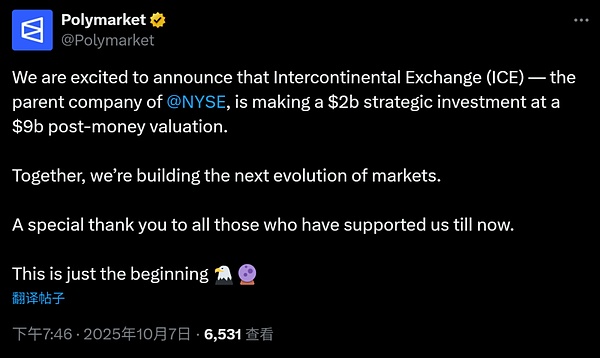
On October 7, 2025, the prediction market Polymarket officially announced that the Intercontinental Exchange (ICE), the parent company of the New York Stock Exchange, would make a strategic investment of US$2 billion in it, with a post-investment valuation of up to US$9 billion. This is not only one of the highest financing amounts obtained by a Web3 project in recent years, but also pushes the potential and popularity of the prediction market to the center of the stage.

Interestingly, the competition has been accelerating visibly in recent times, whether it’s decentralized players like Hyperliquid joining the fray or compliant latecomers like Kalshi accelerating their efforts to catch up.

Behind this, it is not only about who will dominate the future prediction market, but also about how to financialize all uncertainties in the real world.
From Polymarket to Kalshi, multiple blossoms

Decentralized prediction markets have always been one of the important practical tracks for early blockchain applications. For example, I frequently saw examples of old players such as Augur in many popular science books many years ago. Whether it is elections, weather, inflation, sports or IPOs, users can directly trade "yes/no" contracts on a decentralized platform.

But in fact, although the concept was proposed early, it was not until the emergence of Polymarket that the concept was truly broken out of the circle, and this was largely inseparable from the boost from the 2024 US presidential election:

Against the backdrop of traditional polls generally favoring one side, Polymarket ultimately demonstrated, with its accurate predictions and verifiable price signals that surpassed polls, that this decentralized prediction market, which uses "real money" to vote, has extremely high reference value for observing market trends.

This has also led to Polymarket becoming a frequent probability reference source cited by mainstream media in different events in the past six months. However, the prediction market has been struggling with the shackles of compliance. For example, in 2022, Polymarket was fined $1.4 million by the U.S. Commodity Futures Trading Commission (CFTC) for operating an unregistered derivatives market and was banned from providing services to U.S. users.

In the past two years, Kalshi, which was established earlier than Polymarket, has emerged as a dark horse and chosen a path focused on compliance - becoming the first prediction market platform regulated by the U.S. Commodity Futures Trading Commission (CFTC). In October 2024, a federal court also ruled that it was allowed to launch the first regulated election market in the United States, which also made Kalshi's regulatory position more solid.
 Source: polymarketanalytics

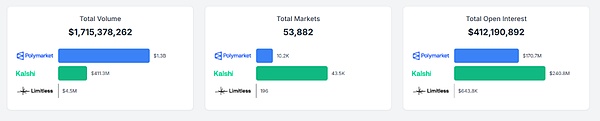
As of October 10, 2025, a comparison of Polymarket and Kalshi data shows that, in addition to the total trading volume of Polymarket being $1.3 billion vs $410 million, which is a significant lead, Polymarket has fallen behind Kalshi in terms of the number of markets (10,200 vs 43,500) and open interest (US$170 million vs US$240 million).

It is worth noting that in order to return to the US market, Polymarket actually adopted a compliance grafting strategy this year: as early as July, it acquired QCX LLC, a trading platform holding a CFTC license, for US$112 million and has begun self-certification of event contracts including sports events and election markets.

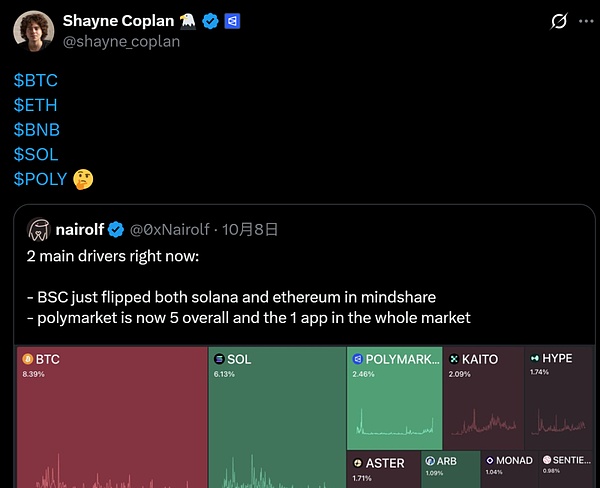
This is also likely a combination of the latest $2 billion in financing, and Polymarket CEO Shayne Coplan also posted a tweet with the POLY symbol on October 9, which may become a key variable in the competition between the two giants.
From prediction markets to larger parent sets

Many people may be curious about why ICE, the parent company of the New York Stock Exchange, made a huge bet of $2 billion on Polymarket?

This requires going beyond Web3 and understanding the prediction market from a larger financial perspective.

First of all, ICE has been actively deploying in the Crypto field, including deploying crypto financial products through its parent company and multiple affiliated entities over the years, gradually covering targets such as Bitcoin spot and futures contracts, as well as the well-known crypto trading platform Bakkt.

Secondly, the prediction market is essentially a subset of the "trading platform", or another form of presentation. For example, Polymarket has many price prediction bets for mainstream crypto assets such as BTC and ETH at different time points such as the end of October and the end of the year.

Theoretically, if the time nodes for predicting fulfillment are infinitely subdivided, from the end of the year to the end of today, to 1 minute later, and 1 second later, then this essentially becomes an instant "bet" (buying and selling behavior) on the trading platform. Perhaps what ICE values is this ability to financialize all uncertainties, which can expand the boundaries of existing derivatives markets such as futures and options.

Therefore, platforms like Polymarket, with their vast user base and trading volume, can serve as a key entry point for ICE Group's future structured financial products, institutional hedging tools, and information pricing services. In other words, ICE isn't focused on a single application, but rather on the potential of the prediction market to "derivative everything"—the uncertainty.

For this reason, in addition to the competition between Polymarket and Kalshi, which is more like a specialized path for event markets, decentralized players such as Hyperliquid have also begun to explore a hybrid path of inserting prediction modules at the entrance of high-performance contract platforms. Both paths have their own advantages and disadvantages, but they may also complement or compete with each other in the future.

New variables for decentralized players like Hyperliquid

For example, the HIP-3 proposal passed by Hyperliquid introduced a permissionless, developer-deployed perpetual contract market on the core infrastructure. Previously, only the core team could list trading pairs, but now any user who pledges 1 million HYPE can deploy their own market directly on the chain.

In short, HIP-3 allows the permissionless creation and listing of derivatives markets for any asset on Hyperliquid, which completely breaks the limitation that Perp DEX could only trade mainstream cryptocurrencies in the past.

This not only means an open contract deployment mechanism, but also lays the technical foundation for subsequent prediction market modules. In the future, users on Hyperliquid may be able to directly trade such markets:

  • Will the Fed cut interest rates at its next meeting?
  • "Will BTC break through $70,000 this week?"
  • "Will Arbitrum TVL exceed Base at the end of the month?"

Under this architecture, the prediction market is no longer an independent track, but a sub-module in the on-chain high-performance derivatives system. And because it reuses Hyperliquid's matching depth, clearing system and order book logic, it naturally has higher transaction efficiency and capital utilization.

In comparison, Polymarket's model is more inclined towards "event trading" and Hyperliquid's model is more inclined towards "price trading" - one starts from information and the other starts from structure, but both point to the same end: allowing future probabilities to be priced instantly by the market.

Final Thoughts

Overall, with the involvement of heavyweight decentralized players like Hyperliquid and ICE’s $2 billion investment, the prediction market is no longer just a tool for people to “bet” or “predict the future”, but has become a frontier for institutions, analysts, and even central banks to observe market sentiment.

This also means that it is no longer just a paradise for speculators, but is rapidly transforming into a highly efficient and highly liquid financial derivatives market, becoming an indispensable financial primitive in the DeFi infrastructure.

Market Opportunity
Notcoin Logo
Notcoin Price(NOT)
$0.0006503
$0.0006503$0.0006503
+4.43%
USD
Notcoin (NOT) Live Price Chart
Disclaimer: The articles reposted on this site are sourced from public platforms and are provided for informational purposes only. They do not necessarily reflect the views of MEXC. All rights remain with the original authors. If you believe any content infringes on third-party rights, please contact service@support.mexc.com for removal. MEXC makes no guarantees regarding the accuracy, completeness, or timeliness of the content and is not responsible for any actions taken based on the information provided. The content does not constitute financial, legal, or other professional advice, nor should it be considered a recommendation or endorsement by MEXC.

You May Also Like

The Channel Factories We’ve Been Waiting For

The Channel Factories We’ve Been Waiting For

The post The Channel Factories We’ve Been Waiting For appeared on BitcoinEthereumNews.com. Visions of future technology are often prescient about the broad strokes while flubbing the details. The tablets in “2001: A Space Odyssey” do indeed look like iPads, but you never see the astronauts paying for subscriptions or wasting hours on Candy Crush.  Channel factories are one vision that arose early in the history of the Lightning Network to address some challenges that Lightning has faced from the beginning. Despite having grown to become Bitcoin’s most successful layer-2 scaling solution, with instant and low-fee payments, Lightning’s scale is limited by its reliance on payment channels. Although Lightning shifts most transactions off-chain, each payment channel still requires an on-chain transaction to open and (usually) another to close. As adoption grows, pressure on the blockchain grows with it. The need for a more scalable approach to managing channels is clear. Channel factories were supposed to meet this need, but where are they? In 2025, subnetworks are emerging that revive the impetus of channel factories with some new details that vastly increase their potential. They are natively interoperable with Lightning and achieve greater scale by allowing a group of participants to open a shared multisig UTXO and create multiple bilateral channels, which reduces the number of on-chain transactions and improves capital efficiency. Achieving greater scale by reducing complexity, Ark and Spark perform the same function as traditional channel factories with new designs and additional capabilities based on shared UTXOs.  Channel Factories 101 Channel factories have been around since the inception of Lightning. A factory is a multiparty contract where multiple users (not just two, as in a Dryja-Poon channel) cooperatively lock funds in a single multisig UTXO. They can open, close and update channels off-chain without updating the blockchain for each operation. Only when participants leave or the factory dissolves is an on-chain transaction…
Share
BitcoinEthereumNews2025/09/18 00:09
Onyxcoin Price Breakout Coming — Is a 38% Move Next?

Onyxcoin Price Breakout Coming — Is a 38% Move Next?

The post Onyxcoin Price Breakout Coming — Is a 38% Move Next? appeared on BitcoinEthereumNews.com. Onyxcoin price action has entered a tense standoff between bulls
Share
BitcoinEthereumNews2026/01/14 00:33
CEO Sandeep Nailwal Shared Highlights About RWA on Polygon

CEO Sandeep Nailwal Shared Highlights About RWA on Polygon

The post CEO Sandeep Nailwal Shared Highlights About RWA on Polygon appeared on BitcoinEthereumNews.com. Polygon CEO Sandeep Nailwal highlighted Polygon’s lead in global bonds, Spiko US T-Bill, and Spiko Euro T-Bill. Polygon published an X post to share that its roadmap to GigaGas was still scaling. Sentiments around POL price were last seen to be bearish. Polygon CEO Sandeep Nailwal shared key pointers from the Dune and RWA.xyz report. These pertain to highlights about RWA on Polygon. Simultaneously, Polygon underlined its roadmap towards GigaGas. Sentiments around POL price were last seen fumbling under bearish emotions. Polygon CEO Sandeep Nailwal on Polygon RWA CEO Sandeep Nailwal highlighted three key points from the Dune and RWA.xyz report. The Chief Executive of Polygon maintained that Polygon PoS was hosting RWA TVL worth $1.13 billion across 269 assets plus 2,900 holders. Nailwal confirmed from the report that RWA was happening on Polygon. The Dune and https://t.co/W6WSFlHoQF report on RWA is out and it shows that RWA is happening on Polygon. Here are a few highlights: – Leading in Global Bonds: Polygon holds 62% share of tokenized global bonds (driven by Spiko’s euro MMF and Cashlink euro issues) – Spiko U.S.… — Sandeep | CEO, Polygon Foundation (※,※) (@sandeepnailwal) September 17, 2025 The X post published by Polygon CEO Sandeep Nailwal underlined that the ecosystem was leading in global bonds by holding a 62% share of tokenized global bonds. He further highlighted that Polygon was leading with Spiko US T-Bill at approximately 29% share of TVL along with Ethereum, adding that the ecosystem had more than 50% share in the number of holders. Finally, Sandeep highlighted from the report that there was a strong adoption for Spiko Euro T-Bill with 38% share of TVL. He added that 68% of returns were on Polygon across all the chains. Polygon Roadmap to GigaGas In a different update from Polygon, the community…
Share
BitcoinEthereumNews2025/09/18 01:10