Roman Storm, co-founder of the sanctioned Tornado Cash cryptocurrency mixer, has accused federal prosecutors of fundamentally mishandling key evidence ahead of his July 14 criminal trial in Manhattan. The dispute centers on a Telegram message reading “Heya, anyone around to chat about axie? Would like to ask a few general questions about how one goes about cashing out 600 mil,” which referenced the $600 million Axie Infinity exploit. According to court filings dated July 12, 2025 , prosecutors initially claimed the message was authored by Storm’s co-developer Alexey Pertsev. Source: Court Listener Defense attorneys revealed the message was actually written by Andrew Thurman, a former CoinDesk senior tech reporter, then forwarded to a Tornado Cash chat by Pertsev. The revelation emerged just days before Storm’s trial on charges of conspiracy to commit money laundering and sanctions violations related to Tornado Cash, which allegedly facilitated over $1 billion in illicit transactions. Government’s Evidence Chain Under Tight Scrutiny The controversy stems from Dutch authorities’ extraction of what prosecutors claim is Pertsev’s phone following his arrest in the Netherlands, where he was sentenced to 64 months in prison for money laundering through Tornado Cash. ⚖️ DOJ pursues federal charges against Roman Storm, cofounder of Tornado Cash, after dropping unlicensed money transmission charge. #TornadoCash #RomanStorm https://t.co/ZGXe7IGREZ — Cryptonews.com (@cryptonews) May 16, 2025 Storm’s defense argues that the government’s extraction contains multiple fatal flaws, including missing author information for forwarded Telegram messages and incomplete file retrieval by FBI Agent Dickerman from Dutch authorities. The defense contends that prosecutors cannot authenticate the extraction’s completeness because they were limited in what files they could obtain from Dutch law enforcement. This authentication challenge becomes more significant given that the government admitted in court filings that its original September 2023 production of extracted text messages to the defense did not include “forwarded” tags on forwarded messages. Prosecutors provided a corrected version in December 2024, which they plan to use at trial, but defense attorneys argue this timeline raises serious questions about the government’s handling of evidence. The misattribution carried real consequences in court proceedings when Assistant U.S. Attorney Ben Arad referenced the message during a July 8 pretrial hearing, telling the judge it demonstrated the co-founders’ awareness of wrongdoing. According to the hearing transcript, Arad told the court: “For example, when the Ronin hack happened, one of the co-conspirators asked, sum and substance, I’d like to ask you some questions about how you go about laundering $600 million worth of stolen crypto.” The defense characterized this as providing “false information” to both the court and potentially the grand jury that issued the indictment. Defense attorneys wrote in their filing: “Given that the government mistakenly attributed the reporter’s Telegram message to Pertsev at the Pretrial Conference, it appears that the government itself was unaware of this issue until the defense raised it.” Enforcement Challenges Echo Across Crypto Cases The evidence dispute highlights a pattern of prosecutorial challenges emerging across high-profile cryptocurrency cases, particularly when international evidence gathering intersects with complex digital communications. Just last month, the DOJ faced similar authentication issues in the case of Russian crypto CEO Iurii Gugnin, who was charged with orchestrating a $530 million fraud scheme through his Miami-based platform Evita. 🇷🇺 A Russian crypto firm CEO used his crypto company, Evita, to funnel $530 million of overseas payments via US banks and crypto platforms. #Evita #CryptoFraud #IuriiGugnin https://t.co/hk5kgucF95 — Cryptonews.com (@cryptonews) June 10, 2025 That case also involved cross-border evidence collection and questions about the authenticity of digital communications used to establish criminal intent. Storm’s defense has consistently argued that the case threatens to criminalize open-source software development, with the Ethereum Foundation pledging $500,000 toward his legal defense and matching up to $750,000 in community contributions. As part of the DOJ’s crypto fraud crackdown, the recently seized $225 million in USDT was linked to a global “pig butchering” scam that defrauded over 400 victims through a network of international exchanges and wallets.Roman Storm, co-founder of the sanctioned Tornado Cash cryptocurrency mixer, has accused federal prosecutors of fundamentally mishandling key evidence ahead of his July 14 criminal trial in Manhattan. The dispute centers on a Telegram message reading “Heya, anyone around to chat about axie? Would like to ask a few general questions about how one goes about cashing out 600 mil,” which referenced the $600 million Axie Infinity exploit. According to court filings dated July 12, 2025 , prosecutors initially claimed the message was authored by Storm’s co-developer Alexey Pertsev. Source: Court Listener Defense attorneys revealed the message was actually written by Andrew Thurman, a former CoinDesk senior tech reporter, then forwarded to a Tornado Cash chat by Pertsev. The revelation emerged just days before Storm’s trial on charges of conspiracy to commit money laundering and sanctions violations related to Tornado Cash, which allegedly facilitated over $1 billion in illicit transactions. Government’s Evidence Chain Under Tight Scrutiny The controversy stems from Dutch authorities’ extraction of what prosecutors claim is Pertsev’s phone following his arrest in the Netherlands, where he was sentenced to 64 months in prison for money laundering through Tornado Cash. ⚖️ DOJ pursues federal charges against Roman Storm, cofounder of Tornado Cash, after dropping unlicensed money transmission charge. #TornadoCash #RomanStorm https://t.co/ZGXe7IGREZ — Cryptonews.com (@cryptonews) May 16, 2025 Storm’s defense argues that the government’s extraction contains multiple fatal flaws, including missing author information for forwarded Telegram messages and incomplete file retrieval by FBI Agent Dickerman from Dutch authorities. The defense contends that prosecutors cannot authenticate the extraction’s completeness because they were limited in what files they could obtain from Dutch law enforcement. This authentication challenge becomes more significant given that the government admitted in court filings that its original September 2023 production of extracted text messages to the defense did not include “forwarded” tags on forwarded messages. Prosecutors provided a corrected version in December 2024, which they plan to use at trial, but defense attorneys argue this timeline raises serious questions about the government’s handling of evidence. The misattribution carried real consequences in court proceedings when Assistant U.S. Attorney Ben Arad referenced the message during a July 8 pretrial hearing, telling the judge it demonstrated the co-founders’ awareness of wrongdoing. According to the hearing transcript, Arad told the court: “For example, when the Ronin hack happened, one of the co-conspirators asked, sum and substance, I’d like to ask you some questions about how you go about laundering $600 million worth of stolen crypto.” The defense characterized this as providing “false information” to both the court and potentially the grand jury that issued the indictment. Defense attorneys wrote in their filing: “Given that the government mistakenly attributed the reporter’s Telegram message to Pertsev at the Pretrial Conference, it appears that the government itself was unaware of this issue until the defense raised it.” Enforcement Challenges Echo Across Crypto Cases The evidence dispute highlights a pattern of prosecutorial challenges emerging across high-profile cryptocurrency cases, particularly when international evidence gathering intersects with complex digital communications. Just last month, the DOJ faced similar authentication issues in the case of Russian crypto CEO Iurii Gugnin, who was charged with orchestrating a $530 million fraud scheme through his Miami-based platform Evita. 🇷🇺 A Russian crypto firm CEO used his crypto company, Evita, to funnel $530 million of overseas payments via US banks and crypto platforms. #Evita #CryptoFraud #IuriiGugnin https://t.co/hk5kgucF95 — Cryptonews.com (@cryptonews) June 10, 2025 That case also involved cross-border evidence collection and questions about the authenticity of digital communications used to establish criminal intent. Storm’s defense has consistently argued that the case threatens to criminalize open-source software development, with the Ethereum Foundation pledging $500,000 toward his legal defense and matching up to $750,000 in community contributions. As part of the DOJ’s crypto fraud crackdown, the recently seized $225 million in USDT was linked to a global “pig butchering” scam that defrauded over 400 victims through a network of international exchanges and wallets.

Tornado Cash Developer Storm Claims DOJ Bungled Critical Telegram Evidence

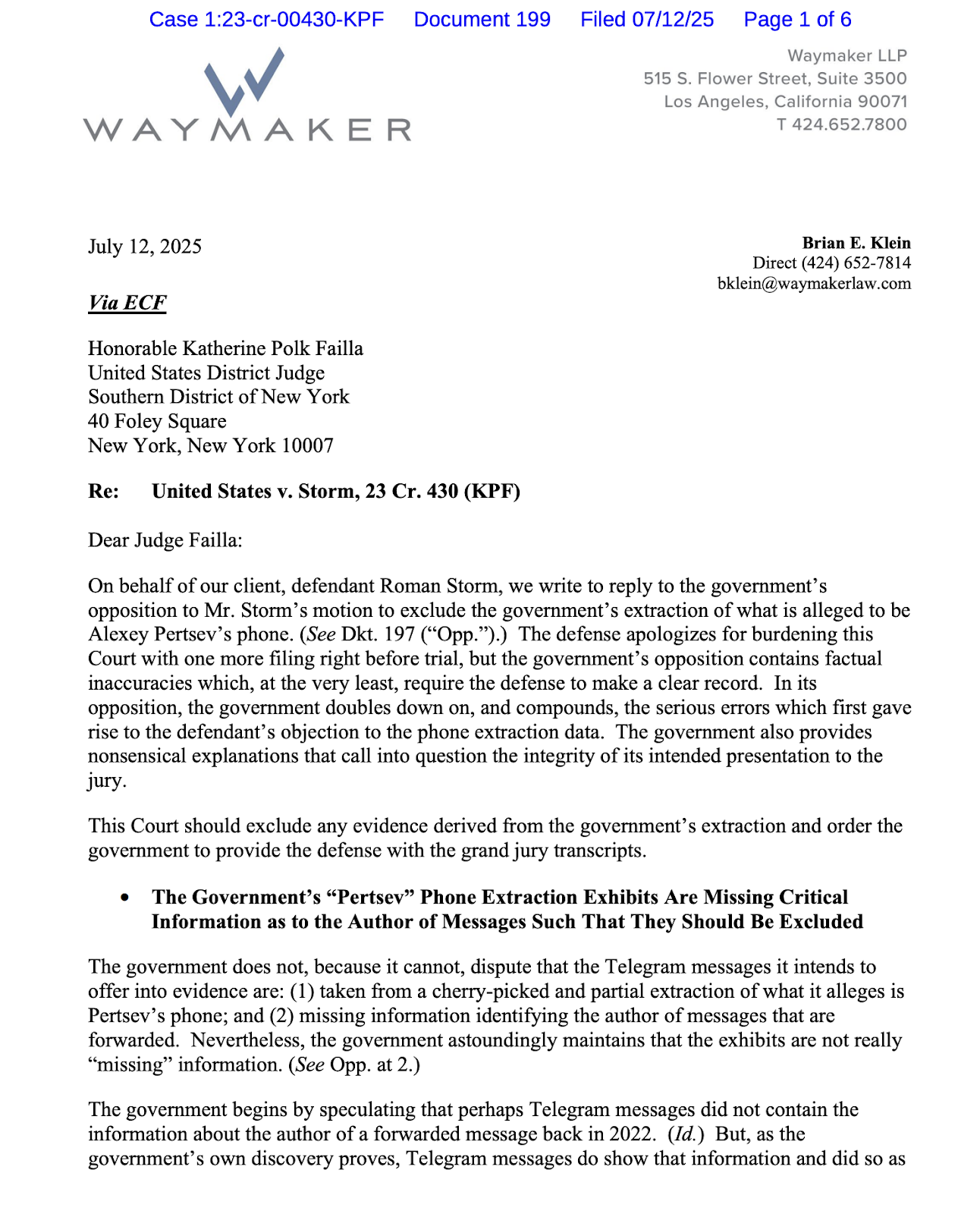
Roman Storm, co-founder of the sanctioned Tornado Cash cryptocurrency mixer, has accused federal prosecutors of fundamentally mishandling key evidence ahead of his July 14 criminal trial in Manhattan.

The dispute centers on a Telegram message reading “Heya, anyone around to chat about axie? Would like to ask a few general questions about how one goes about cashing out 600 mil,” which referenced the $600 million Axie Infinity exploit.

According to court filings dated July 12, 2025, prosecutors initially claimed the message was authored by Storm’s co-developer Alexey Pertsev.
Tornado Cash Developer Storm Claims DOJ Bungled Critical Telegram EvidenceSource: Court Listener

Defense attorneys revealed the message was actually written by Andrew Thurman, a former CoinDesk senior tech reporter, then forwarded to a Tornado Cash chat by Pertsev.

The revelation emerged just days before Storm’s trial on charges of conspiracy to commit money laundering and sanctions violations related to Tornado Cash, which allegedly facilitated over $1 billion in illicit transactions.

Government’s Evidence Chain Under Tight Scrutiny

The controversy stems from Dutch authorities’ extraction of what prosecutors claim is Pertsev’s phone following his arrest in the Netherlands, where he was sentenced to 64 months in prison for money laundering through Tornado Cash.

Storm’s defense argues that the government’s extraction contains multiple fatal flaws, including missing author information for forwarded Telegram messages and incomplete file retrieval by FBI Agent Dickerman from Dutch authorities.

The defense contends that prosecutors cannot authenticate the extraction’s completeness because they were limited in what files they could obtain from Dutch law enforcement.

This authentication challenge becomes more significant given that the government admitted in court filings that its original September 2023 production of extracted text messages to the defense did not include “forwarded” tags on forwarded messages.

Prosecutors provided a corrected version in December 2024, which they plan to use at trial, but defense attorneys argue this timeline raises serious questions about the government’s handling of evidence.

The misattribution carried real consequences in court proceedings when Assistant U.S. Attorney Ben Arad referenced the message during a July 8 pretrial hearing, telling the judge it demonstrated the co-founders’ awareness of wrongdoing.

According to the hearing transcript, Arad told the court: “For example, when the Ronin hack happened, one of the co-conspirators asked, sum and substance, I’d like to ask you some questions about how you go about laundering $600 million worth of stolen crypto.”

The defense characterized this as providing “false information” to both the court and potentially the grand jury that issued the indictment.

Defense attorneys wrote in their filing: “Given that the government mistakenly attributed the reporter’s Telegram message to Pertsev at the Pretrial Conference, it appears that the government itself was unaware of this issue until the defense raised it.”

Enforcement Challenges Echo Across Crypto Cases

The evidence dispute highlights a pattern of prosecutorial challenges emerging across high-profile cryptocurrency cases, particularly when international evidence gathering intersects with complex digital communications.

Just last month, the DOJ faced similar authentication issues in the case of Russian crypto CEO Iurii Gugnin, who was charged with orchestrating a $530 million fraud scheme through his Miami-based platform Evita.

That case also involved cross-border evidence collection and questions about the authenticity of digital communications used to establish criminal intent.

Storm’s defense has consistently argued that the case threatens to criminalize open-source software development, with the Ethereum Foundation pledging $500,000 toward his legal defense and matching up to $750,000 in community contributions.

As part of the DOJ’s crypto fraud crackdown, the recently seized $225 million in USDT was linked to a global “pig butchering” scam that defrauded over 400 victims through a network of international exchanges and wallets.

Market Opportunity
DAR Open Network Logo
DAR Open Network Price(D)
$0.0189
$0.0189$0.0189
+42.96%
USD
DAR Open Network (D) Live Price Chart
Disclaimer: The articles reposted on this site are sourced from public platforms and are provided for informational purposes only. They do not necessarily reflect the views of MEXC. All rights remain with the original authors. If you believe any content infringes on third-party rights, please contact service@support.mexc.com for removal. MEXC makes no guarantees regarding the accuracy, completeness, or timeliness of the content and is not responsible for any actions taken based on the information provided. The content does not constitute financial, legal, or other professional advice, nor should it be considered a recommendation or endorsement by MEXC.

You May Also Like

Bitcoin Has Taken Gold’s Role In Today’s World, Eric Trump Says
Bitcoin Has Taken Gold’s Role In Today’s World, Eric Trump Says

Eric Trump on Tuesday described Bitcoin as a “modern-day gold,” calling it a liquid store of value that can act as a hedge to real estate and other assets. Related Reading: XRP’s Biggest Rally Yet? Analyst Projects $20+ In October 2025 According to reports, the remark came during a TV appearance on CNBC’s Squawk Box, tied to the launch of American Bitcoin, the mining and treasury firm he helped start. Company Holdings And Strategy Based on public filings and company summaries, American Bitcoin has accumulated 2,443 BTC on its balance sheet. That stash has been valued in the low hundreds of millions of dollars at recent spot prices. The firm mixes large-scale mining with the goal of holding Bitcoin as a strategic reserve, which it says will help it grow both production and asset holdings over time. Eric Trump’s comments were direct. He told viewers that institutions are treating Bitcoin more like a store of value than a fringe idea, and he warned firms that resist blockchain adoption. The tone was strong at times, and the line about Bitcoin being a modern equivalent of gold was used to frame American Bitcoin’s role as both miner and holder.   Eric Trump has said: bitcoin is modern-day gold — unusual_whales (@unusual_whales) September 16, 2025 How The Company Went Public American Bitcoin moved toward a public listing via an all-stock merger with Gryphon Digital Mining earlier this year, a deal that kept most of the original shareholders in control and positioned the new entity for a Nasdaq debut. Reports show that mining partner Hut 8 holds a large ownership stake, leaving the Trump family and other backers with a minority share. The listing brought fresh attention and capital to the firm as it began trading under the ticker ABTC. Market watchers say the firm’s public debut highlights two trends: mining companies are trying to grow by both producing and holding Bitcoin, and political ties are bringing more headlines to crypto firms. Some analysts point out that holding large amounts of Bitcoin on the balance sheet exposes a company to price swings, while supporters argue it aligns incentives between miners and investors. Related Reading: Ethereum Bulls Target $8,500 With Big Money Backing The Move – Details Reaction And Possible Risks Based on coverage of the launch, investors have reacted with both enthusiasm and caution. Supporters praise the prospect of a US-based miner that aims to be transparent and aggressive about building a reserve. Critics point to governance questions, possible conflicts tied to high-profile backers, and the usual risks of a volatile asset being held on corporate balance sheets. Eric Trump’s remark that Bitcoin has taken gold’s role in today’s world reflects both his belief in its value and American Bitcoin’s strategy of mining and holding. Whether that view sticks will depend on how investors and institutions respond in the months ahead. Featured image from Meta, chart from TradingView
Share
NewsBTC2025/09/18 06:00
Fed Makes First Rate Cut of the Year, Lowers Rates by 25 Bps

Fed Makes First Rate Cut of the Year, Lowers Rates by 25 Bps

The post Fed Makes First Rate Cut of the Year, Lowers Rates by 25 Bps appeared on BitcoinEthereumNews.com. The Federal Reserve has made its first Fed rate cut this year following today’s FOMC meeting, lowering interest rates by 25 basis points (bps). This comes in line with expectations, while the crypto market awaits Fed Chair Jerome Powell’s speech for guidance on the committee’s stance moving forward. FOMC Makes First Fed Rate Cut This Year With 25 Bps Cut In a press release, the committee announced that it has decided to lower the target range for the federal funds rate by 25 bps from between 4.25% and 4.5% to 4% and 4.25%. This comes in line with expectations as market participants were pricing in a 25 bps cut, as against a 50 bps cut. This marks the first Fed rate cut this year, with the last cut before this coming last year in December. Notably, the Fed also made the first cut last year in September, although it was a 50 bps cut back then. All Fed officials voted in favor of a 25 bps cut except Stephen Miran, who dissented in favor of a 50 bps cut. This rate cut decision comes amid concerns that the labor market may be softening, with recent U.S. jobs data pointing to a weak labor market. The committee noted in the release that job gains have slowed, and that the unemployment rate has edged up but remains low. They added that inflation has moved up and remains somewhat elevated. Fed Chair Jerome Powell had also already signaled at the Jackson Hole Conference that they were likely to lower interest rates with the downside risk in the labor market rising. The committee reiterated this in the release that downside risks to employment have risen. Before the Fed rate cut decision, experts weighed in on whether the FOMC should make a 25 bps cut or…
Share
BitcoinEthereumNews2025/09/18 04:36
UK Looks to US to Adopt More Crypto-Friendly Approach

UK Looks to US to Adopt More Crypto-Friendly Approach

The post UK Looks to US to Adopt More Crypto-Friendly Approach appeared on BitcoinEthereumNews.com. The UK and US are reportedly preparing to deepen cooperation on digital assets, with Britain looking to copy the Trump administration’s crypto-friendly stance in a bid to boost innovation.  UK Chancellor Rachel Reeves and US Treasury Secretary Scott Bessent discussed on Tuesday how the two nations could strengthen their coordination on crypto, the Financial Times reported on Tuesday, citing people familiar with the matter.  The discussions also involved representatives from crypto companies, including Coinbase, Circle Internet Group and Ripple, with executives from the Bank of America, Barclays and Citi also attending, according to the report. The agreement was made “last-minute” after crypto advocacy groups urged the UK government on Thursday to adopt a more open stance toward the industry, claiming its cautious approach to the sector has left the country lagging in innovation and policy.  Source: Rachel Reeves Deal to include stablecoins, look to unlock adoption Any deal between the countries is likely to include stablecoins, the Financial Times reported, an area of crypto that US President Donald Trump made a policy priority and in which his family has significant business interests. The Financial Times reported on Monday that UK crypto advocacy groups also slammed the Bank of England’s proposal to limit individual stablecoin holdings to between 10,000 British pounds ($13,650) and 20,000 pounds ($27,300), claiming it would be difficult and expensive to implement. UK banks appear to have slowed adoption too, with around 40% of 2,000 recently surveyed crypto investors saying that their banks had either blocked or delayed a payment to a crypto provider.  Many of these actions have been linked to concerns over volatility, fraud and scams. The UK has made some progress on crypto regulation recently, proposing a framework in May that would see crypto exchanges, dealers, and agents treated similarly to traditional finance firms, with…
Share
BitcoinEthereumNews2025/09/18 02:21