Zcash’s sudden resurgence is not just another rotation, argues Helius CEO Mert Mumtaz; it is a re-centering of crypto on first principles of cryptography and user choice. In a wide-ranging conversation on Messari’s “Fully Diluted” (Oct. 23) with host Dylan Bane and Messari researchers, Mumtaz framed Zcash as “secret Bitcoin”—a full-stack, zero-leakage design for money […]Zcash’s sudden resurgence is not just another rotation, argues Helius CEO Mert Mumtaz; it is a re-centering of crypto on first principles of cryptography and user choice. In a wide-ranging conversation on Messari’s “Fully Diluted” (Oct. 23) with host Dylan Bane and Messari researchers, Mumtaz framed Zcash as “secret Bitcoin”—a full-stack, zero-leakage design for money […]

Zcash Is The ‘Better Bitcoin’ Satoshi Couldn’t Build, Says Helius Labs CEO

Zcash’s sudden resurgence is not just another rotation, argues Helius CEO Mert Mumtaz; it is a re-centering of crypto on first principles of cryptography and user choice. In a wide-ranging conversation on Messari’s “Fully Diluted” (Oct. 23) with host Dylan Bane and Messari researchers, Mumtaz framed Zcash as “secret Bitcoin”—a full-stack, zero-leakage design for money that Bitcoin’s earliest architects wanted but could not ship with 2010-era tooling.

Zcash Proves Satoshi Right

“The simplest conceptual way to understand this is that it’s a secret Bitcoin. It’s an encrypted Bitcoin,” Mumtaz said, invoking early forum posts from Satoshi and Hal Finney. “You have forum posts of Satoshi and Hal [Finney] saying things like, ‘If we knew how to add ZK proofs to Bitcoin, it would make it a better Bitcoin.’ But this is 2010 and they didn’t have the tech. And since then, the tech has been made.” In his telling, that lineage matters: Zcash inherits Bitcoin’s monetary template while replacing probabilistic obfuscation with “pure encryption.”

Mumtaz’s critique of “bolt-on” privacy was unambiguous. Privacy, he argued, is not a feature toggle; it is a system property that must be designed from the ground up to minimize information leakage across the entire stack—wallets, RPCs, mempools, validators, bridges, and application UX. “Privacy is not, in my view, something that can be bolted on,” he said.

“You have to start from first principles and approach the problem from a vertically integrated full-stack solution.” He contrasted Zcash’s shielded pool with approaches like Monero and mixers that rely on decoys: “With Monero… you’re introducing probabilistic decoys… it’s that cups-and-ball game… with Zcash there is no obfuscation, it is a pure encryption—if the ball just didn’t exist at all.”

The immediate catalyst behind Zcash’s rally, Mumtaz suggested, was less a single headline than a confluence: product-level UX improvements, a shifting policy backdrop, and attention—both supportive and hostile—compounding on social media. He pointed to the new Zashi wallet as a turning point: “People are actually able to use this new Zashi wallet to have some fun… sending each other private messages and shielding stuff and tipping each other.”

He also argued the market had “over-indexed on extremely weird coins” while neglecting “privacy ideals,” leaving Zcash’s market cap “pathetically low” relative to its potential at the moment he began highlighting it.

Regulation loomed over privacy the last few years. Mumtaz was blunt about the chilling effect of enforcement on privacy R&D: “People were scared of going to jail for even launching tokens, let alone writing privacy code. And there’s people still in jail for this.” He sees parts of the US moving in a friendlier direction under US President Donald Trump, while parts of Europe move toward surveillance and scanning of private messages.

That divergence makes long-range forecasting difficult, he cautioned, but it reinforces why the industry should “guard zealously people’s right to privacy” as crypto’s legal status improves elsewhere. “There’s people in jail for writing privacy code, but not for launching scams. That seems like a pretty big problem that we need to correct.”

Bitcoin, Solana And ZEC

On the perennial question—why not add robust privacy to Bitcoin directly?—Mumtaz cited both governance inertia and technical realities. Bitcoin core changes are hard by design, he said, and privacy demands more than a script-level patch. “Unless you are designing with leaks minimized from the bottom up, the leaks kind of add up… It just takes one leak to compromise that privacy.”

Zcash’s roadmap featured prominently. Mumtaz expects the Tachyon work spearheaded by Sean Bowe to address “state growth” and lay “foundations for scaling,” cleaning up legacy design choices that waste compute, such as brute-decoding notes. He called for pragmatic fee markets to mitigate spam and for improving mining decentralization as price action draws new hashrate.

But he rejected, in its current form, the “Crosslink” hybrid PoW/PoS finality proposal: “It’s a bad idea… With a privacy system especially, the more moving pieces you introduce, the more attack surface increases… It’s unclear to me what exactly you’re gaining from this other than kind of a new finality time.” If given a token-holder vote, he said he would vote against it unless substantially revised.

Mumtaz repeatedly returned to an “atomic unit” framing of privacy: information leakage. He extended that lens to bridges and cross-ecosystem liquidity. Helius helped bridge ZEC exposure into Solana via NEAR, but he stressed users give up Zcash’s privacy when they hold it on Solana. “Once that asset is on Solana, you don’t have the privacy benefits… You can bridge it back and deposit in the shielded pool… then you get the privacy back, but while you’re on Solana you’re not going to have the same privacy as the private blockchain.” The utility, for now, is market access and DeFi composability rather than end-to-end confidentiality.

The market meta, he conceded, is cyclical because attention is finite. The objective is to ratchet the floor higher each cycle by converting narrative into durable engineering and sensible legislation. “It’s on the builders… to use that momentum… to actually drive forward sensible legislation and harden the engineering of these systems such that they endure in scale and are usable for many people.”

Asked to handicap the 2030 leaderboard, he demurred on precise ordering but volunteered a long-horizon view in which Zcash belongs in the conversation alongside Bitcoin and Solana: “If you were to tell me 20 years then I’m going to say Bitcoin, Solana, ZEC.”

At press time, ZEC traded at $267.
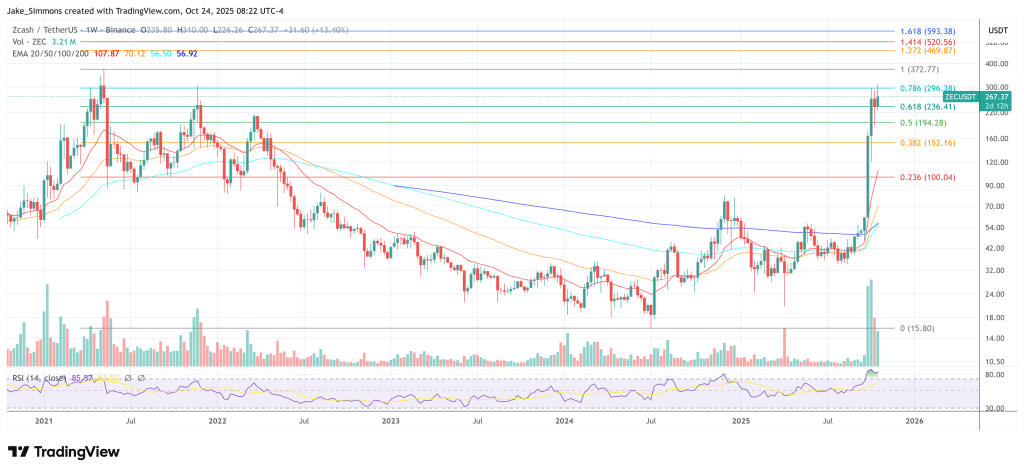
ZCash price
Market Opportunity
Threshold Logo
Threshold Price(T)
$0.00977
$0.00977$0.00977
-0.11%
USD
Threshold (T) Live Price Chart
Disclaimer: The articles reposted on this site are sourced from public platforms and are provided for informational purposes only. They do not necessarily reflect the views of MEXC. All rights remain with the original authors. If you believe any content infringes on third-party rights, please contact service@support.mexc.com for removal. MEXC makes no guarantees regarding the accuracy, completeness, or timeliness of the content and is not responsible for any actions taken based on the information provided. The content does not constitute financial, legal, or other professional advice, nor should it be considered a recommendation or endorsement by MEXC.

You May Also Like

Unprecedented Surge: Gold Price Hits Astounding New Record High

Unprecedented Surge: Gold Price Hits Astounding New Record High

BitcoinWorld Unprecedented Surge: Gold Price Hits Astounding New Record High While the world often buzzes with the latest movements in Bitcoin and altcoins, a traditional asset has quietly but powerfully commanded attention: gold. This week, the gold price has once again made headlines, touching an astounding new record high of $3,704 per ounce. This significant milestone reminds investors, both traditional and those deep in the crypto space, of gold’s enduring appeal as a store of value and a hedge against uncertainty. What’s Driving the Record Gold Price Surge? The recent ascent of the gold price to unprecedented levels is not a random event. Several powerful macroeconomic forces are converging, creating a perfect storm for the precious metal. Geopolitical Tensions: Escalating conflicts and global instability often drive investors towards safe-haven assets. Gold, with its long history of retaining value during crises, becomes a preferred choice. Inflation Concerns: Persistent inflation in major economies erodes the purchasing power of fiat currencies. Consequently, investors seek assets like gold that historically maintain their value against rising prices. Central Bank Policies: Many central banks globally are accumulating gold at a significant pace. This institutional demand provides a strong underlying support for the gold price. Furthermore, expectations around interest rate cuts in the future also make non-yielding assets like gold more attractive. These factors collectively paint a picture of a cautious market, where investors are looking for stability amidst a turbulent economic landscape. Understanding Gold’s Appeal in Today’s Market For centuries, gold has held a unique position in the financial world. Its latest record-breaking performance reinforces its status as a critical component of a diversified portfolio. Gold offers a tangible asset that is not subject to the same digital vulnerabilities or regulatory shifts that can impact cryptocurrencies. While digital assets offer exciting growth potential, gold provides a foundational stability that appeals to a broad spectrum of investors. Moreover, the finite supply of gold, much like Bitcoin’s capped supply, contributes to its perceived value. The current market environment, characterized by economic uncertainty and fluctuating currency values, only amplifies gold’s intrinsic benefits. It serves as a reliable hedge when other asset classes, including stocks and sometimes even crypto, face downward pressure. How Does This Record Gold Price Impact Investors? A soaring gold price naturally raises questions for investors. For those who already hold gold, this represents a significant validation of their investment strategy. For others, it might spark renewed interest in this ancient asset. Benefits for Investors: Portfolio Diversification: Gold often moves independently of other asset classes, offering crucial diversification benefits. Wealth Preservation: It acts as a robust store of value, protecting wealth against inflation and economic downturns. Liquidity: Gold markets are highly liquid, allowing for relatively easy buying and selling. Challenges and Considerations: Opportunity Cost: Investing in gold means capital is not allocated to potentially higher-growth assets like equities or certain cryptocurrencies. Volatility: While often seen as stable, gold prices can still experience significant fluctuations, as evidenced by its rapid ascent. Considering the current financial climate, understanding gold’s role can help refine your overall investment approach. Looking Ahead: The Future of the Gold Price What does the future hold for the gold price? While no one can predict market movements with absolute certainty, current trends and expert analyses offer some insights. Continued geopolitical instability and persistent inflationary pressures could sustain demand for gold. Furthermore, if global central banks continue their gold acquisition spree, this could provide a floor for prices. However, a significant easing of inflation or a de-escalation of global conflicts might reduce some of the immediate upward pressure. Investors should remain vigilant, observing global economic indicators and geopolitical developments closely. The ongoing dialogue between traditional finance and the emerging digital asset space also plays a role. As more investors become comfortable with both gold and cryptocurrencies, a nuanced understanding of how these assets complement each other will be crucial for navigating future market cycles. The recent surge in the gold price to a new record high of $3,704 per ounce underscores its enduring significance in the global financial landscape. It serves as a powerful reminder of gold’s role as a safe haven asset, a hedge against inflation, and a vital component for portfolio diversification. While digital assets continue to innovate and capture headlines, gold’s consistent performance during times of uncertainty highlights its timeless value. Whether you are a seasoned investor or new to the market, understanding the drivers behind gold’s ascent is crucial for making informed financial decisions in an ever-evolving world. Frequently Asked Questions (FAQs) Q1: What does a record-high gold price signify for the broader economy? A record-high gold price often indicates underlying economic uncertainty, inflation concerns, and geopolitical instability. Investors tend to flock to gold as a safe haven when they lose confidence in traditional currencies or other asset classes. Q2: How does gold compare to cryptocurrencies as a safe-haven asset? Both gold and some cryptocurrencies (like Bitcoin) are often considered safe havens. Gold has a centuries-long history of retaining value during crises, offering tangibility. Cryptocurrencies, while newer, offer decentralization and can be less susceptible to traditional financial system failures, but they also carry higher volatility and regulatory risks. Q3: Should I invest in gold now that its price is at a record high? Investing at a record high requires careful consideration. While the price might continue to climb due to ongoing market conditions, there’s also a risk of a correction. It’s crucial to assess your personal financial goals, risk tolerance, and consider diversifying your portfolio rather than putting all your capital into a single asset. Q4: What are the main factors that influence the gold price? The gold price is primarily influenced by global economic uncertainty, inflation rates, interest rate policies by central banks, the strength of the U.S. dollar, and geopolitical tensions. Demand from jewelers and industrial uses also play a role, but investment and central bank demand are often the biggest drivers. Q5: Is gold still a good hedge against inflation? Historically, gold has proven to be an effective hedge against inflation. When the purchasing power of fiat currencies declines, gold tends to hold its value or even increase, making it an attractive asset for preserving wealth during inflationary periods. To learn more about the latest crypto market trends, explore our article on key developments shaping Bitcoin’s price action. This post Unprecedented Surge: Gold Price Hits Astounding New Record High first appeared on BitcoinWorld.
Share
Coinstats2025/09/18 02:30
USD/CNH stays below 7.0000 – BBH

USD/CNH stays below 7.0000 – BBH

The post USD/CNH stays below 7.0000 – BBH appeared on BitcoinEthereumNews.com. USD/CNH remains under 7.0000 as China’s December inflation data showed headline CPI
Share
BitcoinEthereumNews2026/01/09 22:13
Ethereum Name Service price prediction 2025-2031: Is ENS a good investment?

Ethereum Name Service price prediction 2025-2031: Is ENS a good investment?

Key takeaways: The Ethereum Name Service is a network that enables crypto enthusiasts to rename their cryptocurrency addresses into something simpler, making them easier to remember. Renaming crypto addresses through ENS will enable users to recollect and write them quickly. Even though Ethereum Name Service is based on the Ethereum blockchain, it uses its cryptocurrency, […]
Share
Cryptopolitan2025/09/18 01:38