You learn by comparing to what you already know. I was recently bitten by assuming Rust worked as Java regarding transitive dependency version resolution. In this post, I want to compare the two.You learn by comparing to what you already know. I was recently bitten by assuming Rust worked as Java regarding transitive dependency version resolution. In this post, I want to compare the two.

Transitive Dependency Version Resolution in Rust and Java: Comparing the Two

2025/09/21 23:00

You learn by comparing to what you already know. I was recently bitten by assuming Rust worked as Java regarding transitive dependency version resolution. In this post, I want to compare the two.

Dependencies, Transitivity, and Version Resolution

Before diving into the specifics of each stack, let's describe the domain and the problems that come with it.

\ When developing any project above Hello World level, chances are you'll face problems that others have faced before. If the problem is widespread, the probability is high that somebody was kind and civic-minded enough to have packaged the code that solves it, for others to re-use. Now, you can use the package and focus on solving your core problem. It's how industry builds most projects today, even if it brings other problems: you sit on the shoulders of giants.

\ Languages come with build tools that can add such packages to your project. Most of them refer to packages you add to your project as dependencies. In turn, projects' dependencies can have their own dependencies: the latter are called transitive dependencies.
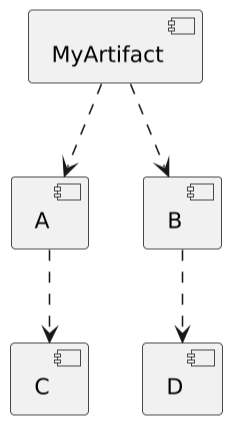
Transitive dependencies

In the above diagram, C and D are transitive dependencies.

\ Transitive dependencies have issues on their own. The biggest one is when a transitive dependency is required from different paths, but in different versions. In the diagram below, A and B both depend on C, but on different versions of it.
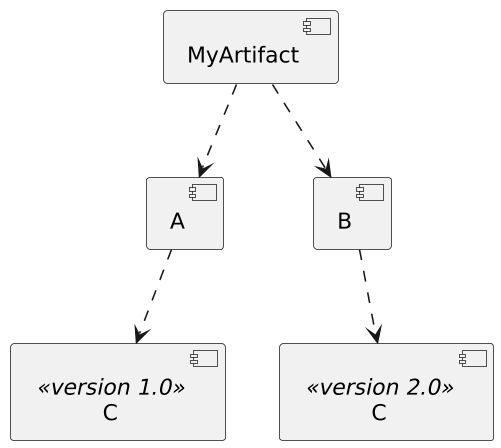
Which version of C should the build tool include in your project? Java and Rust have different answers. Let's describe them in turn.

Java Transitive Dependency Version Resolution

Reminder: Java code compiles to bytecode, which is then interpreted at runtime (and sometimes compiled to native code, but this is outside of our current problem space). I'll first describe runtime dependency resolution and build-time dependency resolution.

\ At runtime, the Java Virtual Machine offers the concept of a classpath. When having to load a class, the runtime searches through the configured classpath in order. Imagine the following class:

public static Main {     public static void main(String[] args) {         Class.forName("ch.frankel.Dep");     } } 

\ Let's compile it and execute it:

java -cp ./foo.jar:./bar.jar Main 

\ The above will first look in the foo.jar for the ch.frankel.Dep class. If found, it stops there and loads the class, regardless of whether it might also be present in the bar.jar; if not, it looks further in the bar.jar class. If still not found, it fails with a ClassNotFoundException.

\ Java's runtime dependency resolution mechanism is ordered and has a per-class granularity. It applies whether you run a Java class and define the classpath on the command line as above, or whether you run a JAR that defines the classpath in its manifest.

\ Let's change the above code to the following:

public static Main {     public static void main(String[] args) {         var dep = new ch.frankel.Dep();     } } 

\ Because the new code references Dep directly, new code requires class resolution at compile-time. Classpath resolution works in the same way:

javac -cp ./foo.jar:./bar.jar Main 

\ The compiler looks for Dep in foo.jar, then in bar.jar if not found. The above is what you learn at the beginning of your Java learning journey.

\ Afterwards, your unit of work is the Java Archive, known as the JAR, instead of the class. A JAR is a glorified ZIP archive, with an internal manifest that specifies its version.

\ Now, imagine that you're a user of foo.jar. Developers of foo.jar set a specific classpath when compiling, possibly including other JARs. You'll need this information to run your own command. How does a library developer pass this knowledge to downstream users?

\ The community came up with a few ideas to answer this question: The first response that stuck was Maven. Maven has the concept of Project Object Model, where you set your project's metadata, as well as dependencies. Maven can easily resolve transitive dependencies because they also publish their POM, with their own dependencies. Hence, Maven can trace each dependency's dependencies down to the leaf dependencies.

\ Now, back to the problem statement: how does Maven resolve version conflicts? Which dependency version will Maven resolve for C, 1.0 or 2.0?

\ The documentation is clear: the nearest.
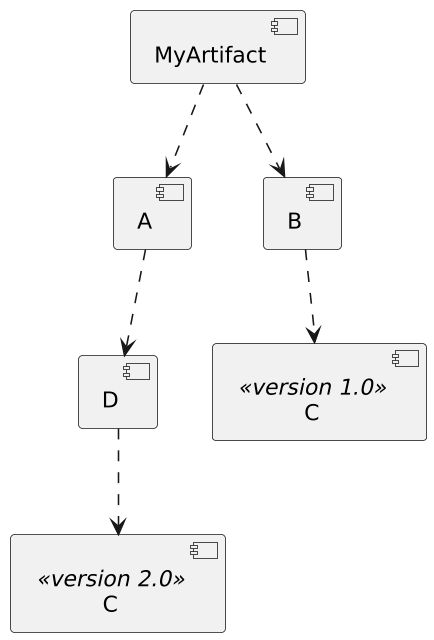
Dependency resolution with the same dependency in different versions

In the above diagram, the path to v1 has a distance of two, one to B, then one to C; meanwhile, the path to v2 has a distance of three, one to A, then one to D, then finally one to C. Thus, the shortest path points to v1.

\ However, in the initial diagram, both C versions are at the same distance from the root artifact. The documentation provides no answer. If you're interested in it, it depends on the order of declaration of A and B in the POM! In summary, Maven returns a single version of a duplicated dependency to include it on the compile classpath.

\ If A can work with C v2.0 or B with C 1.0, great! If not, you'll probably need to upgrade your version of A or downgrade your version of B, so that the resolved C version works with both. It's a manual process that is painful–ask me how I know. Worse, you might find out there's no C version that works with both A and B. Time to replace A or B.

Rust Transitive Dependency Version Resolution

Rust differs from Java in several aspects, but I think the following are the most relevant for the sake of our discussion:

  • Rust has the same dependency tree at compile-time and at runtime
  • It provides a build tool out of the box, Cargo
  • Dependencies are resolved from source

\ Let's examine them one by one.

\ Java compiles to bytecode, then you run the latter. You need to set the classpath both at compilation time and at runtime. Compiling with a specific classpath and running with a different one can lead to errors. For example, imagine you compile with a class you depend on, but the class is absent at runtime. Or alternatively, it's present, but in an incompatible version.

\ Contrary to this modular approach, Rust compiles to a unique native package the crate's code and every dependency. Moreover, Rust provides its own build too, thus avoiding having to remember the quirks of different tools. I mentioned Maven, but other build tools likely have different rules to resolve the version in the use case above.

\ Finally, Java resolves dependencies from binaries: JARs. On the contrary, Rust resolves dependencies from sources. At build time, Cargo resolves the entire dependency tree, downloads all required sources, and compiles them in the correct order.

\ With this in mind, how does Rust resolve the version of the C dependency in the initial problem? The answer may seem strange if you come from a Java background, but Rust includes both. Indeed, in the above diagram, Rust will compile A with C v1.0 and compile B with C v2.0. Problem solved.

Conclusion

JVM languages, and Java in particular, offer both a compile-time classpath and a runtime classpath. It allows modularity and reusability, but opens the door to issues regarding classpath resolution. On the other hand, Rust builds your crate into a single self-contained binary, whether a library or an executable.

\ To go further:

  • Maven - Introduction to the Dependency Mechanism
  • Effective Rust - Item 25: Manage your dependency graph

Originally published at A Java Geek on September 14th, 2025

Sorumluluk Reddi: Bu sitede yeniden yayınlanan makaleler, halka açık platformlardan alınmıştır ve yalnızca bilgilendirme amaçlıdır. MEXC'nin görüşlerini yansıtmayabilir. Tüm hakları telif sahiplerine aittir. Herhangi bir içeriğin üçüncü taraf haklarını ihlal ettiğini düşünüyorsanız, kaldırılması için lütfen service@support.mexc.com ile iletişime geçin. MEXC, içeriğin doğruluğu, eksiksizliği veya güncelliği konusunda hiçbir garanti vermez ve sağlanan bilgilere dayalı olarak alınan herhangi bir eylemden sorumlu değildir. İçerik, finansal, yasal veya diğer profesyonel tavsiye niteliğinde değildir ve MEXC tarafından bir tavsiye veya onay olarak değerlendirilmemelidir.

Ayrıca Şunları da Beğenebilirsiniz

Akash Network’s Strategic Move: A Crucial Burn for AKT’s Future

Akash Network’s Strategic Move: A Crucial Burn for AKT’s Future

BitcoinWorld Akash Network’s Strategic Move: A Crucial Burn for AKT’s Future In the dynamic world of decentralized computing, exciting developments are constantly shaping the future. Today, all eyes are on Akash Network, the innovative supercloud project, as it proposes a significant change to its tokenomics. This move aims to strengthen the value of its native token, AKT, and further solidify its position in the competitive blockchain space. The community is buzzing about a newly submitted governance proposal that could introduce a game-changing Burn Mint Equilibrium (BME) model. What is the Burn Mint Equilibrium (BME) for Akash Network? The core of this proposal revolves around a concept called Burn Mint Equilibrium, or BME. Essentially, this model is designed to create a balance in the token’s circulating supply by systematically removing a portion of tokens from existence. For Akash Network, this means burning an amount of AKT that is equivalent to the U.S. dollar value of fees paid by network users. Fee Conversion: When users pay for cloud services on the Akash Network, these fees are typically collected in various cryptocurrencies or stablecoins. AKT Equivalence: The proposal suggests converting the U.S. dollar value of these collected fees into an equivalent amount of AKT. Token Burn: This calculated amount of AKT would then be permanently removed from circulation, or ‘burned’. This mechanism creates a direct link between network utility and token supply reduction. As more users utilize the decentralized supercloud, more AKT will be burned, potentially impacting the token’s scarcity and value. Why is This Proposal Crucial for AKT Holders? For anyone holding AKT, or considering investing in the Akash Network ecosystem, this proposal carries significant weight. Token burning mechanisms are often viewed as a positive development because they can lead to increased scarcity. When supply decreases while demand remains constant or grows, the price per unit tends to increase. Here are some key benefits: Increased Scarcity: Burning tokens reduces the total circulating supply of AKT. This makes each remaining token potentially more valuable over time. Demand-Supply Dynamics: The BME model directly ties the burning of AKT to network usage. Higher adoption of the Akash Network supercloud translates into more fees, and thus more AKT burned. Long-Term Value Proposition: By creating a deflationary pressure, the proposal aims to enhance AKT’s long-term value, making it a more attractive asset for investors and long-term holders. This strategic move demonstrates a commitment from the Akash Network community to optimize its tokenomics for sustainable growth and value appreciation. How Does BME Impact the Decentralized Supercloud Mission? Beyond token value, the BME proposal aligns perfectly with the broader mission of the Akash Network. As a decentralized supercloud, Akash provides a marketplace for cloud computing resources, allowing users to deploy applications faster, more efficiently, and at a lower cost than traditional providers. The BME model reinforces this utility. Consider these impacts: Network Health: A stronger AKT token can incentivize more validators and providers to secure and contribute resources to the network, improving its overall health and resilience. Ecosystem Growth: Enhanced token value can attract more developers and projects to build on the Akash Network, fostering a vibrant and diverse ecosystem. User Incentive: While users pay fees, the potential appreciation of AKT could indirectly benefit those who hold the token, creating a circular economy within the supercloud. This proposal is not just about burning tokens; it’s about building a more robust, self-sustaining, and economically sound decentralized cloud infrastructure for the future. What Are the Next Steps for the Akash Network Community? As a governance proposal, the BME model will now undergo a period of community discussion and voting. This is a crucial phase where AKT holders and network participants can voice their opinions, debate the merits, and ultimately decide on the future direction of the project. Transparency and community engagement are hallmarks of decentralized projects like Akash Network. Challenges and Considerations: Implementation Complexity: Ensuring the burning mechanism is technically sound and transparent will be vital. Community Consensus: Achieving broad agreement within the diverse Akash Network community is key for successful adoption. The outcome of this vote will significantly shape the tokenomics and economic model of the Akash Network, influencing its trajectory in the rapidly evolving decentralized cloud landscape. The proposal to introduce a Burn Mint Equilibrium model represents a bold and strategic step for Akash Network. By directly linking network usage to token scarcity, the project aims to create a more resilient and valuable AKT token, ultimately strengthening its position as a leading decentralized supercloud provider. This move underscores the project’s commitment to innovative tokenomics and sustainable growth, promising an exciting future for both users and investors in the Akash Network ecosystem. It’s a clear signal that Akash is actively working to enhance its value proposition and maintain its competitive edge in the decentralized future. Frequently Asked Questions (FAQs) 1. What is the main goal of the Burn Mint Equilibrium (BME) proposal for Akash Network? The primary goal is to adjust the circulating supply of AKT tokens by burning a portion of network fees, thereby creating deflationary pressure and potentially enhancing the token’s long-term value and scarcity. 2. How will the amount of AKT to be burned be determined? The proposal suggests burning an amount of AKT equivalent to the U.S. dollar value of fees paid by users on the Akash Network for cloud services. 3. What are the potential benefits for AKT token holders? Token holders could benefit from increased scarcity of AKT, which may lead to higher demand and appreciation in value over time, especially as network usage grows. 4. How does this proposal relate to the overall mission of Akash Network? The BME model reinforces the Akash Network‘s mission by creating a stronger, more economically robust ecosystem. A healthier token incentivizes network participants, fostering growth and stability for the decentralized supercloud. 5. What is the next step for this governance proposal? The proposal will undergo a period of community discussion and voting by AKT token holders. The community’s decision will determine if the BME model is implemented on the Akash Network. If you found this article insightful, consider sharing it with your network! Your support helps us bring more valuable insights into the world of decentralized technology. Stay informed and help spread the word about the exciting developments happening within Akash Network. To learn more about the latest crypto market trends, explore our article on key developments shaping decentralized cloud solutions price action. This post Akash Network’s Strategic Move: A Crucial Burn for AKT’s Future first appeared on BitcoinWorld.
Paylaş
Coinstats2025/09/22 21:35