Author: Umbrella, Deep Tide TechFlow In recent days, there has been a trend of practicing spoken English in the crypto community. An AI voice input project called Poseidon has officially launched. At the current stage, users can obtain their points through voice input every day and obtain future airdrop shares. As a star project incubated by Story Protocol and led by a16z, Poseidon targets the currently scarce high-quality and clear AI voice data, and is committed to helping train AI to understand speech in different languages, dialects and environments. After the experience, the author summarized the background of the Poseidon project and how to participate. Perhaps there is the next opportunity to "make a lot of money for free" hidden in it. Project Background According to its official website, the project's chief scientist, Sandeep Chinchali, holds a Ph.D. from Stanford and is currently an assistant professor at the University of Texas at Austin, specializing in edge computing, artificial intelligence, and generative AI. Poseidon product manager Sarick Shah was a software engineer at LotusFlare and Roadz. He has a background in Johns Hopkins University and was responsible for Story's AI engineering before joining the Poseidon team. LJW, the head of operations for the Poseidon project, was formerly the co-director of Harvard University's Crypto Lab and a senior researcher at Harvard Business School. He has extensive experience in operating AI and Web3 business models. SY Lee, head of the Poseidon project, is also the founder and CEO of Story Protocol. His first entrepreneurial project, Radish, is a mobile serial novel application with millions of downloads. It was sold to South Korean technology giant Kakao for US$440 million in 2021. He then served as the global strategy officer of Kakao Entertainment and is also a venture partner of Hashed Ventures, South Korea's largest blockchain fund. Poseidon's significant attention is also due to the incubation and support of Story Protocol. As an ecosystem focused on on-chain IP, Story Protocol has provided significant support for Poseidon's future development. The connection between the two extends beyond incubation. Story Protocol founder SY Lee's personal involvement as Poseidon project leader underscores its significant role within the Story ecosystem. The financing information announced by Poseidon a few days ago also brought market attention and confidence to this project. On July 23, the Poseidon team announced that its seed round was led by the well-known crypto investment institution a16z, with an amount of US$15 million. Why did a16z take a fancy to such a voice data collection project? The answer to this question begins with one of the core challenges facing the AI industry today: available data. In a research report on Poseidon, a16z partner Chris Dixon pointed out that the AI industry is facing a bottleneck of "data exhaustion," which is precisely the core problem Poseidon aims to solve. Specifically, current AI training faces three major data dilemmas: Slowing Data Growth: The current rate of internet content data production is far slower than the rate at which AI can learn and digest it. The dilemma of AI running out of data to learn from may loom in the near future. In 2024, former OpenAI scientist Sutskever noted that the growth rate of internet content data is slowing, and this "fossil fuel" that has fueled AI's rapid growth is gradually running out. High-quality data is scarce: Compared to text data, clear multilingual language data is an even more scarce resource. Higher-quality voice content data can enable AI to understand what we express more quickly in voice conversations, thereby improving efficiency. Lack of diversity: Most of the existing voice data materials on the Internet are "Mandarin versions", and language data in different dialects, accents and environments are seriously lacking in this field. Poseidon's solution addresses this data demand pain point by encouraging users to contribute multilingual voice data from real scenarios, providing AI models with richer and higher-quality training materials. This model of "everyone contributes data and everyone gets rewards" not only solves the data needs of AI companies, but also creates opportunities for ordinary users to participate in the dividends of AI development. Participate in the tutorial In addition to the web version, Poseidon has also launched a mini-App store within the mobile World Coin App. Users can add applications to log in within the World Coin App. However, this method is more complicated than the official website participation process. This article will use the web version interaction process as an example. Poseidon official website link After entering the project's official website, you can complete the registration via email. Currently, there is no need to bind an encrypted wallet, which is very user-friendly for new users. The first login requires you to enable microphone permission and read a few English words. After passing, you can enter the main interface of the project and select the language you want to input in the "Home" column in the left navigation bar. Currently, Poseidon supports 16 languages including English, Chinese, German, Japanese, etc. The English language, which has the largest number of participants, has more than 24,000 users. After selecting the language you want to input, you can enter the material reading interface. Click "Start Recording" to start reading. After recording for at least 10 seconds, you can click "Submitting" to submit and get 10 points. After submitting the recording, AI will conduct a voice review. If the voice review is passed, you can get an additional 50-250 points. Points acquisition strategy According to the current language reward information on the Poseidon website, English, which has the most participants, receives the lowest points: 10 (for submission) + 50 (for review). Other languages, including Chinese, receive 10 + 250 points. Therefore, for users in the Chinese-speaking region, choosing Chinese voice input is both simpler and more rewarding. It should be noted that the daily recording submission limit is 5 times. Through active interaction (such as submitting high-quality recording content), users can obtain up to 20 recording submissions per day. At the same time, after the author's testing, if the recording is not clear or a blank recording is submitted, the full points reward cannot be obtained, and the daily submission times will also be consumed. Through the "Profile" interface on the left side of the official website, users can view their points acquisition details and exclusive invitation links. The leaderboard interface on the left navigation bar allows you to view the points rankings. It can be seen that there are not many participants at present. The author obtained a total of 3985 points in two days of interaction and ranked 435th on the leaderboard. As the number of participating users increases in the future, the competition may become more and more competitive. Airdrop Expectations Although Poseidon has not yet announced the token issuance time, its official website shows that points for participating in interactions will be converted into rewards or token airdrops after the token economy is determined. With the rapid development of AI in recent years, related encryption projects have emerged in an endless stream, and the basic data for AI development is being continuously consumed. AI urgently needs high-quality voice data in real scenarios. This demand has given birth to the Poseidon project. From the user's perspective, this may be an early opportunity with low risk and high potential. Currently, you only need to invest time and voice to obtain future airdrop expectations.Author: Umbrella, Deep Tide TechFlow In recent days, there has been a trend of practicing spoken English in the crypto community. An AI voice input project called Poseidon has officially launched. At the current stage, users can obtain their points through voice input every day and obtain future airdrop shares. As a star project incubated by Story Protocol and led by a16z, Poseidon targets the currently scarce high-quality and clear AI voice data, and is committed to helping train AI to understand speech in different languages, dialects and environments. After the experience, the author summarized the background of the Poseidon project and how to participate. Perhaps there is the next opportunity to "make a lot of money for free" hidden in it. Project Background According to its official website, the project's chief scientist, Sandeep Chinchali, holds a Ph.D. from Stanford and is currently an assistant professor at the University of Texas at Austin, specializing in edge computing, artificial intelligence, and generative AI. Poseidon product manager Sarick Shah was a software engineer at LotusFlare and Roadz. He has a background in Johns Hopkins University and was responsible for Story's AI engineering before joining the Poseidon team. LJW, the head of operations for the Poseidon project, was formerly the co-director of Harvard University's Crypto Lab and a senior researcher at Harvard Business School. He has extensive experience in operating AI and Web3 business models. SY Lee, head of the Poseidon project, is also the founder and CEO of Story Protocol. His first entrepreneurial project, Radish, is a mobile serial novel application with millions of downloads. It was sold to South Korean technology giant Kakao for US$440 million in 2021. He then served as the global strategy officer of Kakao Entertainment and is also a venture partner of Hashed Ventures, South Korea's largest blockchain fund. Poseidon's significant attention is also due to the incubation and support of Story Protocol. As an ecosystem focused on on-chain IP, Story Protocol has provided significant support for Poseidon's future development. The connection between the two extends beyond incubation. Story Protocol founder SY Lee's personal involvement as Poseidon project leader underscores its significant role within the Story ecosystem. The financing information announced by Poseidon a few days ago also brought market attention and confidence to this project. On July 23, the Poseidon team announced that its seed round was led by the well-known crypto investment institution a16z, with an amount of US$15 million. Why did a16z take a fancy to such a voice data collection project? The answer to this question begins with one of the core challenges facing the AI industry today: available data. In a research report on Poseidon, a16z partner Chris Dixon pointed out that the AI industry is facing a bottleneck of "data exhaustion," which is precisely the core problem Poseidon aims to solve. Specifically, current AI training faces three major data dilemmas: Slowing Data Growth: The current rate of internet content data production is far slower than the rate at which AI can learn and digest it. The dilemma of AI running out of data to learn from may loom in the near future. In 2024, former OpenAI scientist Sutskever noted that the growth rate of internet content data is slowing, and this "fossil fuel" that has fueled AI's rapid growth is gradually running out. High-quality data is scarce: Compared to text data, clear multilingual language data is an even more scarce resource. Higher-quality voice content data can enable AI to understand what we express more quickly in voice conversations, thereby improving efficiency. Lack of diversity: Most of the existing voice data materials on the Internet are "Mandarin versions", and language data in different dialects, accents and environments are seriously lacking in this field. Poseidon's solution addresses this data demand pain point by encouraging users to contribute multilingual voice data from real scenarios, providing AI models with richer and higher-quality training materials. This model of "everyone contributes data and everyone gets rewards" not only solves the data needs of AI companies, but also creates opportunities for ordinary users to participate in the dividends of AI development. Participate in the tutorial In addition to the web version, Poseidon has also launched a mini-App store within the mobile World Coin App. Users can add applications to log in within the World Coin App. However, this method is more complicated than the official website participation process. This article will use the web version interaction process as an example. Poseidon official website link After entering the project's official website, you can complete the registration via email. Currently, there is no need to bind an encrypted wallet, which is very user-friendly for new users. The first login requires you to enable microphone permission and read a few English words. After passing, you can enter the main interface of the project and select the language you want to input in the "Home" column in the left navigation bar. Currently, Poseidon supports 16 languages including English, Chinese, German, Japanese, etc. The English language, which has the largest number of participants, has more than 24,000 users. After selecting the language you want to input, you can enter the material reading interface. Click "Start Recording" to start reading. After recording for at least 10 seconds, you can click "Submitting" to submit and get 10 points. After submitting the recording, AI will conduct a voice review. If the voice review is passed, you can get an additional 50-250 points. Points acquisition strategy According to the current language reward information on the Poseidon website, English, which has the most participants, receives the lowest points: 10 (for submission) + 50 (for review). Other languages, including Chinese, receive 10 + 250 points. Therefore, for users in the Chinese-speaking region, choosing Chinese voice input is both simpler and more rewarding. It should be noted that the daily recording submission limit is 5 times. Through active interaction (such as submitting high-quality recording content), users can obtain up to 20 recording submissions per day. At the same time, after the author's testing, if the recording is not clear or a blank recording is submitted, the full points reward cannot be obtained, and the daily submission times will also be consumed. Through the "Profile" interface on the left side of the official website, users can view their points acquisition details and exclusive invitation links. The leaderboard interface on the left navigation bar allows you to view the points rankings. It can be seen that there are not many participants at present. The author obtained a total of 3985 points in two days of interaction and ranked 435th on the leaderboard. As the number of participating users increases in the future, the competition may become more and more competitive. Airdrop Expectations Although Poseidon has not yet announced the token issuance time, its official website shows that points for participating in interactions will be converted into rewards or token airdrops after the token economy is determined. With the rapid development of AI in recent years, related encryption projects have emerged in an endless stream, and the basic data for AI development is being continuously consumed. AI urgently needs high-quality voice data in real scenarios. This demand has given birth to the Poseidon project. From the user's perspective, this may be an early opportunity with low risk and high potential. Currently, you only need to invest time and voice to obtain future airdrop expectations.

Poseidon, the AI voice input project led by a16z, is a great way to practice speaking and get free airdrops.

2025/09/05 14:00

Author: Umbrella, Deep Tide TechFlow

In recent days, there has been a trend of practicing spoken English in the crypto community.

An AI voice input project called Poseidon has officially launched. At the current stage, users can obtain their points through voice input every day and obtain future airdrop shares.

As a star project incubated by Story Protocol and led by a16z, Poseidon targets the currently scarce high-quality and clear AI voice data, and is committed to helping train AI to understand speech in different languages, dialects and environments.

After the experience, the author summarized the background of the Poseidon project and how to participate. Perhaps there is the next opportunity to "make a lot of money for free" hidden in it.

Project Background

According to its official website, the project's chief scientist, Sandeep Chinchali, holds a Ph.D. from Stanford and is currently an assistant professor at the University of Texas at Austin, specializing in edge computing, artificial intelligence, and generative AI.

Poseidon product manager Sarick Shah was a software engineer at LotusFlare and Roadz. He has a background in Johns Hopkins University and was responsible for Story's AI engineering before joining the Poseidon team.

LJW, the head of operations for the Poseidon project, was formerly the co-director of Harvard University's Crypto Lab and a senior researcher at Harvard Business School. He has extensive experience in operating AI and Web3 business models.

SY Lee, head of the Poseidon project, is also the founder and CEO of Story Protocol. His first entrepreneurial project, Radish, is a mobile serial novel application with millions of downloads. It was sold to South Korean technology giant Kakao for US$440 million in 2021. He then served as the global strategy officer of Kakao Entertainment and is also a venture partner of Hashed Ventures, South Korea's largest blockchain fund.

Poseidon's significant attention is also due to the incubation and support of Story Protocol. As an ecosystem focused on on-chain IP, Story Protocol has provided significant support for Poseidon's future development. The connection between the two extends beyond incubation. Story Protocol founder SY Lee's personal involvement as Poseidon project leader underscores its significant role within the Story ecosystem.

The financing information announced by Poseidon a few days ago also brought market attention and confidence to this project. On July 23, the Poseidon team announced that its seed round was led by the well-known crypto investment institution a16z, with an amount of US$15 million.

Why did a16z take a fancy to such a voice data collection project?

The answer to this question begins with one of the core challenges facing the AI industry today: available data. In a research report on Poseidon, a16z partner Chris Dixon pointed out that the AI industry is facing a bottleneck of "data exhaustion," which is precisely the core problem Poseidon aims to solve.

Specifically, current AI training faces three major data dilemmas:

Slowing Data Growth: The current rate of internet content data production is far slower than the rate at which AI can learn and digest it. The dilemma of AI running out of data to learn from may loom in the near future. In 2024, former OpenAI scientist Sutskever noted that the growth rate of internet content data is slowing, and this "fossil fuel" that has fueled AI's rapid growth is gradually running out.

High-quality data is scarce: Compared to text data, clear multilingual language data is an even more scarce resource. Higher-quality voice content data can enable AI to understand what we express more quickly in voice conversations, thereby improving efficiency.

Lack of diversity: Most of the existing voice data materials on the Internet are "Mandarin versions", and language data in different dialects, accents and environments are seriously lacking in this field.

Poseidon's solution addresses this data demand pain point by encouraging users to contribute multilingual voice data from real scenarios, providing AI models with richer and higher-quality training materials.

This model of "everyone contributes data and everyone gets rewards" not only solves the data needs of AI companies, but also creates opportunities for ordinary users to participate in the dividends of AI development.

Participate in the tutorial

In addition to the web version, Poseidon has also launched a mini-App store within the mobile World Coin App. Users can add applications to log in within the World Coin App. However, this method is more complicated than the official website participation process. This article will use the web version interaction process as an example.

Poseidon official website link

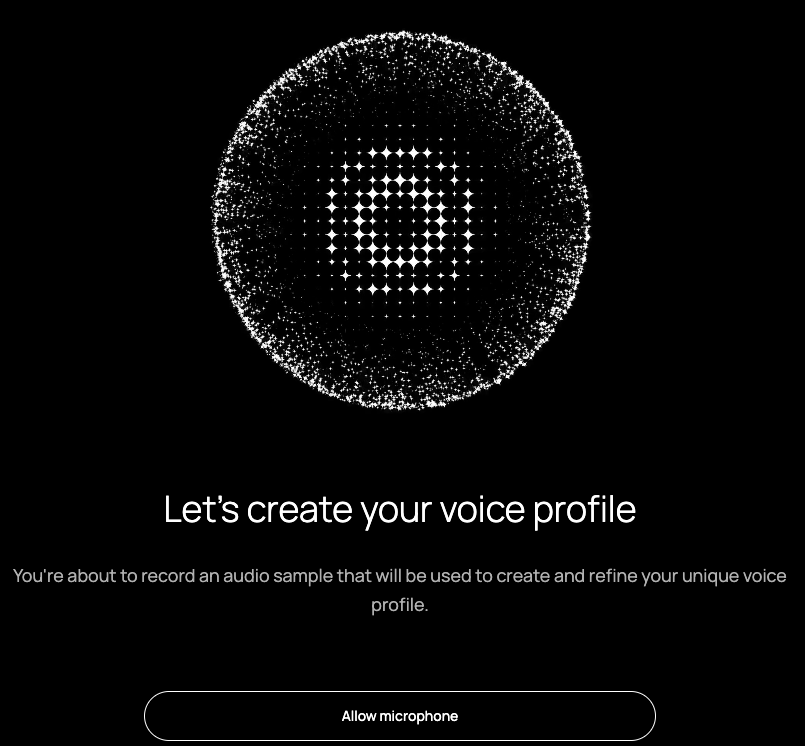
After entering the project's official website, you can complete the registration via email. Currently, there is no need to bind an encrypted wallet, which is very user-friendly for new users. The first login requires you to enable microphone permission and read a few English words.
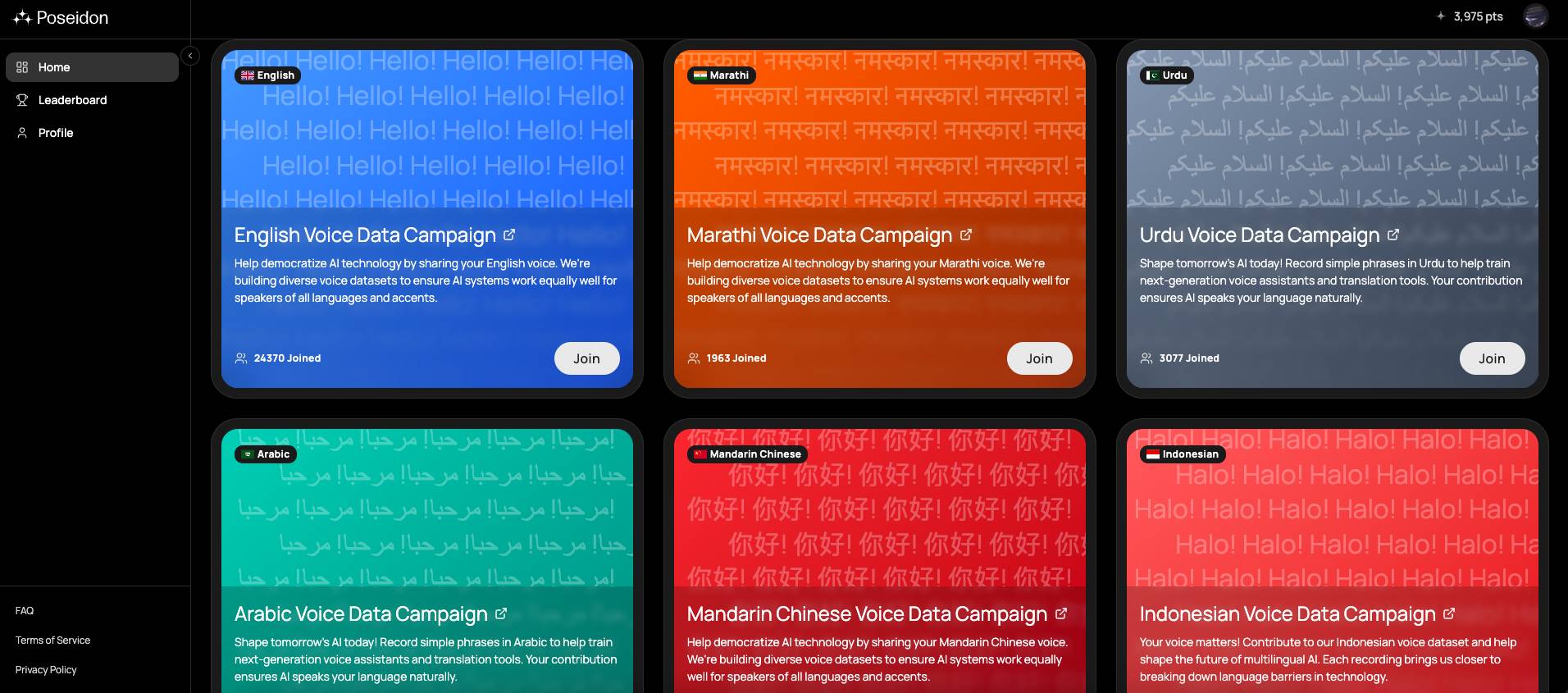
After passing, you can enter the main interface of the project and select the language you want to input in the "Home" column in the left navigation bar. Currently, Poseidon supports 16 languages including English, Chinese, German, Japanese, etc. The English language, which has the largest number of participants, has more than 24,000 users.
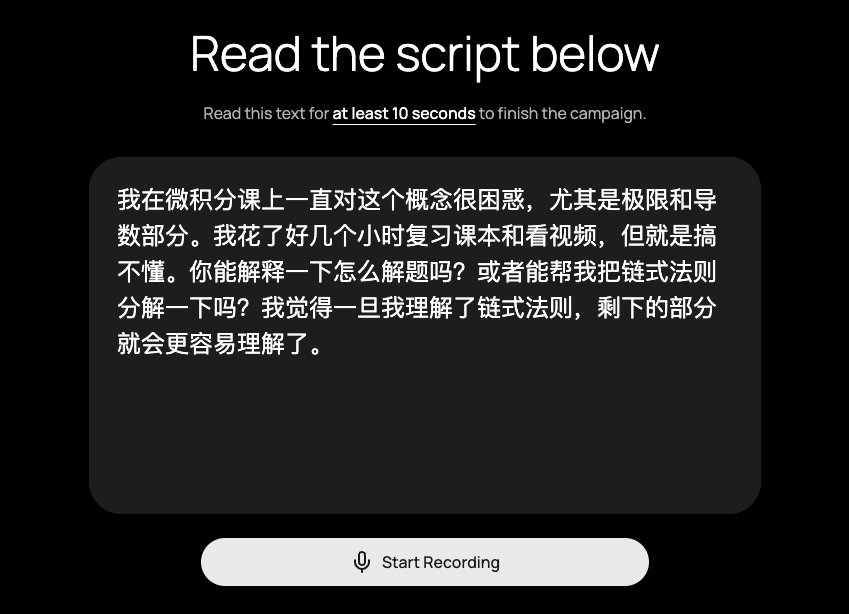
After selecting the language you want to input, you can enter the material reading interface. Click "Start Recording" to start reading. After recording for at least 10 seconds, you can click "Submitting" to submit and get 10 points.
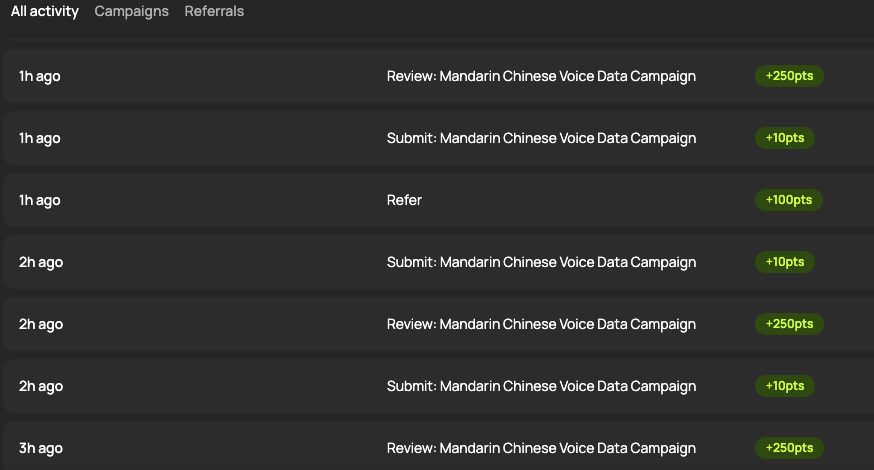
After submitting the recording, AI will conduct a voice review. If the voice review is passed, you can get an additional 50-250 points.
Points acquisition strategy

According to the current language reward information on the Poseidon website, English, which has the most participants, receives the lowest points: 10 (for submission) + 50 (for review). Other languages, including Chinese, receive 10 + 250 points. Therefore, for users in the Chinese-speaking region, choosing Chinese voice input is both simpler and more rewarding.
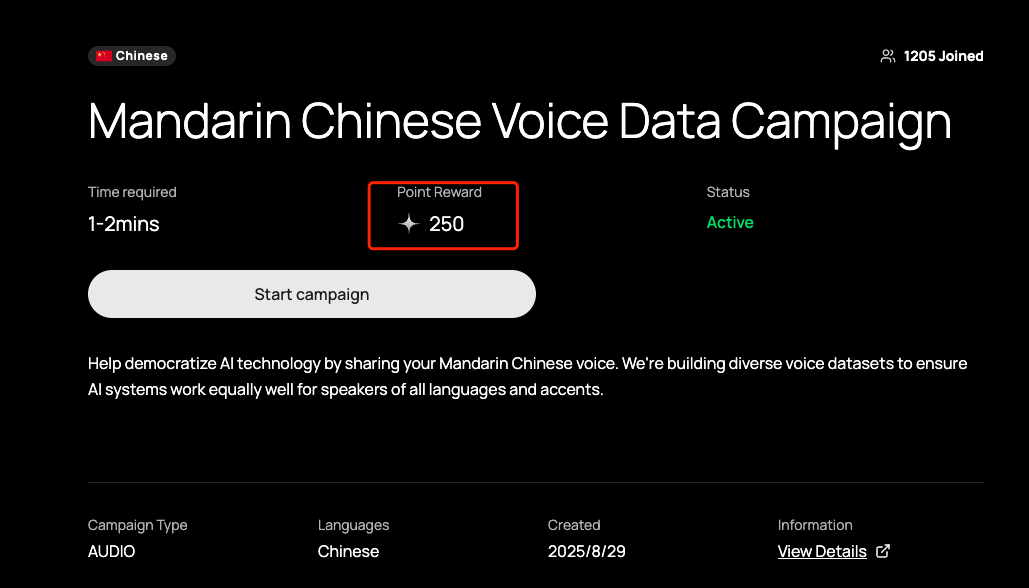
It should be noted that the daily recording submission limit is 5 times. Through active interaction (such as submitting high-quality recording content), users can obtain up to 20 recording submissions per day.

At the same time, after the author's testing, if the recording is not clear or a blank recording is submitted, the full points reward cannot be obtained, and the daily submission times will also be consumed.

Through the "Profile" interface on the left side of the official website, users can view their points acquisition details and exclusive invitation links.
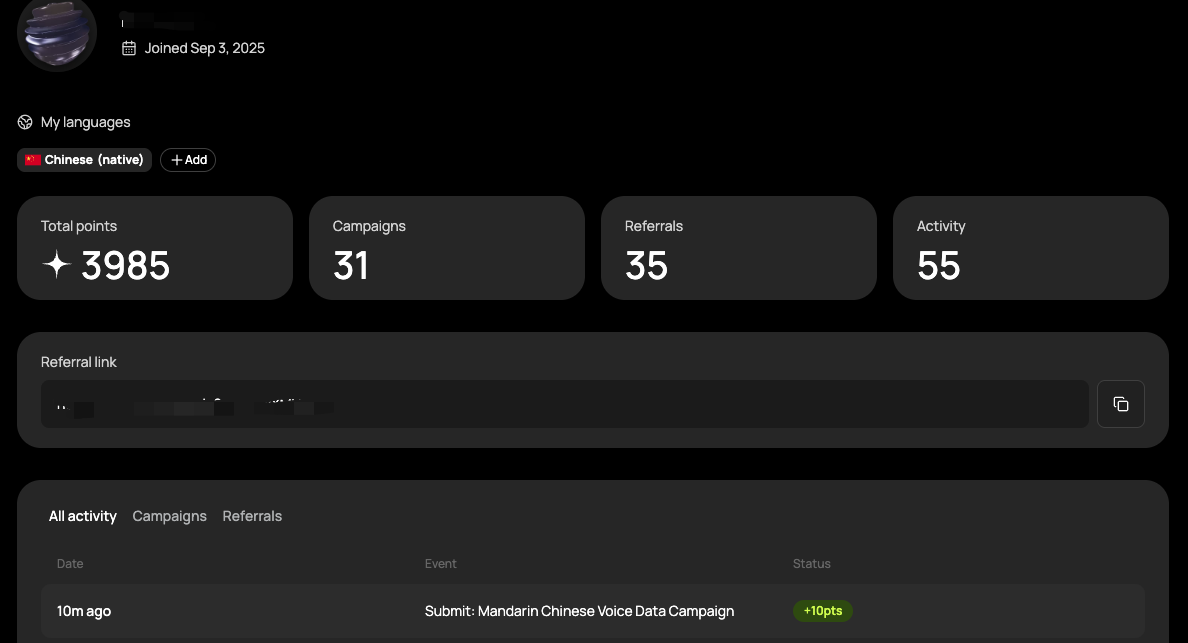
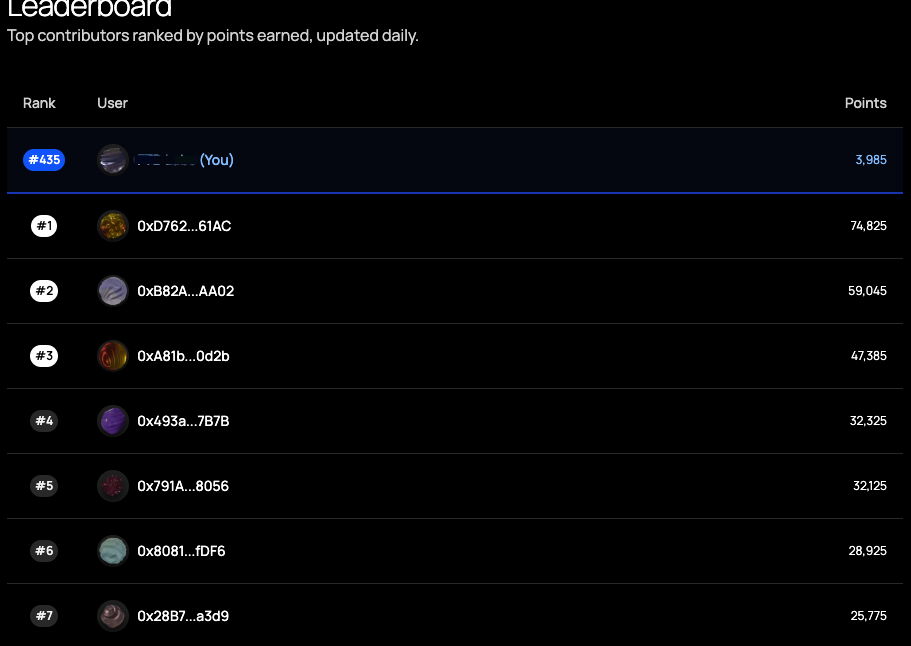
The leaderboard interface on the left navigation bar allows you to view the points rankings. It can be seen that there are not many participants at present. The author obtained a total of 3985 points in two days of interaction and ranked 435th on the leaderboard. As the number of participating users increases in the future, the competition may become more and more competitive.
Airdrop Expectations

Although Poseidon has not yet announced the token issuance time, its official website shows that points for participating in interactions will be converted into rewards or token airdrops after the token economy is determined.
With the rapid development of AI in recent years, related encryption projects have emerged in an endless stream, and the basic data for AI development is being continuously consumed. AI urgently needs high-quality voice data in real scenarios. This demand has given birth to the Poseidon project.

From the user's perspective, this may be an early opportunity with low risk and high potential. Currently, you only need to invest time and voice to obtain future airdrop expectations.

Piyasa Fırsatı
NEAR Logosu
NEAR Fiyatı(NEAR)
$1.528
$1.528$1.528
-0.39%
USD
NEAR (NEAR) Canlı Fiyat Grafiği
Sorumluluk Reddi: Bu sitede yeniden yayınlanan makaleler, halka açık platformlardan alınmıştır ve yalnızca bilgilendirme amaçlıdır. MEXC'nin görüşlerini yansıtmayabilir. Tüm hakları telif sahiplerine aittir. Herhangi bir içeriğin üçüncü taraf haklarını ihlal ettiğini düşünüyorsanız, kaldırılması için lütfen service@support.mexc.com ile iletişime geçin. MEXC, içeriğin doğruluğu, eksiksizliği veya güncelliği konusunda hiçbir garanti vermez ve sağlanan bilgilere dayalı olarak alınan herhangi bir eylemden sorumlu değildir. İçerik, finansal, yasal veya diğer profesyonel tavsiye niteliğinde değildir ve MEXC tarafından bir tavsiye veya onay olarak değerlendirilmemelidir.

Ayrıca Şunları da Beğenebilirsiniz

The Channel Factories We’ve Been Waiting For

The Channel Factories We’ve Been Waiting For

The post The Channel Factories We’ve Been Waiting For appeared on BitcoinEthereumNews.com. Visions of future technology are often prescient about the broad strokes while flubbing the details. The tablets in “2001: A Space Odyssey” do indeed look like iPads, but you never see the astronauts paying for subscriptions or wasting hours on Candy Crush.  Channel factories are one vision that arose early in the history of the Lightning Network to address some challenges that Lightning has faced from the beginning. Despite having grown to become Bitcoin’s most successful layer-2 scaling solution, with instant and low-fee payments, Lightning’s scale is limited by its reliance on payment channels. Although Lightning shifts most transactions off-chain, each payment channel still requires an on-chain transaction to open and (usually) another to close. As adoption grows, pressure on the blockchain grows with it. The need for a more scalable approach to managing channels is clear. Channel factories were supposed to meet this need, but where are they? In 2025, subnetworks are emerging that revive the impetus of channel factories with some new details that vastly increase their potential. They are natively interoperable with Lightning and achieve greater scale by allowing a group of participants to open a shared multisig UTXO and create multiple bilateral channels, which reduces the number of on-chain transactions and improves capital efficiency. Achieving greater scale by reducing complexity, Ark and Spark perform the same function as traditional channel factories with new designs and additional capabilities based on shared UTXOs.  Channel Factories 101 Channel factories have been around since the inception of Lightning. A factory is a multiparty contract where multiple users (not just two, as in a Dryja-Poon channel) cooperatively lock funds in a single multisig UTXO. They can open, close and update channels off-chain without updating the blockchain for each operation. Only when participants leave or the factory dissolves is an on-chain transaction…
Paylaş
BitcoinEthereumNews2025/09/18 00:09
XRP Price Prediction: Can Ripple Rally Past $2 Before the End of 2025?

XRP Price Prediction: Can Ripple Rally Past $2 Before the End of 2025?

The post XRP Price Prediction: Can Ripple Rally Past $2 Before the End of 2025? appeared first on Coinpedia Fintech News The XRP price has come under enormous pressure
Paylaş
CoinPedia2025/12/16 19:22
BlackRock boosts AI and US equity exposure in $185 billion models

BlackRock boosts AI and US equity exposure in $185 billion models

The post BlackRock boosts AI and US equity exposure in $185 billion models appeared on BitcoinEthereumNews.com. BlackRock is steering $185 billion worth of model portfolios deeper into US stocks and artificial intelligence. The decision came this week as the asset manager adjusted its entire model suite, increasing its equity allocation and dumping exposure to international developed markets. The firm now sits 2% overweight on stocks, after money moved between several of its biggest exchange-traded funds. This wasn’t a slow shuffle. Billions flowed across multiple ETFs on Tuesday as BlackRock executed the realignment. The iShares S&P 100 ETF (OEF) alone brought in $3.4 billion, the largest single-day haul in its history. The iShares Core S&P 500 ETF (IVV) collected $2.3 billion, while the iShares US Equity Factor Rotation Active ETF (DYNF) added nearly $2 billion. The rebalancing triggered swift inflows and outflows that realigned investor exposure on the back of performance data and macroeconomic outlooks. BlackRock raises equities on strong US earnings The model updates come as BlackRock backs the rally in American stocks, fueled by strong earnings and optimism around rate cuts. In an investment letter obtained by Bloomberg, the firm said US companies have delivered 11% earnings growth since the third quarter of 2024. Meanwhile, earnings across other developed markets barely touched 2%. That gap helped push the decision to drop international holdings in favor of American ones. Michael Gates, lead portfolio manager for BlackRock’s Target Allocation ETF model portfolio suite, said the US market is the only one showing consistency in sales growth, profit delivery, and revisions in analyst forecasts. “The US equity market continues to stand alone in terms of earnings delivery, sales growth and sustainable trends in analyst estimates and revisions,” Michael wrote. He added that non-US developed markets lagged far behind, especially when it came to sales. This week’s changes reflect that position. The move was made ahead of the Federal…
Paylaş
BitcoinEthereumNews2025/09/18 01:44