Pi Network Price Prediction 2026–2030: Can PI Hit $0.30 Soon?
- Pi Network Struggles to Gain Traction After 2026 Upgrade
- Developer toolkit strengthens long-term utility, but near-term price remains capped.
- Heavy EMA resistance and token unlocks continue to limit upside momentum.
Pi Network price today trades near $0.2085 following the project’s first major update of 2026, which introduced a bundled developer toolkit aimed at reducing integration time to under ten minutes. The update represents a meaningful step toward transitioning Pi away from its mobile mining origins and into a utility-driven settlement network. Despite this progress, price action has remained muted as traders continue to prioritize supply dynamics and liquidity constraints over development milestones.
Although the infrastructure upgrade improves the long-term outlook, the short-term technical structure remains fragile. PI continues to consolidate beneath key resistance levels, raising the question of whether improving fundamentals can support a move toward $0.30 in the near term.
Pi Network’s Development Progress Signals Utility, Not Immediate Repricing
Pi Network has rolled out a combined Software Development Kit with backend APIs designed to simplify payment and application integration across JavaScript, React, Next.js, and Ruby on Rails. The toolkit lowers entry barriers for developers and is intended to accelerate the creation of applications that use PI as a settlement layer rather than as a purely speculative asset.
At the protocol level, version 23 integrating Stellar Core v23.0.1 has been deployed to enhance transaction speed and security. The network now supports more than 15.8 million Mainnet Pioneers, underscoring its scale advantage. The team has also confirmed plans to launch a decentralized exchange in early 2026, with Rust-based smart contracts already live.
Despite these milestones, markets have yet to reflect a meaningful repricing. Traders continue to view development progress as foundational rather than a direct catalyst for short-term price appreciation.
Also Read: Pudgy Penguins (PUDGY) Price Prediction 2025–2029: Can PUDGY Break $0.015 Soon?
Token Unlocks Continue to Weigh on Near-Term Price
A major overhang for PI remains supply expansion. Nearly 95 million PI tokens, valued at roughly $20 million, are scheduled to unlock in January. While this figure is lower than February’s expected release, it remains significant relative to current liquidity and continues to weigh on sentiment.
On-chain data presents mixed signals. More than 2.7 million PI tokens left exchanges during the first week of January, suggesting some holders are opting for self-custody rather than immediate selling. However, Pi Network’s social dominance has fallen to 0.004 percent, reflecting weak media coverage and subdued retail interest.
Until demand expands meaningfully, token unlocks are likely to remain a headwind that delays any sustained move toward $0.30.
EMA Resistance Defines the Path to $0.30
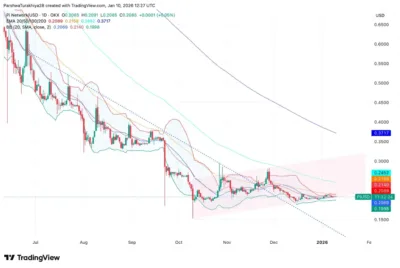
Technically, PI remains below all major exponential moving averages, reinforcing a bearish structure that has persisted since mid-2025. The 20-day EMA near $0.2089 continues to cap short-term rebounds, while the 50-day EMA around $0.2159 and the 100-day EMA near $0.2452 form layered resistance overhead. The 200-day EMA remains far above price near $0.3717, highlighting the distance PI must travel to confirm a broader trend reversal.
Source: Tradingview
Support continues to hold along a rising trendline near $0.2060, which has absorbed multiple downside tests. Bollinger Bands show price hovering near the lower band around $0.1998, with the mid-band near $0.2140 acting as immediate resistance. A sustained break above this zone would be the first technical step toward a test of $0.24 and eventually $0.30.
Short-Term Structure Shows Consolidation, Not Breakout
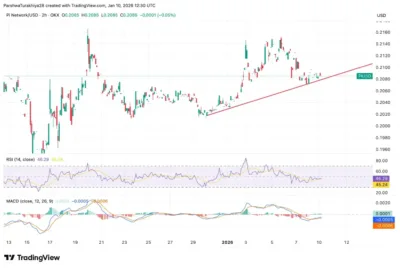
On the two-hour timeframe, PI continues to consolidate along the rising trendline formed in late December. RSI remains neutral near 46, while MACD stays flat, indicating a lack of directional momentum. Buyers have defended support, but follow-through strength remains absent.
Source: Tradingview
Without a clear catalyst or surge in volume, price remains trapped within a descending channel that has guided the broader decline since mid-2025. This suggests that while downside momentum has slowed, upside expansion toward $0.30 is not yet confirmed.
Market Sentiment Remains Cautious Ahead of 2026 Catalysts
Market sentiment around Pi Network remains tactical rather than conviction-driven. While the SDK launch has been well received among developers, traders continue to focus on unlock schedules, liquidity limitations, and the absence of major exchange expansion.
Discussion across social channels reflects patience rather than enthusiasm. Most participants appear willing to wait for confirmation that ecosystem upgrades translate into real transactional demand before pricing in a sustained rally.
Support and Resistance Levels: What PI Needs to Reach $0.30
For PI to realistically challenge the $0.30 level, price must first hold support at $0.2060 and reclaim the $0.22 area with volume. Acceptance above this zone would allow price to test the $0.24–$0.26 resistance band, which aligns with the upper portion of the EMA cluster.
Failure to hold trendline support would expose downside toward $0.19, with a deeper move toward $0.15 possible if selling pressure accelerates.
Bullish and Bearish Scenarios for Pi Network
In a bullish scenario, PI absorbs new supply without major drawdowns and successfully reclaims short-term EMA resistance. Momentum driven by the upcoming decentralized exchange launch could provide the demand necessary to push price toward $0.30.
In a bearish scenario, rejection at resistance combined with unlock-driven selling reinforces the broader downtrend. A decisive breakdown below $0.2060 would delay any upside ambitions and increase the risk of a deeper correction.
Pi Network Price Prediction 2026–2030
| Year | Minimum Price | Average Price | Maximum Price |
|---|---|---|---|
| 2026 | $0.20 | $0.28 | $0.35 |
| 2027 | $0.25 | $0.40 | $0.60 |
| 2028 | $0.30 | $0.55 | $0.85 |
| 2029 | $0.40 | $0.70 | $1.10 |
| 2030 | $0.55 | $0.90 | $1.40 |
2026
Pi Network enters 2026 attempting to stabilize above the $0.20 region. A move toward $0.30 is possible if resistance near $0.24 is cleared and demand improves following the decentralized exchange launch.
2027
Assuming gradual ecosystem growth and improved liquidity, PI could trade in a broader range as volatility compresses and sellers thin out.
2028
With sustained utility adoption, PI may challenge higher resistance zones, though upside is likely to remain cyclical rather than linear.
2029
By 2029, a confirmed trend reversal could see PI trading comfortably above $1.00, provided long-term resistance levels are cleared.
2030
If Pi Network successfully converts its large user base into active economic participants, 2030 could mark a mature phase with stronger price stability and higher valuation ceilings.
Conclusion
Pi Network is making measurable progress on the development front, but price remains constrained by supply pressure, weak visibility, and heavy technical resistance. While a move toward $0.30 is possible, it depends on PI reclaiming key resistance levels and absorbing ongoing token unlocks.
For now, PI sits at a critical inflection point. Fundamentals are improving, but until demand confirms the shift, any rally toward $0.30 remains conditional rather than assured.
FAQs
1. Can Pi Network hit $0.30 in 2026?
Yes, PI can reach $0.30 in 2026, but only if it reclaims the $0.22–$0.24 resistance zone, absorbs token unlocks, and sees improved liquidity. Without these conditions, any move toward $0.30 would likely lack sustainability.
2. What is currently holding PI price back?
Heavy token unlocks, limited exchange liquidity, weak retail participation, and strong overhead resistance from multiple EMAs are the main constraints on price.
3. Is Pi Network bullish or bearish right now?
PI remains structurally bearish on higher timeframes, although short-term momentum has stabilized into consolidation.
4. What resistance levels must PI break to move higher?
PI must first reclaim $0.22, followed by the $0.24–$0.26 zone. Clearing these levels would significantly improve the probability of a push toward $0.30.
5. Could PI drop below $0.20 again?
Yes. A decisive loss of trendline support near $0.2060 could expose downside toward $0.19 and potentially $0.15.
6. Will the Pi Network DEX launch impact price?
The DEX could act as a catalyst if it drives real transactional demand and improves liquidity. Its impact will depend on adoption, not the launch itself.
7. What is Pi Network’s long-term outlook?
Long-term prospects depend on whether Pi Network converts its large user base into active economic participants. If utility adoption scales and liquidity deepens, a sustained trend reversal between 2027 and 2030 becomes possible.
Also Read: KAITO Price Prediction 2025–2029: Can KAITO Hit $1.05 Soon?
The post Pi Network Price Prediction 2026–2030: Can PI Hit $0.30 Soon? appeared first on 36Crypto.


You May Also Like

USD/JPY Holds Below Critical 159.00 Level as Crucial Iran Ceasefire Deadline Looms

Soluna funds $53M wind farm to power AI facility for Bitcoin mining