As Goldman Sachs loads up on safe, regulated Bitcoin ETFs, crypto-native whales are chasing bolder bets, like APORK, a memecoin mixing virality with real utility. #sponsoredAs Goldman Sachs loads up on safe, regulated Bitcoin ETFs, crypto-native whales are chasing bolder bets, like APORK, a memecoin mixing virality with real utility. #sponsored

Goldman Sachs bets on Bitcoin ETFs; Telegram whales eye this Solana-based presale

Disclosure: This article does not represent investment advice. The content and materials featured on this page are for educational purposes only.

As Goldman Sachs loads up on safe, regulated Bitcoin ETFs, crypto-native whales are chasing bolder bets, like APORK, a memecoin mixing virality with real utility.

Table of Contents

  • Why does Goldman Sachs bet on the BTC ETF?
  • What is it about APORK that attracts the Telegram Whales?

In February 2025, we saw that Goldman Sachs make a significant investment in Bitcoin ETFs, as it increased its holdings in the iShares Bitcoin Trust (IBIT) by 28%. For a firm that manages billions in client capital, Bitcoin (BTC) via ETF is the safest way to offer exposure in the crypto market to its consumers.

Why does Goldman Sachs bet on the BTC ETF?

Because it is most likely a safer bet. It’s regulated by the SEC, and the assets are custodied by trusted third parties like Coinbase. In fact, everything from liquidity to tax treatment is structured in a way that they don’t touch private keys. And they do it all in clean, auditable ways.

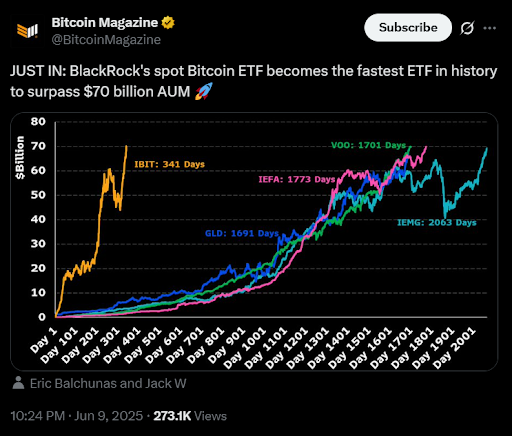
For firms as large as Goldman Sachs, it’s about parking large amounts of money into an asset they believe is now legitimised. In fact, in early June, we saw that the Bitcoin ETF surged past $70 billion in assets under management (AUM), reaching the milestone in just 341 trading days.
Goldman Sachs bets on Bitcoin ETFs; Telegram whales eye this Solana-based presale - 1

But the Telegram whales, or the big analysts that assess communities of fast-moving private groups filled with crypto-native players, don’t have to stick to less risky assets just to play it safe. Many are leaning toward something much louder, faster, and looser: memecoins with utility, like APORK.

Goldman Sachs bets on Bitcoin ETFs; Telegram whales eye this Solana-based presale - 2

What is it about APORK that attracts the Telegram Whales?

What we have seen over the years is that whales don’t have compliance departments and don’t need to wait for ETFs. What they care about is multipliers, narrative momentum, early access, and spotting trends. 

What makes it stand out?

Its core idea is to build a memecoin that monetizes attention, not just speculation. APORK does this through three layers of engagement:

  1. Meme culture: It uses humor, branding, and virality to attract attention.
  2. Through GambleFi games, staking, deflation, and reward tiers, it ensures users have reasons to stay.
  3. With CommunityFi, users earn coins for holding and for spreading the word and adding value to the community.

This trifecta makes APORK a hybrid: part meme, part GameFi, part DeFi.

Solana’s memecoin sector exploded in late 2023 and early 2024 thanks to the platform’s ultra-low fees, fast confirmation times, and strong Telegram-native community support. But most of these coins were short-lived pumps with no real matter. There were very few coins that timed its virality right in the markets. 

In this sense, APORK could be:

  • Solana’s first GambleFi-meme hybrid
  • A blueprint for sustainable memecoin design

As the Solana market shows maturity and saturation of old memecoins, it surely looks like Angry Pepe Fork could be the one to pump up the markets again.

Disclosure: This content is provided by a third party. crypto.news does not endorse any product mentioned on this page. Users must do their own research before taking any actions related to the company.

Market Opportunity
RealLink Logo
RealLink Price(REAL)
$0.07489
$0.07489$0.07489
+1.49%
USD
RealLink (REAL) Live Price Chart
Disclaimer: The articles reposted on this site are sourced from public platforms and are provided for informational purposes only. They do not necessarily reflect the views of MEXC. All rights remain with the original authors. If you believe any content infringes on third-party rights, please contact service@support.mexc.com for removal. MEXC makes no guarantees regarding the accuracy, completeness, or timeliness of the content and is not responsible for any actions taken based on the information provided. The content does not constitute financial, legal, or other professional advice, nor should it be considered a recommendation or endorsement by MEXC.

You May Also Like

Russia’s Central Bank Prepares Crackdown on Crypto in New 2026–2028 Strategy

Russia’s Central Bank Prepares Crackdown on Crypto in New 2026–2028 Strategy

The Central Bank of Russia’s long-term strategy for 2026 to 2028 paints a picture of growing concern. The document, prepared […] The post Russia’s Central Bank Prepares Crackdown on Crypto in New 2026–2028 Strategy appeared first on Coindoo.
Share
Coindoo2025/09/18 02:30
Japanese Yen rises on safe-haven demand and intervention concerns

Japanese Yen rises on safe-haven demand and intervention concerns

The post Japanese Yen rises on safe-haven demand and intervention concerns appeared on BitcoinEthereumNews.com. The Japanese Yen (JPY) attracts some buyers at the
Share
BitcoinEthereumNews2025/12/22 11:49
Cryptos Signal Divergence Ahead of Fed Rate Decision

Cryptos Signal Divergence Ahead of Fed Rate Decision

The post Cryptos Signal Divergence Ahead of Fed Rate Decision appeared on BitcoinEthereumNews.com. Crypto assets send conflicting signals ahead of the Federal Reserve’s September rate decision. On-chain data reveals a clear decrease in Bitcoin and Ethereum flowing into centralized exchanges, but a sharp increase in altcoin inflows. The findings come from a Tuesday report by CryptoQuant, an on-chain data platform. The firm’s data shows a stark divergence in coin volume, which has been observed in movements onto centralized exchanges over the past few weeks. Bitcoin and Ethereum Inflows Drop to Multi-Month Lows Sponsored Sponsored Bitcoin has seen a dramatic drop in exchange inflows, with the 7-day moving average plummeting to 25,000 BTC, its lowest level in over a year. The average deposit per transaction has fallen to 0.57 BTC as of September. This suggests that smaller retail investors, rather than large-scale whales, are responsible for the recent cash-outs. Ethereum is showing a similar trend, with its daily exchange inflows decreasing to a two-month low. CryptoQuant reported that the 7-day moving average for ETH deposits on exchanges is around 783,000 ETH, the lowest in two months. Other Altcoins See Renewed Selling Pressure In contrast, other altcoin deposit activity on exchanges has surged. The number of altcoin deposit transactions on centralized exchanges was quite steady in May and June of this year, maintaining a 7-day moving average of about 20,000 to 30,000. Recently, however, that figure has jumped to 55,000 transactions. Altcoins: Exchange Inflow Transaction Count. Source: CryptoQuant CryptoQuant projects that altcoins, given their increased inflow activity, could face relatively higher selling pressure compared to BTC and ETH. Meanwhile, the balance of stablecoins on exchanges—a key indicator of potential buying pressure—has increased significantly. The report notes that the exchange USDT balance, around $273 million in April, grew to $379 million by August 31, marking a new yearly high. CryptoQuant interprets this surge as a reflection of…
Share
BitcoinEthereumNews2025/09/18 01:01