When we launched our first product, I felt like we had crossed a finish line that cost us blood. The tech team was drowning in bugs, improvements, feedback, and a roadmap piling up on top of us. And there I was, with an idea, but without knowing how to code. What if I build the first version myself, even if I don’t know how to program? I did it. In 2 weeks and I’ll tell you how.When we launched our first product, I felt like we had crossed a finish line that cost us blood. The tech team was drowning in bugs, improvements, feedback, and a roadmap piling up on top of us. And there I was, with an idea, but without knowing how to code. What if I build the first version myself, even if I don’t know how to program? I did it. In 2 weeks and I’ll tell you how.

I Didn’t Know How to Code. But I Knew What We Needed: An MVP

When we launched our first product, I felt like we had crossed a finish line that cost us blood. There was something alive—out in the stores, in users’ hands. But reality doesn’t let you breathe for long.

Our real workhorse was the next step and we didn’t have the luxury to do it “later, but better.”

The tech team was drowning in bugs, improvements, feedback, and a roadmap piling up on top of us. The heaviest weight wasn’t outside pressure—it was looking at the backlog, realizing how much depended on our small team, and feeling stuck.

All this while AI was moving at a ridiculous pace. And there I was, with an idea, but without knowing how to code.

Until I asked myself:

What if I just do it? What if I build the first version of the product myself, even if I don’t know how to program?

Spoiler: I did it. In 2 weeks and I’ll tell you how. Because if you’re in a similar situation, this might unlock you.

From Failing a “Hello, World” to Cloning a Repo

For context: I’m not a developer. Years ago, I tried to do a simple “Hello, World!” and failed miserably.

But this time was different. I had a concrete need and when you have a real need, no-code tools stop being “toys” to become your only way forward.

I stumbled upon a free mini-course by Ariel Mathov on LinkedIn where he explained Cursor. I watched two full lessons. That was enough to download the app, open it, and freeze…

Cursor gave me three options: clone repo, open project, or connect via SSH. I didn’t understand any of it, but that’s where the adventure began.
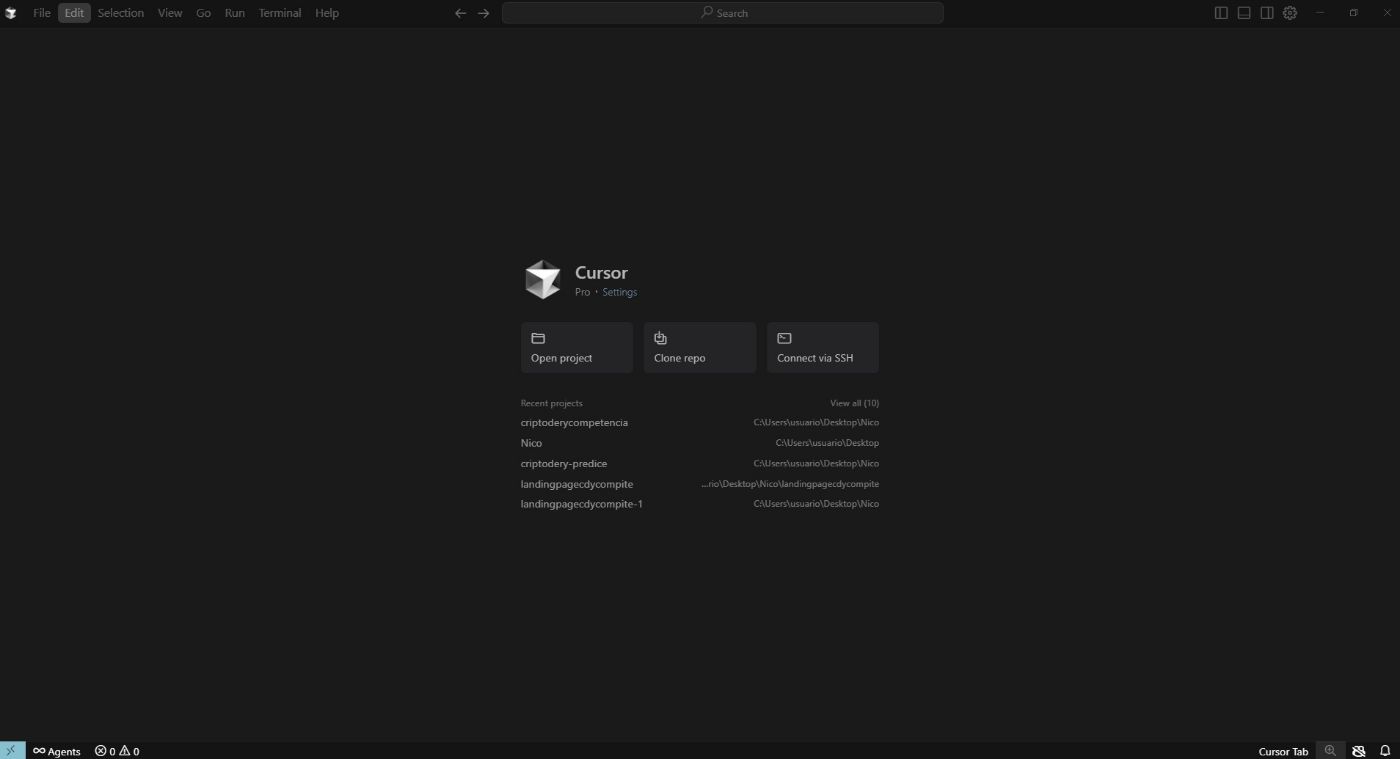
Cursor, GitHub and My First “Hello Agent”

I realized I needed a GitHub project to move forward. So, without fully understanding what I was doing, I cloned a repo, opened it in Cursor, and wrote my first message to the AI chat:

Hello, friend.

Cursor’s AI replied instantly. It asked me what I wanted to build. I said:

“I want to validate an idea in two weeks. Ask me whatever you need.”

It threw 50 questions at me I couldn’t answer, so I just typed: “==Yes, I want all that== 😳.”

And the show began.

Seeing Code Without Understanding It (But Trusting It Works)

Line after line, the AI agent started building with Next.js + TypeScript. It explained what it was doing:

“We’re generating a robust and scalable environment so you can test your product quickly.”

I stared at the screen like it was The Matrix. I didn’t understand a thing—but it didn’t matter.

A Note of Respect

Let me be clear: I’m not a developer, and I don’t intend to be. I have enormous respect for my colleagues who are. This article isn’t about “replacing” anyone—it’s about how AI today lets small teams unblock things faster. For me, it was a way to move forward when time was crushing us, knowing the development team could later audit, refine, and clean up what I had started—while they focused on putting out other fires.

So I listed out the features I needed—things like authentication, flows, and results tracking. The AI spun it all up in minutes.

I ran npm run dev and opened localhost:3000. And there it was: a functioning app. Some errors, sure—but it worked. It had an interface, a full flow, and even animations.

From Skeleton to Experience

I had the basic structure working but what was missing was real-time interaction between users. The AI suggested using Firebase so I opened an account, set up a database, and suddenly had a working foundation for storing and syncing information.

The rest was about iterating on what I did know: adjusting UX, adding design, writing questions by level. The tech stuff, I kept resolving with AI prompts:

“This doesn’t look right.” → “Fixed.” \n “Can you center this?” → “Done.”

In two weeks, we had a functional MVP—clean, aesthetic, and aligned with the product we wanted to validate.

What You Can Do Right Now

If you’re in a situation like mine—with a product that can’t wait or a tech team overwhelmed—try this:

\

  • ==Define your ideal flow==. You don’t need to code, but you do need clarity on what you want your product to do. I didn’t at first, and I ended up redoing everything twice. \n

  • ==Write prompts as if you were talking to a developer friend==. Use whatever technical terms you know; if you don’t know many, that’s fine—AI will figure it out, though it might take longer. For precision, you can even use another AI to translate your idea into “developer language.” \n

  • ==Choose tools that play nicely together==. For me: Cursor + GitHub + Firebase + Vercel. \n

  • ==Allow yourself to do things badly==. The first version won’t be perfect—but it will be functional. And that’s enough to test.

    \

  • ==Stay in touch with your developer== so they can review and refine what you build.

What I Learned: Nobody’s Too Far From Building

I didn’t become a developer. I didn’t learn TypeScript. I didn’t fully understand how Firebase stores data.

But over time, I got curious and started grasping some development logic. More importantly: I validated an idea, I had a demo to show, and I discovered I don’t need to know everything to build something that works.

If you know what you want, can explain it out loud, and are patient with an AI, you can create more than you think.

\n

Market Opportunity
Threshold Logo
Threshold Price(T)
$0.009014
$0.009014$0.009014
+0.73%
USD
Threshold (T) Live Price Chart
Disclaimer: The articles reposted on this site are sourced from public platforms and are provided for informational purposes only. They do not necessarily reflect the views of MEXC. All rights remain with the original authors. If you believe any content infringes on third-party rights, please contact service@support.mexc.com for removal. MEXC makes no guarantees regarding the accuracy, completeness, or timeliness of the content and is not responsible for any actions taken based on the information provided. The content does not constitute financial, legal, or other professional advice, nor should it be considered a recommendation or endorsement by MEXC.

You May Also Like

Unexpected Developments Shake the Financial Sphere

Unexpected Developments Shake the Financial Sphere

The post Unexpected Developments Shake the Financial Sphere appeared on BitcoinEthereumNews.com. Japan’s recent move to hike its interest rate to 0.75 ahead of
Share
BitcoinEthereumNews2025/12/19 22:07
Foreigner’s Lou Gramm Revisits The Band’s Classic ‘4’ Album, Now Reissued

Foreigner’s Lou Gramm Revisits The Band’s Classic ‘4’ Album, Now Reissued

The post Foreigner’s Lou Gramm Revisits The Band’s Classic ‘4’ Album, Now Reissued appeared on BitcoinEthereumNews.com. American-based rock band Foreigner performs onstage at the Rosemont Horizon, Rosemont, Illinois, November 8, 1981. Pictured are, from left, Mick Jones, on guitar, and vocalist Lou Gramm. (Photo by Paul Natkin/Getty Images) Getty Images Singer Lou Gramm has a vivid memory of recording the ballad “Waiting for a Girl Like You” at New York City’s Electric Lady Studio for his band Foreigner more than 40 years ago. Gramm was adding his vocals for the track in the control room on the other side of the glass when he noticed a beautiful woman walking through the door. “She sits on the sofa in front of the board,” he says. “She looked at me while I was singing. And every now and then, she had a little smile on her face. I’m not sure what that was, but it was driving me crazy. “And at the end of the song, when I’m singing the ad-libs and stuff like that, she gets up,” he continues. “She gives me a little smile and walks out of the room. And when the song ended, I would look up every now and then to see where Mick [Jones] and Mutt [Lange] were, and they were pushing buttons and turning knobs. They were not aware that she was even in the room. So when the song ended, I said, ‘Guys, who was that woman who walked in? She was beautiful.’ And they looked at each other, and they went, ‘What are you talking about? We didn’t see anything.’ But you know what? I think they put her up to it. Doesn’t that sound more like them?” “Waiting for a Girl Like You” became a massive hit in 1981 for Foreigner off their album 4, which peaked at number one on the Billboard chart for 10 weeks and…
Share
BitcoinEthereumNews2025/09/18 01:26
Adoption Leads Traders to Snorter Token

Adoption Leads Traders to Snorter Token

The post Adoption Leads Traders to Snorter Token appeared on BitcoinEthereumNews.com. Largest Bank in Spain Launches Crypto Service: Adoption Leads Traders to Snorter Token Sign Up for Our Newsletter! For updates and exclusive offers enter your email. Leah is a British journalist with a BA in Journalism, Media, and Communications and nearly a decade of content writing experience. Over the last four years, her focus has primarily been on Web3 technologies, driven by her genuine enthusiasm for decentralization and the latest technological advancements. She has contributed to leading crypto and NFT publications – Cointelegraph, Coinbound, Crypto News, NFT Plazas, Bitcolumnist, Techreport, and NFT Lately – which has elevated her to a senior role in crypto journalism. Whether crafting breaking news or in-depth reviews, she strives to engage her readers with the latest insights and information. Her articles often span the hottest cryptos, exchanges, and evolving regulations. As part of her ploy to attract crypto newbies into Web3, she explains even the most complex topics in an easily understandable and engaging way. Further underscoring her dynamic journalism background, she has written for various sectors, including software testing (TEST Magazine), travel (Travel Off Path), and music (Mixmag). When she’s not deep into a crypto rabbit hole, she’s probably island-hopping (with the Galapagos and Hainan being her go-to’s). Or perhaps sketching chalk pencil drawings while listening to the Pixies, her all-time favorite band. This website uses cookies. By continuing to use this website you are giving consent to cookies being used. Visit our Privacy Center or Cookie Policy. I Agree Source: https://bitcoinist.com/banco-santander-and-snorter-token-crypto-services/
Share
BitcoinEthereumNews2025/09/17 23:45