Cardano’s scaling roadmap hit a visible milestone yesterday as the Hydra team tagged hydra-node v1.0.0 on GitHub—positioning the isomorphic state-channels protocol for production use while still flagging remaining limitations. In a brief comment on X, Cardano founder Charles Hoskinson struck an upbeat tone about the near-term trajectory: “Hydra is going to have an awesome 2026,” […]Cardano’s scaling roadmap hit a visible milestone yesterday as the Hydra team tagged hydra-node v1.0.0 on GitHub—positioning the isomorphic state-channels protocol for production use while still flagging remaining limitations. In a brief comment on X, Cardano founder Charles Hoskinson struck an upbeat tone about the near-term trajectory: “Hydra is going to have an awesome 2026,” […]

Cardano Enters New Scalability Era With Hydra Node V1.0 Release

2025/10/10 23:30

Cardano’s scaling roadmap hit a visible milestone yesterday as the Hydra team tagged hydra-node v1.0.0 on GitHub—positioning the isomorphic state-channels protocol for production use while still flagging remaining limitations. In a brief comment on X, Cardano founder Charles Hoskinson struck an upbeat tone about the near-term trajectory: “Hydra is going to have an awesome 2026,” he wrote, amplifying a community post that framed the upgrade as a step-change for throughput-sensitive use cases.

Cardano’s Hydra Node V1.0 Is Live

The release notes, published under the “A big release of hydra-node! It’s official. We’re at version 1.0.0!” banner, emphasize that the team intends to “continue to support [the] Hydra Head protocol implementation into production environments,” even as they continue work on the “largest outstanding known problem,” partial fanout. Crucially, the tag itself is marked “Pre-release” on GitHub—an important nuance for developers and integrators who follow semantic signals from the repository.

At a technical level, v1.0.0 consolidates months of incremental changes into a package that’s been tested with cardano-node 10.1.2 and cardano-cli 10.1.1.0. The build introduces a beta of incremental commits, allowing funds to be committed to a running Head; adds a –deposit-deadline parameter so operators can define how long a node should watch for deposits before enabling safe recovery; and rewrites the commit and initial scripts in Aiken, moving the initial script to Plutus V3 and shrinking it by 1,337 bytes.

One consequential trade-off appears in the commit-path rewrite: the documented maximum number of Head participants is now eight. The release also notes API refinements (for example, a POST /transaction endpoint) and persistence format changes tied to more efficient snapshot handling.

For builders, these specifics matter because Hydra’s promise has always been pragmatic rather than purely theoretical: execute fast, low-cost transactions off-chain inside a Head while preserving Cardano’s extended-UTXO semantics, then fan the final state back to L1.

The Hydra Head protocol has been mainnet-compatible since v0.10.0, but the v1.0.0 tag signals a harder push toward real-world deployment across DeFi, gaming, and latency-sensitive apps—precisely the domains community voices highlighted in today’s discourse. As one KOL put it in a widely shared post, “Cardano just entered a new era of speed and scalability. Hydra Node v1.0.0 is here — DeFi, gaming, and real-time apps are about to level up.”

While the release notes are measured, the throughput optics behind Hydra are anything but. In prior public stress tests tied to the community’s Hydra Doom project and its CPLAY summit finale, Input Output recorded Hydra hitting 1 million transactions per second.

That figure was presented as a demonstration of how off-chain Hydra Heads can absorb extreme, frame-by-frame game state updates without interrupting service—useful for real-time interactive apps and high-fan-out venues. “We proved that Hydra can scale to 1 million TPS,” Hoskinson said in the company’s recap of the event.

Beneath the headline peak, telemetry circulating during the qualifier rounds showed sustained readings in the hundreds of thousands of TPS, with community dashboards and posts commonly citing plateaus around ~650,000 TPS before the Las Vegas finale pushed beyond the seven-figure mark.

At press time, ADA traded at $0.816.
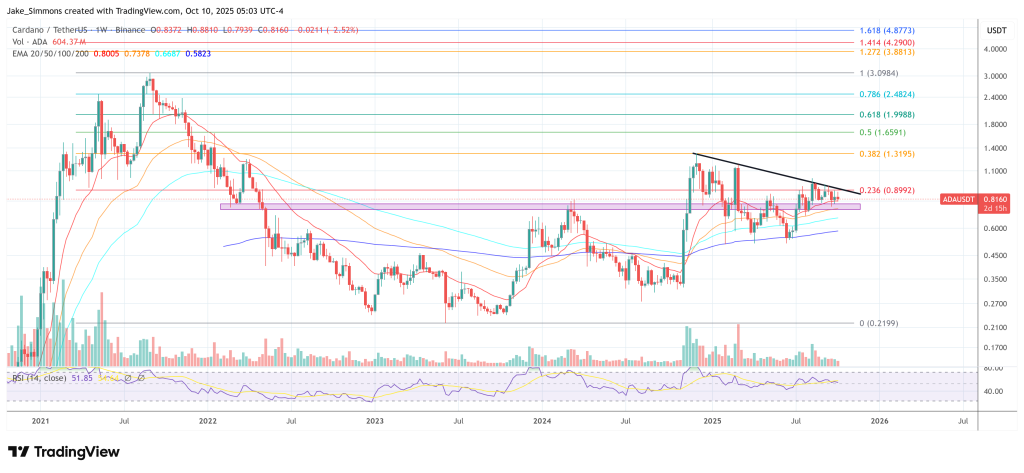
Cardano price
Disclaimer: The articles reposted on this site are sourced from public platforms and are provided for informational purposes only. They do not necessarily reflect the views of MEXC. All rights remain with the original authors. If you believe any content infringes on third-party rights, please contact service@support.mexc.com for removal. MEXC makes no guarantees regarding the accuracy, completeness, or timeliness of the content and is not responsible for any actions taken based on the information provided. The content does not constitute financial, legal, or other professional advice, nor should it be considered a recommendation or endorsement by MEXC.

You May Also Like

Aave DAO to Shut Down 50% of L2s While Doubling Down on GHO

Aave DAO to Shut Down 50% of L2s While Doubling Down on GHO

The post Aave DAO to Shut Down 50% of L2s While Doubling Down on GHO appeared on BitcoinEthereumNews.com. Aave DAO is gearing up for a significant overhaul by shutting down over 50% of underperforming L2 instances. It is also restructuring its governance framework and deploying over $100 million to boost GHO. This could be a pivotal moment that propels Aave back to the forefront of on-chain lending or sparks unprecedented controversy within the DeFi community. Sponsored Sponsored ACI Proposes Shutting Down 50% of L2s The “State of the Union” report by the Aave Chan Initiative (ACI) paints a candid picture. After a turbulent period in the DeFi market and internal challenges, Aave (AAVE) now leads in key metrics: TVL, revenue, market share, and borrowing volume. Aave’s annual revenue of $130 million surpasses the combined cash reserves of its competitors. Tokenomics improvements and the AAVE token buyback program have also contributed to the ecosystem’s growth. Aave global metrics. Source: Aave However, the ACI’s report also highlights several pain points. First, regarding the Layer-2 (L2) strategy. While Aave’s L2 strategy was once a key driver of success, it is no longer fit for purpose. Over half of Aave’s instances on L2s and alt-L1s are not economically viable. Based on year-to-date data, over 86.6% of Aave’s revenue comes from the mainnet, indicating that everything else is a side quest. On this basis, ACI proposes closing underperforming networks. The DAO should invest in key networks with significant differentiators. Second, ACI is pushing for a complete overhaul of the “friendly fork” framework, as most have been unimpressive regarding TVL and revenue. In some cases, attackers have exploited them to Aave’s detriment, as seen with Spark. Sponsored Sponsored “The friendly fork model had a good intention but bad execution where the DAO was too friendly towards these forks, allowing the DAO only little upside,” the report states. Third, the instance model, once a smart…
Share
BitcoinEthereumNews2025/09/18 02:28
Shytoshi Kusama Addresses $2.4 Million Shibarium Bridge Exploit

Shytoshi Kusama Addresses $2.4 Million Shibarium Bridge Exploit

The post Shytoshi Kusama Addresses $2.4 Million Shibarium Bridge Exploit appeared on BitcoinEthereumNews.com. The lead developer of Shiba Inu, Shytoshi Kusama, has publicly addressed the Shibarium bridge exploit that occurred recently, draining $2.4 million from the network. After days of speculation about his involvement in managing the crisis, the project leader broke his silence. Kusama emphasized that a special “war room” has been set up to restore stolen finances and enhance network security. The statement is his first official words since the bridge compromise occurred. “Although I am focusing on AI initiatives to benefit all our tokens, I remain with the developers and leadership in the war room,” Kusama posted on social media platform X. He dismissed claims that he had distanced himself from the project as “utterly preposterous.” The developer said that the reason behind his silence at first was strategic. Before he could make any statements publicly, he must have taken time to evaluate what he termed a complex and deep situation properly. Kusama also vowed to provide further updates in the official Shiba Inu channels as the team comes up with long-term solutions. As highlighted in our previous article, targeted Shibarium’s bridge infrastructure through a sophisticated attack vector. Hackers gained unauthorized access to validator signing keys, compromising the network’s security framework. The hackers executed a flash loan to acquire 4.6 million BONE ShibaSwap tokens. The validator power on the network was majority held by them after this purchase. They were able to transfer assets out of Shibarium with this control. The response of Shibarium developers was timely to limit the breach. They instantly halted all validator functions in order to avoid additional exploitation. The team proceeded to deposit the assets under staking in a multisig hardware wallet that is secure. External security companies were involved in the investigation effort. Hexens, Seal 911, and PeckShield are collaborating with internal developers to…
Share
BitcoinEthereumNews2025/09/18 03:46
