This section examines the gap in current blockchain Transaction Fee Mechanism (TFM) research, noting that most models assume myopic miners and ignore time-sensitive transactions. By introducing the concept of transaction expiry and connecting it to auction theory, packet scheduling, and real-world analogies like ride-sharing, the work expands on existing algorithms (e.g., RMIX, MG) to show how incorporating urgency and discount factors could lead to more efficient and fair blockchain fee systems.This section examines the gap in current blockchain Transaction Fee Mechanism (TFM) research, noting that most models assume myopic miners and ignore time-sensitive transactions. By introducing the concept of transaction expiry and connecting it to auction theory, packet scheduling, and real-world analogies like ride-sharing, the work expands on existing algorithms (e.g., RMIX, MG) to show how incorporating urgency and discount factors could lead to more efficient and fair blockchain fee systems.

The Algorithmic Evolution of Blockchain Fee Design

2025/10/14 03:54

Abstract and 1. Introduction

1.1 Our Approach

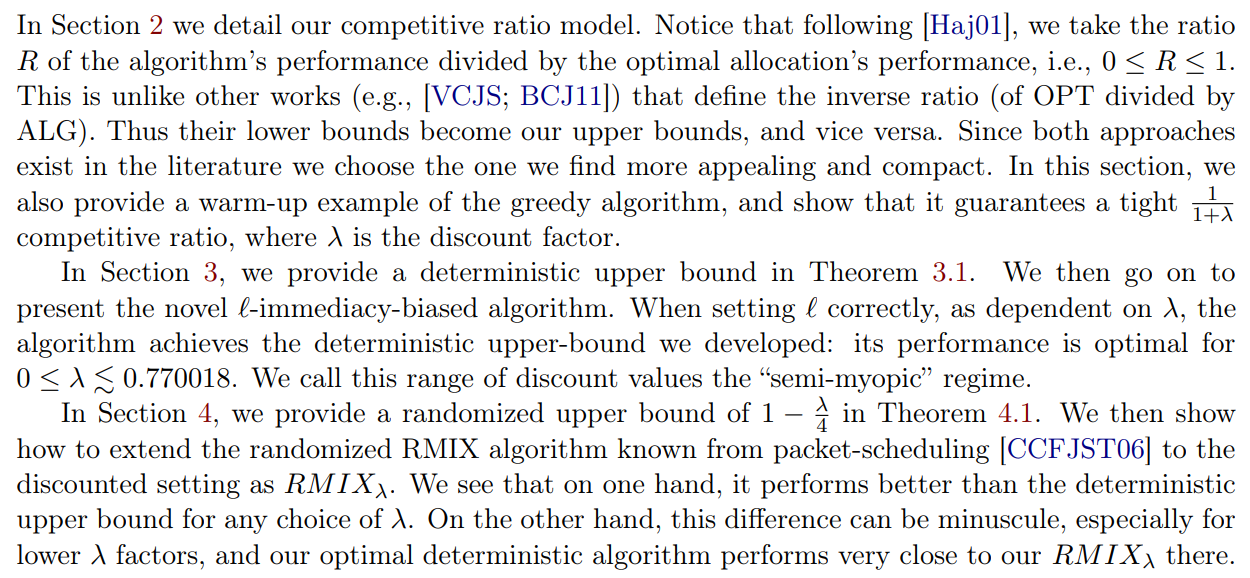
1.2 Our Results & Roadmap

1.3 Related Work

  1. Model and Warmup and 2.1 Blockchain Model

    2.2 The Miner

    2.3 Game Model

    2.4 Warm Up: The Greedy Allocation Function

  2. The Deterministic Case and 3.1 Deterministic Upper Bound

    3.2 The Immediacy-Biased Class Of Allocation Function

  3. The Randomized Case

  4. Discussion and References

  • A. Missing Proofs for Sections 2, 3
  • B. Missing Proofs for Section 4
  • C. Glossary

1.2 Our Results & Roadmap

1.3 Related Work

The application of auction theory to the design of TFMs was explored by a line of works [LSZ22; Yao18; BEOS19; Rou21; CS23], that focused primarily on the axiomatic aspects of the blockchain setting when considering myopic miners.

\ Considerations such as transactions with a finite time to live and non-myopic miners are outside the scope of all the above literature and is a recognized important gap in our understanding of TFMs. Although we focus on the TFM of Blockchain systems, the addition of a predefined expiry date for transactions means that the setting is related to other resource allocation under time-constraints problems. Some examples are deadline-aware job scheduling [SC16] and ride-sharing [DSSX21]. The closest model to ours is perhaps that of Fiat et al. [FGKK16], who analyze a similar framework that considers single-minded users who assign both a fee and some urgency to their requests.

\ \
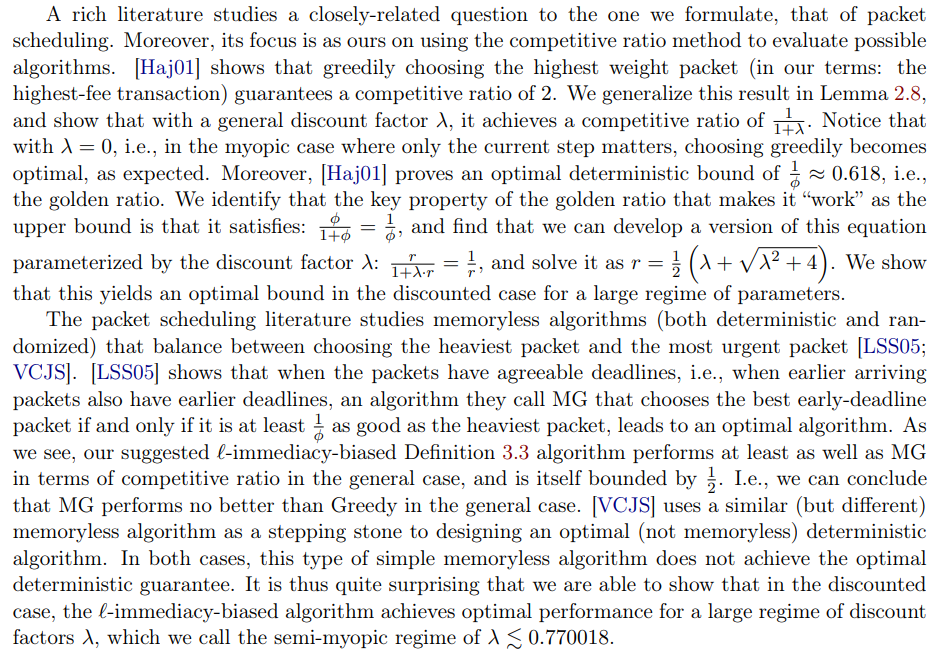
\ \ The literature of packet scheduling also considered randomized algorithms and upper bounds. [CCFJST06] suggested a randomized algorithm that works, similarly to MG, by considering the heaviest packet vs. the best early-deadline packet, but uses a randomized coefficient to determine which of them to choose. We show that [CCFJST06] can be generalized to depend on the discount factor. Our generalization is the same as RMIX when λ = 1, and the same as the greedy algorithm when λ = 0, where it achieves the optimal competitive ratio of 1. [BCJ11] extended RMIX analysis from the oblivious to the adaptive adversary, and also provided an upper bound for any randomized algorithm against the adaptive adversary. We show how to extend their construction to depend on the discount factor. An overview of the packet scheduling literature, including open problems in the field, can be found in [Ves21]. While we do not attempt to give a conclusive overview, we note that there is an alternative literature to that of packet scheduling with deadlines, that considers analysis of whether or not to accept packets to a FIFO queue, and there, a latency sensitive model was previously considered [FMN08].

\

:::info Authors:

(1) Yotam Gafni, Weizmann Institute (yotam.gafni@gmail.com);

(2) Aviv Yaish, The Hebrew University, Jerusalem (aviv.yaish@mail.huji.ac.il).

:::


:::info This paper is available on arxiv under CC BY 4.0 DEED license.

:::

\

Sorumluluk Reddi: Bu sitede yeniden yayınlanan makaleler, halka açık platformlardan alınmıştır ve yalnızca bilgilendirme amaçlıdır. MEXC'nin görüşlerini yansıtmayabilir. Tüm hakları telif sahiplerine aittir. Herhangi bir içeriğin üçüncü taraf haklarını ihlal ettiğini düşünüyorsanız, kaldırılması için lütfen service@support.mexc.com ile iletişime geçin. MEXC, içeriğin doğruluğu, eksiksizliği veya güncelliği konusunda hiçbir garanti vermez ve sağlanan bilgilere dayalı olarak alınan herhangi bir eylemden sorumlu değildir. İçerik, finansal, yasal veya diğer profesyonel tavsiye niteliğinde değildir ve MEXC tarafından bir tavsiye veya onay olarak değerlendirilmemelidir.

Ayrıca Şunları da Beğenebilirsiniz

Akash Network’s Strategic Move: A Crucial Burn for AKT’s Future

Akash Network’s Strategic Move: A Crucial Burn for AKT’s Future

BitcoinWorld Akash Network’s Strategic Move: A Crucial Burn for AKT’s Future In the dynamic world of decentralized computing, exciting developments are constantly shaping the future. Today, all eyes are on Akash Network, the innovative supercloud project, as it proposes a significant change to its tokenomics. This move aims to strengthen the value of its native token, AKT, and further solidify its position in the competitive blockchain space. The community is buzzing about a newly submitted governance proposal that could introduce a game-changing Burn Mint Equilibrium (BME) model. What is the Burn Mint Equilibrium (BME) for Akash Network? The core of this proposal revolves around a concept called Burn Mint Equilibrium, or BME. Essentially, this model is designed to create a balance in the token’s circulating supply by systematically removing a portion of tokens from existence. For Akash Network, this means burning an amount of AKT that is equivalent to the U.S. dollar value of fees paid by network users. Fee Conversion: When users pay for cloud services on the Akash Network, these fees are typically collected in various cryptocurrencies or stablecoins. AKT Equivalence: The proposal suggests converting the U.S. dollar value of these collected fees into an equivalent amount of AKT. Token Burn: This calculated amount of AKT would then be permanently removed from circulation, or ‘burned’. This mechanism creates a direct link between network utility and token supply reduction. As more users utilize the decentralized supercloud, more AKT will be burned, potentially impacting the token’s scarcity and value. Why is This Proposal Crucial for AKT Holders? For anyone holding AKT, or considering investing in the Akash Network ecosystem, this proposal carries significant weight. Token burning mechanisms are often viewed as a positive development because they can lead to increased scarcity. When supply decreases while demand remains constant or grows, the price per unit tends to increase. Here are some key benefits: Increased Scarcity: Burning tokens reduces the total circulating supply of AKT. This makes each remaining token potentially more valuable over time. Demand-Supply Dynamics: The BME model directly ties the burning of AKT to network usage. Higher adoption of the Akash Network supercloud translates into more fees, and thus more AKT burned. Long-Term Value Proposition: By creating a deflationary pressure, the proposal aims to enhance AKT’s long-term value, making it a more attractive asset for investors and long-term holders. This strategic move demonstrates a commitment from the Akash Network community to optimize its tokenomics for sustainable growth and value appreciation. How Does BME Impact the Decentralized Supercloud Mission? Beyond token value, the BME proposal aligns perfectly with the broader mission of the Akash Network. As a decentralized supercloud, Akash provides a marketplace for cloud computing resources, allowing users to deploy applications faster, more efficiently, and at a lower cost than traditional providers. The BME model reinforces this utility. Consider these impacts: Network Health: A stronger AKT token can incentivize more validators and providers to secure and contribute resources to the network, improving its overall health and resilience. Ecosystem Growth: Enhanced token value can attract more developers and projects to build on the Akash Network, fostering a vibrant and diverse ecosystem. User Incentive: While users pay fees, the potential appreciation of AKT could indirectly benefit those who hold the token, creating a circular economy within the supercloud. This proposal is not just about burning tokens; it’s about building a more robust, self-sustaining, and economically sound decentralized cloud infrastructure for the future. What Are the Next Steps for the Akash Network Community? As a governance proposal, the BME model will now undergo a period of community discussion and voting. This is a crucial phase where AKT holders and network participants can voice their opinions, debate the merits, and ultimately decide on the future direction of the project. Transparency and community engagement are hallmarks of decentralized projects like Akash Network. Challenges and Considerations: Implementation Complexity: Ensuring the burning mechanism is technically sound and transparent will be vital. Community Consensus: Achieving broad agreement within the diverse Akash Network community is key for successful adoption. The outcome of this vote will significantly shape the tokenomics and economic model of the Akash Network, influencing its trajectory in the rapidly evolving decentralized cloud landscape. The proposal to introduce a Burn Mint Equilibrium model represents a bold and strategic step for Akash Network. By directly linking network usage to token scarcity, the project aims to create a more resilient and valuable AKT token, ultimately strengthening its position as a leading decentralized supercloud provider. This move underscores the project’s commitment to innovative tokenomics and sustainable growth, promising an exciting future for both users and investors in the Akash Network ecosystem. It’s a clear signal that Akash is actively working to enhance its value proposition and maintain its competitive edge in the decentralized future. Frequently Asked Questions (FAQs) 1. What is the main goal of the Burn Mint Equilibrium (BME) proposal for Akash Network? The primary goal is to adjust the circulating supply of AKT tokens by burning a portion of network fees, thereby creating deflationary pressure and potentially enhancing the token’s long-term value and scarcity. 2. How will the amount of AKT to be burned be determined? The proposal suggests burning an amount of AKT equivalent to the U.S. dollar value of fees paid by users on the Akash Network for cloud services. 3. What are the potential benefits for AKT token holders? Token holders could benefit from increased scarcity of AKT, which may lead to higher demand and appreciation in value over time, especially as network usage grows. 4. How does this proposal relate to the overall mission of Akash Network? The BME model reinforces the Akash Network‘s mission by creating a stronger, more economically robust ecosystem. A healthier token incentivizes network participants, fostering growth and stability for the decentralized supercloud. 5. What is the next step for this governance proposal? The proposal will undergo a period of community discussion and voting by AKT token holders. The community’s decision will determine if the BME model is implemented on the Akash Network. If you found this article insightful, consider sharing it with your network! Your support helps us bring more valuable insights into the world of decentralized technology. Stay informed and help spread the word about the exciting developments happening within Akash Network. To learn more about the latest crypto market trends, explore our article on key developments shaping decentralized cloud solutions price action. This post Akash Network’s Strategic Move: A Crucial Burn for AKT’s Future first appeared on BitcoinWorld.
Paylaş
Coinstats2025/09/22 21:35